Scientists model a cornucopia of Earth-sized planets
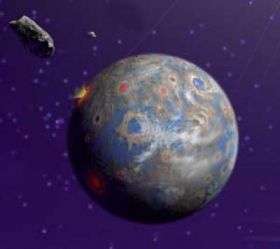
In the Star Wars movies fictional planets are covered with forests, oceans, deserts, and volcanoes. But new models from a team of MIT, NASA, and Carnegie scientists begin to describe an even wider range of Earth-size planets that astronomers might actually be able to find in the near future.
Sara Seager, Massachusetts Institute of Technology, Cambridge, Mass.; Marc Kuchner, NASA Goddard Space Flight Center, Greenbelt, Md.; Catherine Hier-Majumder, Carnegie Institution of Washington, (deceased); and Burkhard Militzer, Carnegie, have created models for 14 different types of solid planets that might exist in our galaxy. The 14 types have various compositions, and the team calculated how large each planet would be for a given mass. Some are pure water ice, carbon, iron, silicate, carbon monoxide, and silicon carbide; others are mixtures of these various compounds.
"We’re thinking seriously about the different kinds of roughly Earth-size planets that might be out there, like George Lucas, but for real," says Kuchner.
The team took a different approach from previous studies. Rather than assume that planets around other stars are scaled-up or scaled-down versions of the planets in our solar system, they considered all types of planets that might be possible, given what astronomers know about the composition of protoplanetary disks around young stars.
"We have learned that extrasolar giant planets often differ tremendously from the worlds in our solar system, so we let our imaginations run wild and tried to cover all the bases with our models of smaller planets," says Kuchner. "We can make educated guesses about where these different kinds of planets might be found. For example, carbon planets and carbon-monoxide planets might favor evolved stars such as white dwarfs and pulsars, or they might form in carbon-rich disks like the one around the star Beta Pictoris. But ultimately, we need observations to give us the answers."
The team calculated how gravity would compress planets of varying compositions. The resulting computer models predict a planet’s diameter for a given composition and mass. For example, a 1-Earth-mass planet made of pure water will be about 9,500 miles across, whereas an iron planet with the same mass will be only about 3,000 miles in diameter. For comparison, Earth, which is made mostly of silicates, is 7,926 miles across at its equator.
Some of the results were expected, such as the fact that pure water planets (similar to the moons of the outer planets in our solar system, which consist mostly of water ice) were the least dense of the solid planets, and pure iron planets are the most dense. But there were some surprises. The team discovered that no matter what material a planet is made of, the mass/diameter relationship follows a similar pattern.
"All materials compress in a similar way because of the structure of solids," explains Seager. "If you squeeze a rock, nothing much happens until you reach some critical pressure, then it crushes. Planets behave the same way, but they react at different pressures depending on the composition. This is a big step forward in our fundamental understanding of planets."
The team hopes that these models will yield insights into planet compositions when astronomers start finding Earth-sized planets around other stars. Missions such as the French Corot satellite, which launched on December 27, 2006, and NASA’s Kepler spacecraft, scheduled to launch in 2009, can find planets not much larger than Earth by watching them pass in front of their host stars, events known as transits. The transits yield the planet’s size, and follow-up studies can measure the mass. By comparing a planet's size and mass, astronomers might be able to determine whether it is mostly water ice or mostly iron, for example.
But astronomers using the transit method will find it difficult at best to distinguish a silicate planet from a carbon planet, because they’re about the same size for a given mass. "To make this finer distinction, we will need some help from NASA’s James Webb Space Telescope or Terrestrial Planet Finder," says Kuchner. "With these instruments, we could take spectra of Earth-mass planets, which will tell us about their chemistries."
The team’s paper is currently scheduled to appear in the Oct. 20 issue of the Astrophysical Journal.
Source: Goddard Space Flight Center


