New imaging technique allows doctors to 'see' molecular activity
September 24, 2007 New imaging technique allows doctors to 'see' molecular activity

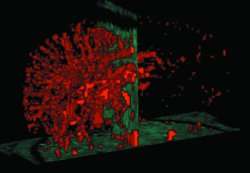
On the left hand side of the brain you can see a red netlike structure showing the accumulation of the new agent on specific molecules within inflamed blood vessels. By contrast, the normal side of the brain shows no such effect. If this can be transferred to human use, diagnosis and treatment could start much earlier. Credit: University of Oxford

A new technique that will enable doctors to ‘see’ things happening at the molecular level using standard imaging techniques has been developed by Oxford scientists. The technique has initially been directed towards multiple sclerosis, but long-term it has the potential to be used for a vast range of health problems. The findings are published by Nature Medicine on Monday 24 September.

Dr Robin Choudhury and colleagues at the University of Oxford have developed a marker that attaches itself to particular molecules involved in inflammation. As a result, these molecules ‘light up’ on MRI scans.

The ‘VCAM-1’ molecule plays a key role in inflammation, which contributes to many diseases, including multiple sclerosis, arthritis, inflammatory bowel disease and atherosclerosis (a hardening and narrowing of the arteries which can lead to heart attack and stroke).

By injecting into the body markers that attach themselves to VCAM-1 molecules, and which are visible under MRI scanning, the researchers were able to see on a scan exactly where the molecules were in operation, and in what quantities. The ultimate goal is to facilitate earlier diagnosis, guide treatment and provide more precise monitoring of disease progression.

The team has developed the technique with a view to using it in multiple sclerosis (MS), an autoimmune disease that affects the central nervous system. In MS the body’s own immune system, through inflammation, attacks the fatty tissue surrounding nerve fibres (myelin), which helps nerves carry signals, leading to a range of problems with vision and movement.

Compared to conventional MRI techniques, the new technique has the potential to reveal disease activity much earlier and, crucially, before tissue destruction has occurred. Earlier intervention with drug treatments guided by this information may alter disease progression.

‘Ordinarily, by the time lesions are visible, damage is already done,’ says Dr Choudhury. ‘Therefore molecular imaging techniques to accelerate diagnosis are urgently needed, and we think that this approach shows great potential.’

The work has been carried out so far in mice, but the researchers are optimistic that the technique could translate to humans.

‘In the last few years our knowledge about the cellular and molecular basis of diseases, including MS, has expanded vastly, but we haven’t yet matched these with accompanying advances in imaging,’ says Dr Choudhury. ‘The new technique helps to address that issue.

‘The ultimate goal of this line of work is to develop tools than can accelerate diagnosis, guide specific therapies and monitor response to treatment. In the paper, we make a case as to how this could be applied to multiple sclerosis, but in fact this is a platform technology that, in theory, could be adapted for diagnosis in other brain diseases, cancer and coronary artery disease.’

The full paper ’In vivo magnetic resonance imaging of acute brain inflammation using microparticles of iron oxide’ appears online at http://www.nature.com/nm/

Source: University of Oxford


print this article email this article download pdf blog this article bookmark this article     Stumble it Digg this share on Facebook retweet share on Reddit add to delicious
Rate this story - 4.2 /5 (12 votes)


September 24, 2007 all stories

Comments: 0

4.2 /5 (12 votes)
  • Stumble this up

  • Digg this

  • share this

  • hide
  • Related Stories

  • Unlocking mysteries of the brain with PET
    created Oct 30, 2009 | popularity not rated yet | comments 0
  • New study recommends change in treating pulmonary embolisms
    created Oct 27, 2009 | popularity not rated yet | comments 0
  • Faulty 'wiring' in the brain triggers onset of schizophrenia
    created Oct 26, 2009 | popularity not rated yet | comments 0
  • Alzheimer's lesions found in the retina
    created Oct 21, 2009 | popularity not rated yet | comments 0
  • A new scan for lung diseases
    created Oct 13, 2009 | popularity not rated yet | comments 0


  • hide
  • Relevant PhysicsForums posts

  • Improving the brain through chemistry
    created 5 hours ago
  • Sleep / REM Sleep and homeostasis
    created 22 hours ago
  • The Biceps Reflex
    created Nov 05, 2009
  • Consequenses of striking a Vein and an artery?
    created Nov 05, 2009
  • More from Physics Forums - Medical Sciences

Other News

Decision day for health care in the House (AP)

Decision day for health care in the House

Medicine & Health / Health

created 18 hours ago | popularity not rated yet | comments 0

(AP) -- President Barack Obama is trying to close the deal in the House on his health care overhaul, facing a make-or-break vote that's certain to be seen as a test of his presidency.


Island village hit by suspected swine flu (AP)

Island village hit by suspected swine flu

Medicine & Health / Diseases

created 18 hours ago | popularity 5 / 5 (1) | comments 1

(AP) -- Suspected swine flu is sweeping a traditional Eskimo whaling village on a remote Alaska island - prompting an urgent medical mission to deliver help.


Higher carotid arterial stenting rates associated with poorer clinical outcomes

Medicine & Health / Other

created 19 hours ago | popularity not rated yet | comments 0

Among eligible Medicare beneficiaries, increased use of carotid arterial stenting (CAS) procedures to treat carotid stenosis--the narrowing of the carotid artery--is associated with higher rates of mortality and adverse clinical ...


Turn On, Tune In, Develop?

Turn On, Tune In, Develop? Researchers Examine How Brain Benefits From Musical Training

Medicine & Health / Neuroscience

created Nov 06, 2009 | popularity 5 / 5 (9) | comments 4

For most people music is an enjoyable, although momentary, form of entertainment. But for those who seriously practiced a musical instrument when they were young, perhaps when they played in a school orchestra ...


Chocolate

Chocolate rich in flavanols may protect the skin from UV

Medicine & Health / Health

created Nov 06, 2009 | popularity 5 / 5 (9) | comments 3

(PhysOrg.com) -- A new study has discovered for the first time that dark chocolate rich in flavanols may provide significant protection from the harmful effects of ultraviolet light.