Mars may have had large sea near NASA rover landing site
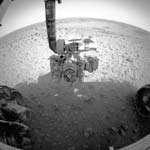
Spacecraft observations of the landing area for one of NASA's two Mars rovers now indicate there likely was an enormous sea or lake covering the region in the past, according to a new University of Colorado at Boulder study. Research Associate Brian Hynek of the Laboratory for Atmospheric and Space Physics said data from the Mars Global Surveyor and Mars Odyssey spacecraft now show that the region surrounding the Opportunity rover's landing site probably had a body of water at least 330,000 square kilometers, or 127,000 square miles. That would make the ancient sea larger in surface area than all the Great Lakes combined, or comparable to Europe's Baltic Sea.
In March, Opportunity instruments scanning the Meridiani Planum landing region confirmed that rock outcrops there, rich in the iron oxide mineral hematite, also contained the types of sulfate that only could have been created by interactions of water with Martian rock. Hynek used thermal emission data and camera images from the orbiting spacecraft to show such bedrock outcrops extend outward for many miles north, east and west.
"If the outcrops are a result of sea deposition, the amount of water once present must have been comparable to the Baltic Sea or all of the Great Lakes combined," he said. Hynek speculated that future studies may show that the ancient sea was even larger.
A paper on the subject by Hynek appears in the Sept. 9 issue of Nature.
The thermal emission imaging system, or THEMIS, aboard Mars Odyssey is used to infer the particle size of rocks near or on the surface of Mars, he said.
High thermal inertia measurements indicate a prevalence of larger chunks of rock, which heat up more slowly in daylight and cool more slowly in evenings. Low thermal inertia measurements are from fine-grained particles that heat and cool more quickly.
The thermal maps of Mars developed by Hynek indicate the rocky outcrops associated with ancient water extend far outside the boundaries of the landing area. "The thermal inertia for this area is relatively high, an indication the region contains substantial bedrock," he said.
Hynek speculated that if the outcrops at the landing site are the result of sea deposition, as believed, the body of water must have been deep enough and persisted long enough to build up sediments roughly one-third of a mile deep. "For this to occur, the ancient global climate of Mars must have been different from its present climate and have lasted for an extended period," Hynek wrote in the Nature paper.
"I believe new findings showing evidence of large amounts of water on Mars over long periods of time could increase the science potential for those seeking evidence of past or present life on Mars," said Hynek.
Hematite deposits on Earth come primarily from the presence of long-standing water or groundwater systems, Hynek said. Many scientists believe the requirement for primitive life forms, at least on Earth, include water or some other liquid, a source of energy and access to elements to construct complex molecules.
"It is important to understand how extensive these water-rich environments were and how long they persisted, because life required at least some degree of environmental stability in order to begin and to evolve," said NASA-Ames Research Center astrobiologist David Des Marais regarding Hynek's study. "Orbital observations and future landed missions will provide crucial details about the long-term legacy of liquid water on Mars, and whether life ever became a part of that legacy," said Des Marais, a member of the Mars rover science team.
The Mars rover, Spirit, landed in the Gusev Crater on Jan. 4. Opportunity, its twin, landed on the Meridiani Planum on the opposite side of the planet Jan. 25. Both rovers still are under operation by NASA and returning science data.


