Primate sperm competition: speed matters
Researchers at UC San Diego and UC Irvine have found evidence that supports the theory that reproductive competition during the evolution of primate species has occurred at the level of sperm cell motility.
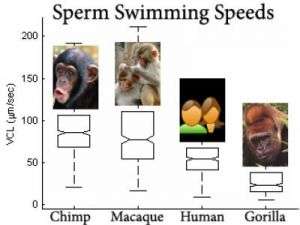
In a paper published online by the Journal of the Royal Society Interface, a team led by Michael Berns, an adjunct professor of bioengineering at UCSD and a professor of biomedical engineering at the Beckman Laser Institute at UC Irvine, and UCSD Ph.D. candidate Jaclyn Nascimento reported that sperm cells from the more promiscuous chimpanzee and rhesus macaque species swim much faster and with much greater force than those of humans and gorillas, species where individual females mate primarily with only one male during a reproductive cycle.
Female chimps and macaques typically mate with several males in a social group, so that a male with faster and stronger swimming sperm cells would in theory be more likely to successfully fertilize an egg.
“Rapidly swimming sperm cells would be evolutionarily favored when the mating pattern is polygamous and that is consistent with our measurements of chimp and rhesus macaque sperm,” said Nascimento.
The research team found significantly lower swimming forces and slower swimming speeds with human sperm, and the slowest of all belonged to gorillas. “Dominant silverbacks are known to effectively discourage other males from mating with the females in their harems, so faster sperm wouldn’t seem to be an advantage to them,” Nascimento said.
However the researchers were surprised that the speed and force of human sperm fell in between the gorillas and the chimps. “Maybe humans haven’t always been as monogamous as we had thought,” Berns said.
Beginning more than 35 years ago, scientists began using laser beams to trap individual atoms, microscopic particles, DNA molecules, and various cells. Berns has been a pioneer in the design of “laser tweezers,” which rely on the momentum inherent in laser light: when the path of laser light bends as it passes through a small transparent object such as a cell, some of the light’s momentum is transferred to the cell, effectively holding, or trapping it. The brighter the laser, the more firmly the cell is held.
After attending a talk at the Center for Reproduction of Endangered Species (CRES) at the San Diego Zoo about the theory that faster sperm could have an advantage in the reproductive success of polygamous primates, Berns modified his laser tweezers so that after a cell was trapped, the light intensity could be reduced in a precise manner. Such a timed decay in laser brightness allows a trapped sperm cell to escape at the point at which its swimming force exceeds the trapping force. The adjustable laser tweezers and sperm-tracking software allowed the team led by Berns and Nascimento to precisely and accurately measure swimming force and speed of hundreds of individual sperm cells from males of the four primate species.
“While biologists have been interested in this sperm competition question for years, it required the collaboration of biologists, physicists and engineers to design the right equipment to test the theory,” said Berns.
Source: University of California - San Diego


