NASA finds Greenland snow melting hit record high in high places
September 25th, 2007 NASA finds Greenland snow melting hit record high in high places

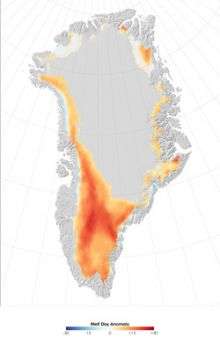
Microwave data from the Special Sensor Microwave Imaging radiometer was used to create this image of the 2007 Greenland melting anomaly which reflects the difference between the number of melting days occurring in 2007 and the average number of melting days during the period 1988 – 2006. Credit: NASA/Earth Observatory

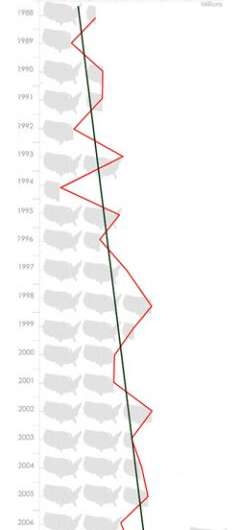
A new NASA-supported study reports that 2007 marked an overall rise in the melting trend over the entire Greenland ice sheet and, remarkably, melting in high-altitude areas was greater than ever at 150 percent more than average. In fact, the amount of snow that has melted this year over Greenland could cover the surface size of the U.S. more than twice.

Marco Tedesco, a research scientist at the Joint Center for Earth Systems Technology, cooperatively managed by NASA's Goddard Space Flight Center in Greenbelt, Md., and the University of Maryland at Baltimore County, used satellite data to compare average snow melting from 1988-2006 with what has taken place this summer.
NASA finds Greenland snow melting hit record high in high places

Marco Tedesco summarizes the trend of the melting index in Greenland between 1988 and 2007 by showing a plot of how many surface size of the U.S. match the melting index observed each year of his study. Credit: NASA/Marco Tedesco and Luisa Valle

He found that in high altitude areas over 1.2 miles above sea level, the melting index -- an indicator of where melting is occurring and for how long - was significantly higher than average. Melting over those areas occurred 25-30 days longer this year than the observed average in the previous 19 years.

"When snow melts at those high altitudes and then refreezes, it can absorb up to four times more energy than fresh, unthawed snow," said Tedesco. "This can affect Earth's energy budget by changing how much radiation from the sun is absorbed by the Earth versus that reflected back into the atmosphere. Refrozen snow can also alter the snow density, thickness and snow-water content." Tedesco's findings were published Sept. 25 in the American Geophysical Union's Eos newspaper.

Researchers determine the melting index by multiplying how long melting took place by the area where the increased melting took place. According to Tedesco, melting in April and May of this year in high-altitude areas was very low, but in June melting jumped unexpectedly and led to the record melting index for the year.

"This record melting index in those areas came as a bit of a surprise, showing us, once again, the extreme variability and complexity of these processes," said Tedesco. His expertise in documenting melting trends produced other recent studies on increased snow melting over Greenland and the Antarctic.

The data collected by the Special Sensor Microwave Imagers on the Defense Meteorological Satellite Program satellites provided Tedesco with insight into how much of an electromagnetic signal was naturally emitted by snow and ice in areas beneath the satellite overpass. The microwave instruments can detect melting above and below the snow surface. The data were processed at the National Snow and Ice Data Center in Boulder, Colo., in just 24 hours after the satellite overpass, enabling Tedesco to quickly spot changes that could signal a melting trend or new record.

Tedesco's work also confirmed that the melting index this year in lower altitude areas of Greenland, though not record breaking, was higher than average by 30 percent, placing 2007 in fifth place for the highest melting index after 2005, 2002, 1998 and 2004, in that order.

"Increases in the overall melting trend over Greenland have an impact that stretches beyond its icy shores," said Tedesco. "Aside from contributing to direct sea level rise, melting especially along the coast can speed up glaciers since the meltwater acts like a lubricant between the frozen surface and the bedrock deep below. The faster glaciers flow, the more water enters the ocean and potentially impacts sea level rise."

Tedesco, along with U.S. and European colleagues, plans to combine satellite data with related climate model results. He plans to visit Greenland in 2008 to compare his findings from space-borne data with those obtained by ground-based sensors, all with an eye to gathering further clues of what is happening on Greenland.

Source: Goddard Space Flight Center


print this article email this article download pdf blog this article bookmark this article     Digg this Stumble it share on Facebook share on Reddit add to delicious save to Yahoo! bookmarks
4.3/5 after 32 votes


September 25th, 2007 all stories
Space & Earth / Environment

Comments: 0
Rank: 4.3/5 after 32 votes

  • Stumble this up

  • Digg this

  • Share it:
  • share on Facebook
  • share on MySpace
  • share on Slashdot
  • rss-newsfeed
  • share on Google
  • share on Reddit
  • add to delicious
  • save to Yahoo! bookmarks
  • share on Windows Live
  • Add to Mixx!
Rating: 4.3/5 after 32 votes

  • Related Stories

  • NASA researchers find snowmelt in Antarctica creeping inland
    created Sep 20, 2007 | popularity not rated yet | comments 0
  • NASA researcher finds days of snow melting on the rise in Greenland
    created May 29, 2007 | popularity not rated yet | comments 0
  • Mars data published in Science this week
    created Jul 02, 2009 | popularity not rated yet | comments 0
  • Lifestyle melts away with Uganda peak snow cap
    created Jun 15, 2009 | popularity not rated yet | comments 0
  • Spring agricultural fires have large impact on melting Arctic
    created May 26, 2009 | popularity not rated yet | comments 0

Tags


  • Physicists Demonstrate Quantum Memory with Matter Qubits
    Physicists Demonstrate Quantum Memory with Matter Qubits
    Physics / General Physics
    created Jul 03, 2009 | popularity 4.4 / 5 (17) | comments 1
  • 'Holey' Nanosheets for Wastewater Dye Removal
    Nanotechnology / Nanomaterials
    created Jul 01, 2009 | popularity 5 / 5 (5) | comments 1
  • Jellyfish Robot Swims Like its Biological Counterpart
    Jellyfish Robot Swims Like its Biological Counterpart
    Electronics / Robotics
    created Jun 26, 2009 | popularity 4.4 / 5 (8) | comments 1
  • Could Maxwell's Demon Exist in Nanoscale Systems?
    Could Maxwell's Demon Exist in Nanoscale Systems?
    Physics / General Physics
    created Jun 24, 2009 | popularity 4.4 / 5 (18) | comments 29
  • Living Safely with Robots, Beyond Asimov's Laws
    Living Safely with Robots, Beyond Asimov's Laws
    Electronics / Robotics
    created Jun 22, 2009 | popularity 4.6 / 5 (53) | comments 40
  • Other News

    China environmental phenomena monitored from space

    Space & Earth / Earth Sciences

    created 56 minutes ago | popularity not rated yet | comments 0

    China is in a very seismically active area and has had many catastrophic earthquakes during its history. A joint European-Chinese team is using satellite radar data to monitor ground deformation across major continental faults ...


    California to require sun-blocking car windows

    Space & Earth / Environment

    created 2 hours ago | popularity 2.3 / 5 (3) | comments 4

    New cars sold in California must include windshields that block or absorb the sun's rays beginning in 2012, the state's Air Resources Board recently ruled.


    Scientists: Silent tremors may foretell next Big One

    Space & Earth / Earth Sciences

    created 2 hours ago | popularity not rated yet | comments 0

    The seismometer is snugged in its hole and tamped over with dirt. Now it's time for the stomp test.


    Steam billows from the cooling towers at a nuclear power generating station in Byron

    Tropical zone expanding due to climate change: study

    Space & Earth / Earth Sciences

    created 4 hours ago | popularity 3 / 5 (4) | comments 1

    Climate change is rapidly expanding the size of the world's tropical zone, threatening to bring disease and drought to heavily populated areas, an Australian study has found.


    The least sea ice in 800 years

    The least sea ice in 800 years

    Space & Earth / Earth Sciences

    created Jul 01, 2009 | popularity 4.1 / 5 (65) | comments 60

    New research, which reconstructs the extent of ice in the sea between Greenland and Svalbard from the 13th century to the present indicates that there has never been so little sea ice as there is now. The ...