Simulation reveals how body repairs balance after damage
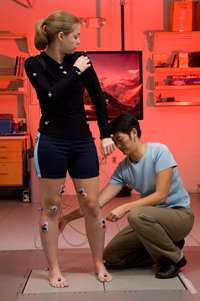
Your body goes to a lot of trouble to make sure you stay upright. But when the brain’s neural pathways are impaired through injury, age or illness, muscles are deprived of the detailed sensory information they need to perform the constant yet delicate balancing act required for normal movement and standing.
With an eye towards building robots that can balance like humans, researchers at Georgia Tech and Emory University have created a computer simulation that sheds new light on how the nervous system reinvents its communication with muscles after sensory loss. The findings could someday be used to better diagnose and rehabilitate patients with balance problems (through normal aging or diseases such as Multiple Sclerosis or Parkinson’s) by retraining their muscles and improving overall balance.
The research will be published in the October issue of Nature Neuroscience.
“The ultimate goal of rehabilitation is for patients to find the best way to adapt to their particular deficit. This system may help predict what the optimum combination of muscle and nerve activity looks like for each patient, helping patients and doctors set realistic goals and speeding recovery,” said Lena Ting, lead researcher on the project and an assistant professor in the Wallace H. Coulter Department of Biomedical Engineering at Georgia Tech and Emory University.
In a body without balance impairment, the nervous system collects sensory information from all over the body (skin, ears, feet, arms, eyes, etc.) and transmits this information to the muscles that control balance. When that information changes through the introduction of something like a strong wind, a raised crack in the pavement or an accidental bump from a nearby stranger, the nervous system sends the new information to the muscles and they adjust accordingly to maintain the body’s balance.
Impairments and injuries to the nervous system or the senses that report to the nervous system (experienced with a loss of vision or touch and problems in the inner ear) lead to balance problems. Experts traditionally have had little understanding of how the nervous system’s communication with the muscles associated with balance changes when one or several pieces of necessary sensory information are missing.
Georgia Tech and Emory researchers set out to create an effective way to interpret how commands from the nervous system to muscles (measured through electrical signals in the muscles) are changed by sensory impairment — similar to the numbing of feet experienced by diabetes patients — and how these changes affect balance control. The team started with data sets from animals. They were able to determine that, after a period of rehabilitation, subjects with some sensory damage were able to regain their balance despite the loss of some sensory information. So how do the nervous system and muscles fill in the information gaps"
The Georgia Tech and Emory team hypothesized that the nervous system relies on the relationship between the body’s center of gravity and its environment to control balance. They reasoned that the best predictor of how muscles would be activated when the subject experienced a balance threat was not the motion of the individual body parts, but the horizontal motion of the body’s center of gravity.
To test their theory, the researchers created a computer simulation that could accurately simulate standing balance and muscle reactions to balance disturbances by focusing on the relation of the subject’s center of gravity to the ground. Rather than predicting neural control patterns for the multitude of sensory information processed by the body to maintain balance, the team instead tracked a small set of signals related to the body’s control of its center of gravity.
The Georgia Tech and Emory team determined that subjects who had impaired sensory information were slowly using new sensory pathways to track the motion of the body’s center of gravity, compensating for the loss of information from the damaged sensory pathways. In effect, the subjects’ muscles were using different neural information to perform the same balance tasks, resulting in muscle activity patterns that looked “abnormal,” but that were actually similar to the predicted optimum.
The research team is now testing its center of gravity simulation with human subjects and a small robot with simulated muscles. They predict that the simulation could recognize impairment and pinpoint the optimum recovery points for each sensory-impaired subject — all based on the body’s reliance on center of gravity information. When applied to a robot, these neural communication patterns allowed the robot to successfully move fluidly like an animal, in contrast to what its gears and motors might suggest. The robot demonstrates all of the different strategies that could be used by normal and sensory-loss patients.
“This finding will change the way we approach rehabilitation,” Ting said. “We can’t expect patients to mimic normal balance performance when they’re using a different set of sensory information. Instead, our work can help identify the best performance possible given a patient’s level and type of sensory impairment.”
Source: Georgia Institute of Technology


