MIT tether could aid asteroid missions
September 25, 2007
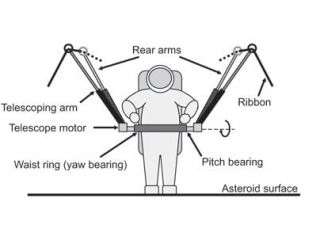
Diagram of the system for tethering an astronaut to an asteroid using circumferential ropes. Graphic / Ian Garrick-Bethell
Using a tether system devised by MIT researchers, astronauts could one day stroll across the surface of small asteroids, collecting samples and otherwise exploring these rocks in space without floating away.
The ability to visit asteroids could also be invaluable for testing equipment for a mission to Mars by humans. Further, knowing how to tether an asteroid could be helpful if one needs to be towed away from a potential collision course with Earth, says Christopher Carr, a postdoctoral associate in MIT's Department of Earth, Atmospheric and Planetary Sciences.
Carr and Ian Garrick-Bethell, a graduate student in the department, describe their system in an upcoming issue of the journal Acta Astronautica.
Walking on an asteroid is much more difficult than walking on a planet because asteroids have so little gravity. An astronaut who tried to step onto one would likely fly off or hover above the surface.
Now Carr and Garrick-Bethell say that tying a lightweight rope completely around an asteroid could solve that problem. Once the rope was in place, astronauts could attach themselves to it and maneuver or possibly even walk along the surface.
That would allow an in-depth exploration of the composition and history of asteroids, which could shed light on some of the big questions about our solar system, such as how the planets formed, said Carr.
"This is an innovative approach to a task nobody has spent much time thinking about," said former astronaut Jeffrey Hoffman, an MIT professor of aeronautics and astronautics who sponsored the paper. "NASA has taken a brief look at a human visit to a Near Earth Object, and it may be something we can do long before going to Mars. Clever ideas will be necessary to allow people to do useful work near objects on which you cannot 'land,' but only 'dock.'"
An asteroid's gravity varies depending on its density and size, which can range from a speck of dust to hundreds of kilometers. On an asteroid that has a diameter larger than eight kilometers, an astronaut who jumps will probably come back to the surface, Carr said. But if the asteroid is smaller than that, the astronaut may float away.
Even if an asteroid has enough gravity to keep an astronaut on the surface, it would be difficult to move around or collect samples. "You couldn't touch anything without sending yourself on a new trajectory or spinning yourself around," said Garrick-Bethell, who is the first author of the Acta Astronautica paper.
Some people have suggested that astronauts could bolt themselves directly to the asteroid, but the granular material covering the asteroids could prevent this.
"It would be like trying to bolt yourself to a pile of gravel or sand," Garrick-Bethell said.
The MIT researchers envision deploying their system with an astronaut or a remote-controlled rocket that unwinds a spool of rope while flying around the asteroid. When the craft reaches the starting point, a loop is formed and tightened. Astronauts could then be held to the asteroid using one or more ropes, permitting them to work on the surface.
One unknown is whether the rope would cut into the granular surface of an asteroid, hindering the system's effectiveness. But even if the rope does not allow astronauts to walk on the surface, it could at least give them something to hold onto as they pull themselves along the asteroid without floating away, said Carr.
Source: MIT
-
Engineers build first sub-10-nm carbon nanotube transistor
Feb 01, 2012 |
4.9 / 5 (31) |
30
-
Something old, something new: Evolution and the structural divergence of duplicate genes
Jan 31, 2012 |
4.6 / 5 (7) |
1
-
The hidden nanoworld of ice crystals: Revealing the dynamic behavior of quasi-liquid layers
Jan 30, 2012 |
5 / 5 (3) |
1
-
Stock market network reveals investor clustering
Jan 27, 2012 |
3.9 / 5 (23) |
8
-
Of microchemistry and molecules: Electronic microfluidic device synthesizes biocompatible probes
Jan 26, 2012 |
5 / 5 (1) |
0
-
Titan's lack of impact craters
Feb 09, 2012
-
Real pictures of black hole eating a star?
Feb 08, 2012
-
Hypothetical way to travel faster than light, but not technically exceed lightspeed
Feb 06, 2012
-
How do scientists monitor the Sun's activity?
Feb 05, 2012
-
Search patterns in observational studies
Feb 05, 2012
-
Derivation of Pogson's law
Feb 03, 2012
- More from Physics Forums - General Astronomy
More news stories
Humans may have helped the decline of African rainforests 3000 years ago
(PhysOrg.com) -- Large areas of rainforests in Central Africa mysteriously disappeared over three thousand years ago, to be replaced by savannas. The prevailing theory has been that the cause was a change ...
Could Venus be shifting gear?
(PhysOrg.com) -- ESAs Venus Express spacecraft has discovered that our cloud-covered neighbour spins a little slower than previously measured. Peering through the dense atmosphere in the infrared, the ...
Space & Earth / Space Exploration
6 hours ago |
5 / 5 (5) |
7
|
Mars Science Laboratory computer issue resolved
(PhysOrg.com) -- Engineers have found the root cause of a computer reset that occurred two months ago on NASA's Mars Science Laboratory and have determined how to correct it.
Space & Earth / Space Exploration
7 hours ago |
5 / 5 (5) |
3
|
Clam fields found at deep, low-temperature Mariana vents
(PhysOrg.com) -- Scientists have marveled at the unusual life forms thriving at high temperature hydrothermal vents of the deep ocean.
Space & Earth / Earth Sciences
6 hours ago |
not rated yet |
0
|
Two new moons for Jupiter
Advances in technology have lead to the discovery of new planets outside of our Solar System, and now even new moons in our own backyard.
Space & Earth / Space Exploration
6 hours ago |
not rated yet |
3
Human cognitive performance suffers following natural disasters, researchers find
Not surprisingly, victims of a natural disaster can experience stress and anxiety, but a new study indicates that it might also cause them to make more errors - some serious - in their daily lives. In their upcoming Human Fa ...
The power of estrogen -- male snakes attract other males
A new study has shown that boosting the estrogen levels of male garter snakes causes them to secrete the same pheromones that females use to attract suitors, and turned the males into just about the sexiest ...
New error-correcting codes guarantee the fastest possible rate of data transmission
Error-correcting codes are one of the triumphs of the digital age. Theyre a way of encoding information so that it can be transmitted across a communication channel such as an optical fiber o ...
Putting the squeeze on planets outside our solar system
(PhysOrg.com) -- Using high-powered lasers, scientists at Lawrence Livermore National Laboratory and collaborators discovered that molten magnesium silicate undergoes a phase change in the liquid state, abruptly ...
Both maternal and paternal age linked to autism
Older maternal and paternal age are jointly associated with having a child with autism, according to a recently published study led by researchers at The University of Texas Health Science Center at Houston (UTHealth).
Curry spice component may help slow prostate tumor growth
Curcumin, an active component of the Indian curry spice turmeric, may help slow down tumor growth in castration-resistant prostate cancer patients on androgen deprivation therapy (ADT), a study from researchers ...