Researchers Develop Nanoblade
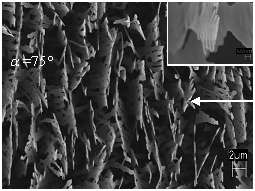
Researchers at Rensselaer Polytechnic Institute have created a razor-like material that is truly on the “cutting edge” of nanotechnology. Called nanoblades, these first-of-their-kind magnesium nanomaterials challenge conventional wisdom about nanostructure growth, and could have applications in energy storage and fuel cell technology.
The discovery is detailed in the September 2007 issue of the Journal of Nanoscience and Nanotechnology.
The sharp nanometer-scale surface is vastly different from any other nanomaterial that has been created before using oblique angle deposition, according to lead researcher Gwo-Ching Wang, professor and head of physics, applied physics, and astronomy at Rensselaer. The team’s nearly two-dimensional structure changes the traditional understanding of oblique angle deposition, which was previously thought to always create cylindrical structures like nanorods or nanosprings.
Unlike three-dimensional springs and rods, nanoblades are extremely thin, with very large surface areas. They also are surprisingly spread out for a uniform nanomaterial, with one to two micron meters in between each blade, according to Wang.
The materials could be extremely useful for energy storage, particularly hydrogen storage, Wang said. In order to store hydrogen, a large surface area is needed to provide room for the material to expand as more hydrogen atoms are stored. The vast surface area of each nanoblade, coupled with the large spaces between each blade, could make them ideal for this application.
To create the nanoblades, the researchers used oblique angle vapor deposition. This widely used fabrication technique builds nanostructures by vaporizing a material — magnesium in this case — and allowing the vaporized atoms to deposit on a surface at an angle. As the deposition angle changes, the structure of the material deposited on the surface also changes.
When the researchers deposited the magnesium straight onto a surface at zero degrees, the blades resembled a handful of cornflakes — flat, flakey structures overlapping one another. It wasn’t until the deposition angle was increased that the blade-like nature of these new nanomaterials became apparent.
As the magnesium deposition angle was increased, the researchers were surprised that the structures first tilted away from the magnesium vapor source instead of the expected inclination toward the source. The blades then quickly curved upward to form nearly vertical structures resembling nano-scale razorblades.
The blades also become ultra thin. From the side, the nanoblades resemble an overgrown lawn with thin, blade-like spires. At a 75 degree angle, the nanoblades had a thickness of as little as 15 nanometers and a width of a few hundred nanometers.
Researchers at Rensselaer are now looking at ways to coat the magnesium nanoblades with metallic catalysts to trap and store hydrogen.
The researchers monitored the blades as they were growing using a reflection high-energy electron diffraction (RHEED) technique to create a surface pole figure or image. The new technique, created at Rensselaer, is different from other diffraction techniques such as X-rays because it monitors the surface structure of the material as it grows. X-rays and other technologies measure the entire material, from the tip of the new growth straight through the substrate that the material is growing on.
Tracking the surface evolution of the material provides insight into how the structure evolves over time and helps scientists understand the mechanism of nanostructure formation, allowing engineers to later recreate ideal nanomaterials in the future. The creation of surface pole figures was particularly important in understanding the growth of nanoblades, as the surface morphology changed vastly over time.
The surface pole figure technique was first outline by Fu Tang, a postdoctoral research associate in Wang’s group, in a 2006 issue of Applied Physics Letters. In that paper, surface pole figures were created for nanorod growth. The researchers are now working to analyze nanoblade growth to provide additional insight into the growth patterns of these new nanomaterials.
Other Rensselaer researchers involved with the project are Toh-Ming Lu, the R.P. Baker Distinguished Professor of Physics; GAANN fellow Tom Parker; and postdoctoral research associate Huafang Li.
Source: Rensselaer Polytechnic Institute


