Optics Researchers See the Light
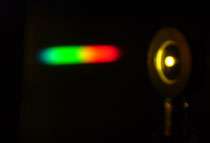
Lehigh's Jean Toulouse and Iavor Veltchev are studying a phenomenon that few scientists in the world have been able to achieve.
Two physicists at Lehigh have produced a rainbow of visible and invisible colors by focusing laser light in a specially designed optical fiber that confines light in a glass core whose diameter is 40 times smaller than that of a human hair.
Jean Toulouse, professor of physics, and Iavor Veltchev, research associate in the Center for Optical Technologies (COT), are the first scientists at Lehigh and among the few in the world to achieve and study the phenomenon, which is called “supercontinuum generation in nonlinear fibers.”
The phenomenon can be observed in a new class of optical fibers, called photonic crystal fibers. These fibers consist of a tiny solid glass core surrounded by a cladding, or casing, that contains air holes along the length of the fiber.
When Toulouse and Veltchev run a demonstration in their lab, incoming infrared (IR) light waves, which are invisible to the human eye, are converted to visible lightwaves. As the IR light propagates, or spreads, through a 1-meter-long fiber, the light appears, first orange, then yellow, and finally green.
IR and UV light of varying wavelengths are also generated at both ends of the visible spectrum.
The visible lightwaves emerge from the fiber as white light, which contains all the colors of the spectrum. The colors are dispersed by the precisely spaced grooves of a diffraction grating, in the same way that water droplets create a rainbow.
Potential uses for supercontinuum generation in nonlinear fiber optics range from medical applications, including non-invasive imaging of live tissues, to all-optical networks, in which light waves, not electronics, perform switching, routing, amplifying and other functions.
Nonlinear optical effects are the main focus of the COT’s All-Optical Network research thrust, which Toulouse directs. Toulouse receives funding from the National Science Foundation.
Supercontinuum generation is not observed in conventional optical fibers, Toulouse says, because their optical intensity (the optical power per unit area) is too low. In the new fibers, the light is confined in a much smaller core and the optical intensity is much greater. This modifies the optical properties of the medium (the fiber), creating new, nonlinear optical effects.
Linear optical effects occur when the optical intensity of light is not great enough to alter the properties of the medium (especially the speed at which the light propagates) through which the light is passing.
Nonlinear effects occur when the light’s optical intensity alters the properties of the medium, which, in turn, affects the manner in which the light itself propagates. The increased intensity, says Veltchev, also causes a corresponding increase in the refraction, or bending, of the light wave by the medium.
Nonlinear effects cause different parts of a wave to move at different velocities and distort the light’s periodic sinusoidal pattern. These effects generate new wavelengths and result in what Toulouse calls an “avalanche effect” – as more wavelengths are generated, more distortion results, leading to yet more wavelengths.
“What we see in the nonlinear regime,” says Toulouse, “is that if we send light in at one wavelength, we generate many other wavelengths” – thus achieving supercontinuum generation in nonlinear fiber optics.
The high optical intensity necessary for supercontinuum generation is achieved by the tight confinement of the incoming light wave in the extremely small core of the fiber, says Toulouse.
Toulouse and Veltchev begin their demonstration by using lenses to steer and focus the incident, or incoming, lightwaves with a wavelength (the distance between two adjacent crests of the wave) of approximately 800 nanometers (1 nm is one one-billionth of a meter). At 800 nm, the lightwaves fall within the infrared range and are not visible.
The incident lightwave, being powerful enough, creates nonlinear effects inside the glass fiber, generating new light waves with longer and shorter wavelengths (visible and multi-colored). This is caused by two factors. First, the light waves are confined to a solid glass core inside the optical fiber that measures only 2.5 microns in diameter. (A micron is one one-millionth of a meter; 2.5 microns is roughly one-fourtieth the thickness of a typical human hair.) By contrast, the core of a typical optical fiber, measures 10 microns in diameter. And a typical laser beam has a diameter of about 2 millimeters, almost 1,000 times greater than the diameter of the Lehigh researchers’ new optical fiber core.
The optical intensity (power transmitted per unit area) in the core of these new fibers, says Toulouse, is thus almost 1 million times greater than the intensity in the core of a typical laser, given that the area of a circle equals times the radius squared.
The creation of nonlinear effects is also triggered by air holes in the cladding around the fiber core. The holes force the light to remain confined inside the narrow glass core, Toulouse says, because “light hates to be in air when it can be in a medium where it travels more slowly.”
The tight confinement of light inside the new PCFs forces the waves to propagate coherently (with a well-defined initial-phase relationship), thus producing the full spectrum of visible colors.
The optical fiber used by Toulouse and Veltchev costs up to several thousand dollars per meter, and is manufactured by only five companies in the world, several of which have ties to the COT.
Toulouse has contacts with other researchers who have achieved supercontinuum generation in nonlinear fibers. In 2002, he spent six months studying the nonlinear effects of new types of optical fibers at the University of Bath in England, with the very people who invented PCFs in 1992.
Veltchev has a Ph.D. in physics from the Free University of Amsterdam (The Netherlands) and will soon join the Fox Chase Cancer Research Center near Philadelphia on a project utilizing laser radiation in cancer treatment.
This press release apeared on Lehigh University web-site.


