Cave records provide clues to climate change
When Georgia Tech Assistant Professor Kim Cobb and graduate student Jud Partin wanted to understand the mechanisms that drove the abrupt climate change events that occurred thousands of years ago, they didn't drill for ice cores from the glaciers of Greenland or the icy plains of Antarctica, as is customary for paleoclimatolgists. Instead, they went underground.
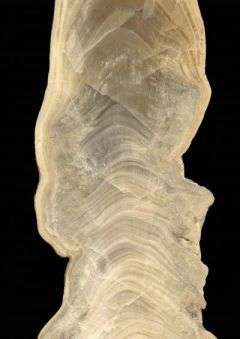
Growing inside the caves of the tropical Pacific island of Borneo are some of the keys to understanding how the Earth's climate suddenly changed - several times - over the last 25,000 years. By analyzing stalagmites, the pilar-like rock formations that stem from the ground in caves, they were able to produce a high-resolution and continuous record of the climate over this equatorial rainforest.
"These stalagmites are, in essence, tropical ice cores forming over thousands of years," said Partin. "Each layer of the rock contains important chemical traces that help us determine what was going on in the climate thousands of years ago, much like the ice cores drilled from Greenland or Antarctica."
The tropical Pacific currently plays a powerful role in shaping year-to-year climate variations around the globe (as evidenced by the number of weather patterns influenced by the Pacific's El Nino), but its role in past climate change is less understood. Partin and Cobb's results suggest that the tropical Pacific played a much more active role in some of the abrupt climate change events of Earth's past than was once thought and may even have played a leading role in some of these changes.
Polar ice cores reveal that the Northern Hemisphere and the Southern Hemisphere each have their own distinct patterns of abrupt climate change; the tropical Pacific may provide the mechanistic link between the two systems. Understanding how the climate changes occurred and what they looked like is important to helping scientists put into context the current trends in today's climate. They published their findings in the Sept 27, 2007, issue of the journal Nature.
The research team collected stalagmites from the Gunung Buda cave system in Borneo in 2003, 2005 and 2006. Analyzing three stalagmites from two separate caves allowed the pair to create a near-continuous record of the climate from 25,000 years ago to the present. While this study is not the first to use stalagmites to examine climate over this time period, it is the first to do so in the tropical Pacific. Typically, in these types of studies, only one stalagmite is analyzed, but Partin and Cobb compared their three stalagmite records to isolate shared climate-related signals.
Stalagmites are formed as rain water, mixed with calcium carbonate and other elements, makes its way through the ground and onto the cave floor. As this solution drips over time, it hardens in layers, creating a column of rock.
Partin and Cobb cut open each stalagmite and took 1,300 measurements of their chemical content to determine the relative moisture of the climate at various periods in history starting from the oldest layers at the bottom to the present at the top. They dated the rocks by analyzing the radioactive decay of uranium and thorium, and determined the amount of precipitation at given times by measuring the ratio of oxygen isotopes.
"Our records contain signatures of both Northern and Southern Hemisphere climate influences as the Earth emerged from the last ice age, which makes sense given its equatorial location,” said Cobb. “However, tropical Pacific climate was not a simple linear combination of high-latitude climate events. It reflects the complexity of mechanisms linking high and low latitude climate.”
For example, Partin and Cobb's records suggest that the tropical Pacific began drying about 20,000 years ago and that this trend may have pre-conditioned the North Atlantic for an abrupt climate change event that occurred about 16,500 years ago, known as the Heinrich 1 event.
"In addition, the Borneo records indicate that the tropical Pacific began to get wetter before the North Atlantic recovered from the Heinrich 1 event 14,000 years ago. Perhaps the tropical Pacific is again driving that trend," said Partin.
"Currently our knowledge of how these dramatic climate changes occurred comes from just a few sites," said Cobb. "As more studies are done from caves around the world, hopefully we'll be able to piece together a more complete picture of these changes. Understanding how the dominoes fell is very important to our understanding of our current warming trend."
Source: Georgia Institute of Technology


