New material means 'x-ray specs' no longer required
A new optical effect has been created in a London laboratory that means solid objects such as walls could one day be rendered transparent, scientists report today in the journal Nature Materials.
Researchers from Imperial College London and the University of Neuchatel, Switzerland, have pioneered the technique which could be used to see through rubble at earthquake sites, or look at parts of the body obscured by bone.
The effect is based on the development of a new material that exploits the way atoms in matter move, to make them interact with a laser beam in an entirely new way.
The work is based on a breakthrough which contradicts Einstein's theory that in order for a laser to work, the light-amplifying material it contains, usually a crystal or glass, must be brought to a state known as 'population inversion'. This refers to the condition of the atoms within the material, which must be excited with enough energy to make them emit rather than absorb light.
Quantum physicists, however, have long predicted that by interfering with the wave-patterns of atoms, light could be amplified without population inversion. This has previously been demonstrated in the atoms of gases but has not before been shown in solids.
In order to make this breakthrough, the team created specially patterned crystals only a few billionths of a metre in length that behaved like 'artificial atoms'. When light was shone into the crystals, it became entangled with the crystals at a molecular level rather than being absorbed, causing the material to become transparent.
This new transparent material created by the entanglement is made up of molecules that are half matter and half light. This allows light to be amplified without population inversion for the first time in a solid. Professor Chris Phillips, of Imperial College London, says:
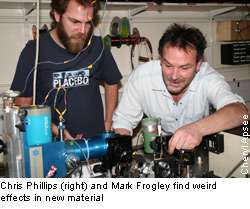
"This real life 'x-ray specs' effect relies on a property of matter that is usually ignored – that the electrons it contains move in a wave-like way. What we have learnt is how to control these waves directly. The results can be pretty weird at times, but it's very exciting and so fundamental. At the moment the effect can only be produced in a lab under specific conditions but it has the potential to lead to all sorts of new applications."
The team also discovered that as light passes through this new material, it slows right down and could potentially be completely stopped and stored. Professor Phillips believes this has important implications for entirely secure information networks. He says:
"When we send information, for example by sending light pulses down optical fibres, it can only be accessed by making a form of measurement, and these measurements always disturb the information. This technology offers us a means of sending light signals through a network without us having to disturb them ourselves. Now, if confidential information is being spied on, the disturbance shows up straight away and we can nab the eavesdropper with 100% certainty."
Source: Imperial College London


