Using nanotubes to detect and repair cracks in aircraft wings, other structures
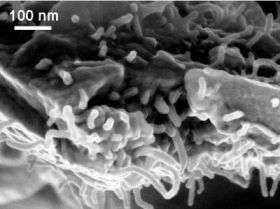
Adding even a small amount of carbon nanotubes can go a long way toward enhancing the strength, integrity, and safety of plastic materials widely used in engineering applications, according to a new study.
Researchers at Rensselaer Polytechnic Institute have developed a simple new technique for identifying and repairing small, potentially dangerous cracks in high-performance aircraft wings and many other structures made from polymer composites.
By infusing a polymer with electrically conductive carbon nanotubes, and then monitoring the structure’s electrical resistance, the researchers were able to pinpoint the location and length of a stress-induced crack in a composite structure. Once a crack is located, engineers can then send a short electrical charge to the area in order to heat up the carbon nanotubes and in turn melt an embedded healing agent that will flow into and seal the crack with a 70 percent recovery in strength.
Real-time detection and repair of fatigue-induced damage will greatly enhance the performance, reliability, and safety of structural components in a variety of engineering systems, according to principal investigator Nikhil A. Koratkar, an associate professor in Rensselaer’s Department of Mechanical, Aerospace and Nuclear Engineering
Details of the project are outlined in the paper “In situ health monitoring and repair in composites using carbon nanotube additives,” which was published online this week by Applied Physics Letters. Rensselaer graduate students Wei Zhang and Varun Sakalkar were co-authors of the paper. The team has been working on the project for more than 18 months.
The majority of failures in any engineered structure are generally due to fatigue-induced microcracks that spread to dangerous proportions and eventually jeopardize the structure’s integrity, Koratkar said. His research is looking to solve this problem with an elegant solution that allows for real-time diagnostics and no additional or expensive equipment.
Koratkar’s team made a structure from common epoxy, the kind used to make everything from the lightweight frames of fighter jet wings to countless devices and components used in manufacturing and industry, but added enough multi-walled carbon nanotubes to comprise 1 percent of the structure’s total weight. The team mechanically mixed the liquid epoxy to ensure the carbon nanotubes were properly dispersed throughout the structure as it dried in a mold. The researchers also introduced into the structure a series of wires in the form of a grid, which can be used to measure electrical resistance and also apply control voltages to the structure.
By sending a small amount of electricity through the carbon nanotubes, the research team was able to measure the electrical resistance between any two points on the wire grid. They then created a tiny crack in the structure, and measured the electrical resistance between the two nearest grid points. Because the electrical current now had to travel around the crack to get from one point to another, the electrical resistance – the difficulty electricity faces when moving from one place to the next – increased. The longer the crack grew, the higher the electrical resistance between the two points increased.
Koratkar is confident this method will be just as effective with much larger structures. Since the nanotubes are ubiquitous through the structure, this technique can be used to monitor any portion of the structure by performing simple resistance measurements without the need to mount external sensors or sophisticated electronics.
“The beauty of this method is that the carbon nanotubes are everywhere. The sensors are actually an integral part of the structure, which allows you to monitor any part of the structure,” Koratkar said. “We’ve shown that nanoscale science, if applied creatively, can really make a difference in large-scale engineering and structures.”
Koratkar said the new crack detection method should eventually be more cost effective and more convenient than ultrasonic sensors commonly used today. His sensor system can also be used in real time as a device or component is in use, whereas the sonic sensors are external units that require a great deal of time to scan the entire surface area of a stationary structure.
Plus, Koratkar’s system features a built-in repair kit.
When a crack is detected, Koratkar can increase the voltage going through the carbon nanotubes at a particular point in the grid. This extra voltage creates heat, which in turn melts a commercially available healing agent that was mixed into the epoxy. The melted healing agent flows into the crack and cools down, effectively curing the crack. Koratkar shows that these mended structures are about 70 percent as strong as the original, uncracked structure – strong enough to prevent a complete, or catastrophic, structural failure. This method is an effective way to combat both microcracks, as well as a less-common form of structural damage called delamination.
“What’s novel about this application is that we’re using carbon nanotubes not just to detect the crack, but also to heal the crack,” he said. “We use the nanotubes to create localized heat, which melts the healing agent, and that’s what cures the crack.”
Koratkar said he envisions the new system for detecting cracks to eventually be integrated into the built-in computer system of a fighter jet or large piece of equipment. The system will allow the operator to monitor a structure’s integrity in real time, and any microcracks or delamination will become obvious by provoking a change in electrical resistance at some point in the structure.
The system should help increase the lifetime, safety, and cost effectiveness of polymer structures, which are commonly used in place of metal when weight is a factor, Koratkar said. There is also evidence that carbon nanotubes play a passive role in suppressing the rate at which microcracks grow in polymeric structures, which is the subject of a paper Koratkar expects to publish in the near future.
The research is team is now working to optimize the system, scale it up to larger structures, and develop new information technology to better collect and analyze the electrical resistance data created from the embedded grid and embedded carbon nanotubes.
Source: Rensselaer Polytechnic Institute


