Carbon Dioxide Underground Storage Feasible Using 'Off-the-Shelf' Technology from Oil Industry
September 27, 2007 Carbon Dioxide Underground Storage Feasible Using 'Off-the-Shelf' Technology from Oil Industry

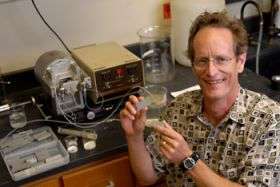
Dr. Steven Bryant, associate professor of petroleum and geosystems engineering, holds two halves of a fractured sample of wellbore cement. Confining the two halves together at pressures similar to those in formations deep below the Earth's surface provides a laboratory model of one type of pathway conceivably allowing carbon dioxide to escape the storage formation. Photo: Erin McCarley

Despite the sobering amount of carbon dioxide needing storage to reduce greenhouse gases, funneling the offensive chemical underground remains technologically possible for the oil industry, says Dr. Steven Bryant, associate professor of petroleum and geosystems engineering at The University of Texas at Austin.

His feasibility study proving the capability and documenting the technical requirements for storing carbon dioxide underground, as well as the parallels to current processes within the oil industry, appears in the September issue of the Journal of Petroleum Technology.

"The oil industry has decades of experience moving large amounts of gas underground and above ground," Bryant said. "In fact, capturing carbon dioxide from fixed sources, such as coal-fired and gas-fired power plants, and injecting it into geological formations mimics many of the processes already undertaken to produce fossil fuels."

Few other industries deal with fluid volumes of this size, he said. The industry could respond with an 'off-the-shelf' geological-storage service in a short time—a key advantage given the urgency of the problem.

"This is not to dismiss the very real difficulty of finding and developing the financial and human resources for such an enterprise, nor of building the necessary infrastructure," he said.

Now in his fourth year of investigating the key physical processes associated with sequestering carbon dioxide, Bryant has found that injecting carbon dioxide into formations deep within the Earth's crust is one of the few technologies that can be implemented rapidly enough and at a large-enough scale to mitigate greenhouse gas emissions. He directs the Geologic CO2 Storage Joint Industry Project in the Center for Petroleum and Geosystems Engineering.

Bryant's research was featured in the Special Report on Carbon Dioxide Capture and Storage released by the Intergovernmental Panel on Climate Change in spring 2007. The panel highlighted his findings for the "inject low and let rise" strategy of maximizing the secure, long-term immobilization of stored carbon dioxide.

"But doing this is going to require society—industry, government, consumers—to make a tremendous investment of resources, both financial and human," he said. "This challenge motivates the current goals of our Joint Industry Project: to train a new breed of 'carbon management engineers' to design, construct, operate, optimize and regulate large-scale carbon dioxide sequestration projects, and to carry out research that makes this technology as cost-effective and routine as possible."

Nevertheless, Bryant remains realistic about the prospects for his industry to create clean air.

"The public perception of the 'fairness' of the industry's role in geologic storage may distort or even overwhelm a rational evaluation of the challenges," he noted in the report. "Although it provides more than half of the energy needed to fuel the global economy, the oil and gas industry has never garnered much public sympathy for its efforts. Ironically, being uniquely qualified to help save the planet may not improve the industry's image."

Source: University of Texas at Austin


Rate this story - 4.2 /5 (6 votes)

Rank Filter

Move the slider to adjust rank threshold, so that you can hide some of the comments.


Display comments: newest first

  • Pieter_Pietersen - Dec 05, 2007
    • Rank: not rated yet
    With sarcastic voice:
    "one wonders where this mistrust of the oil-industry comes from"

September 27, 2007 all stories

Comments: 1

4.2 /5 (6 votes)

  • hide
  • Related Stories

  • Despite millions in tax credits, wind energy firms aren't hiring
    created Feb 08, 2010 | popularity not rated yet | comments 0
  • Node-3 and Cupola: European technology to complete the ISS
    created Feb 08, 2010 | popularity not rated yet | comments 0
  • Texas entrepreneur hopes to turn mesquite into power
    created Feb 05, 2010 | popularity not rated yet | comments 0
  • Renewable oil companies
    created Feb 05, 2010 | popularity not rated yet | comments 0
  • Cyber fraudsters attack EU's carbon trading system
    created Feb 04, 2010 | popularity not rated yet | comments 0


  • hide
  • Relevant PhysicsForums posts

Other News

Taiwan Acer's 2009 profit down 3.54 percent

Technology / Business

created 3 minutes ago | popularity not rated yet | comments 0

Taiwan's Acer Inc, the world's second biggest computer vendor by revenues, said Wednesday that its profit for 2009 edged down just 3.54 percent from a year ago despite the global economic meltdown.


The power of 'random'

The power of 'random': 'Seemingly loopy' technique could dramatically improve communications networks

Technology / Computer Sciences

created 20 hours ago | popularity 4.8 / 5 (9) | comments 5 | with audio podcast

A radical new approach to the design of communications networks, called "network coding," promises to make Internet file sharing faster, streaming video more reliable, and cell-phone reception better -- among ...


'Revolutionary' water treatment units on their way to Afghanistan

Technology / Engineering

created 14 hours ago | popularity 4.3 / 5 (8) | comments 5 | with audio podcast

The United States Army has taken delivery of the first two units of a "revolutionary" waste-water treatment system that will clean putrid water within 24 hours and leave no toxic by-products, according to scientists at Sam ...


Android

Google developing a translator for smartphones

Technology / Software

created 21 hours ago | popularity 4.8 / 5 (9) | comments 3 | with audio podcast report

(PhysOrg.com) -- Google is developing a translator for its Android smartphones that aims to almost instantly translate from one spoken language to another during phone calls.


Imec and Holst Centre achieve breakthrough in battery-less radios

Imec achieves breakthrough in battery-less radios

Technology / Semiconductors

created 15 hours ago | popularity 4.8 / 5 (15) | comments 1 | with audio podcast

At today's International Solid State Circuit Conference, Imec and Holst Centre report a 2.4GHz/915MHz wake-up receiver which consumes only 51µW power. This record low power achievement opens the door to battery-less ...