Wasp genetics study suggests altruism evolved from maternal behavior
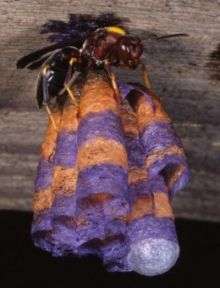
Researchers at the University of Illinois have used an innovative approach to reveal the molecular basis of altruistic behavior in wasps. The research team focused on the expression of behavior-related genes in Polistes metricus paper wasps, a species for which little genetic data was available when the study was begun. Their findings appear today online in Science Express.
Like honey bee workers, wasp workers give up their reproductive capabilities and focus entirely on nurturing their larval siblings, a practice that seems to defy the Darwinian prediction that a successful organism strives, above all else, to reproduce itself. Such behaviors are indicative of a eusocial society, in which some individuals lose, or sacrifice, their reproductive functions and instead work to benefit the larger group.
Behavioral scientists have long noted the similarity between the maternal behaviors of some wasps and the nurturing and provisioning activities of workers. Until now, no study had uncovered a genetic link between the two.
The researchers found that the pattern of behavior-related genes expressed in the brains of worker wasps was most similar to that seen in foundresses, the female wasps who alone build new colonies and devote much of their early lives to maternal tasks.
“These wasps start out as single moms,” said postdoctoral researcher Amy Toth. “They don’t have any workers to help them, so they’re responsible for laying all the eggs and provisioning the developing larvae which then turn into workers.”
The researchers selected this species because it appears to represent an evolutionary transition. Once a foundress has raised a first generation of workers, she turns over the task of nurturing the larvae to the workers and devotes herself entirely to her “queenly” reproductive function.
At this point, the researchers discovered, behavioral gene expression in her brain changes, becoming distinct from that seen during her maternal period.
Toth noted that the P. metricus wasps represent a kind of intermediate stage in the evolution of eusocial behavior. The honey bee colony, in which queens never perform maternal tasks, is considered a more developed form of eusociality.
“In Polistes metricus wasps you have behavior that’s more similar to what you might see in a maternal ancestor,” Toth said. “That was really important for our study.”
The study team included researchers from 454 Life Sciences, a Connecticut-based company that has pioneered a method for sequencing short segments of DNA.
“If you had to do this with a conventional approach it would cost a phenomenal amount of money,” said Michael Egholm, vice president for research and development at the company. A miniaturized operation and streamlined process for sequencing the DNA makes the new approach much more economical, he said.
Rather than focus on the entire wasp genome, which would be costly, the research team focused on those genes that were expressed in wasp brains in high enough quantities to be detected and sequenced using the new approach. They then relied on a team of bioinformaticians in the department of crop sciences to make sense of the data.
This was a challenge, said crop sciences professor Matt Hudson, who specializes in bioinformatics and genomics. The new technique produced DNA fragments that were much shorter than those typically used. Because very little genetic data was available on this species of wasp, Hudson and graduate student Kranthi Varala used a computer algorithm to compare the sequenced gene fragments to sequences from the honey bee genome, which has been fully sequenced. This method allowed them to positively identify in the wasps 32 genes known to be behavior-related in honey bees.
With these data, the researchers were able to compare behavioral gene expression in the brains of foundresses, workers, queens and gynes. (Gynes perform no work within the colony. They start their own colonies the following spring.)
“We’ve pushed the boundaries a lot further than what has been done before,” Hudson said. “It’s been 100 to 150 million years since there was a common ancestor for paper wasps and honey bees, and during that time the DNA has changed a lot.” But the proteins encoded by those genes that are important to the behaviors the researchers studied changed very little, Hudson said. This allowed for robust comparisons between the behavior-related genes in both species, and identification of those genes in the wasps that were important to the study.
“This is very good news for people who study organisms in nature, rather than in the laboratory,” Toth said. “If your organism is closely related to an organism for which you have a sequenced genome, you can use this approach and you can get a lot of information about unknown gene sequences in just a matter of days.”
Entomology professor Gene Robinson, an author on the study, predicts that this study will increase interest in the application of modern genomic approaches to questions related to behavior, ecology and evolutionary biology.
Source: University of Illinois at Urbana-Champaign


