Surprise in the organic orchard -- a healthier worm in the apple
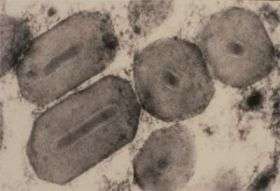
Insects can catch more than a cold from certain viruses. Some viruses can be lethal to pest species - turning their insides to soup - without harming beneficial insects or other organisms. Hence they are used as an environmentally friendly means of biological crop protection worldwide. The proverbial worm in the apple, the codling moth caterpillar, has been controlled in European orchards for years with a baculovirus called codling moth granulovirus (CpGV).
But in southwest Germany, some organic apple growers noticed that the virus was losing its effectiveness. Pest resistance to chemical insecticides is common in agriculture, but resistance to viruses had never been a problem in the past. However, as reported this week in Science magazine, a single gene in the codling moth can make it 100,000 times less susceptible to the granulovirus. This highlights the need to anticipate the risk of resistance in pest control, not only for insecticides but also viruses.
The discovery was reported by a team of insect virologists and geneticists from the Agricultural Service Centre of Rhineland-Palatinate (DLR Rheinpfalz), the German Federal Biological Research Centre (BBA Darmstadt), the University of Hohenheim, and the Max Planck Institute for Chemical Ecology (MPICE Jena). Starting in 2005, codling moths collected from 13 organic orchards in southwest Germany were tested in the laboratory to confirm that the insects could tolerate granulovirus amounts more than a thousand times higher than previously. Genetic studies showed that the resistance could be transmitted from parents to offspring via one of the sex chromosomes - which helps to explain how the resistance increased so quickly.
The sex chromosomes in humans are called X and Y, with XX females and XY males. This is reversed in moths, where the sex chromosomes are called Z and W, with ZZ males and ZW females. The researchers found that the gene for granulovirus resistance occurs on the Z chromosome. Female caterpillars need only a single copy of the resistance gene to be nearly 100,000 times less susceptible to granulovirus infection. They stay healthy and survive to reproduce, when most others have been killed.
Sons from matings between these highly resistant females and susceptible males carry a virus resistance gene on just one of their two Z chromosomes. "Our research has shown that such males can pupate normally if they encounter a low dose of the virus" reports Dr. Johannes Jehle of the DLR Rheinpfalz. They survive and pass on their resistance gene to the next generation. "In later generations, there are also males carrying the resistance gene on both Z chromosomes, and these can survive even higher virus concentrations" explains the leader of the research team.
"This means of inheritance offers the quickest possible way for the insects to evolve resistance" says Prof. David Heckel of the MPICE. "If the apple grower increases virus applications to try to control the damage caused by the resistant population, the opposite results. Selection for resistance accelerates and the frequency of the gene on the Z-chromosome increases even faster in the population."
Jehle and his colleagues are planning for the future in response to this alarming result. In parallel with the inheritance studies, several new isolates of the codling moth granulovirus have been screened since 2006 for their ability to overcome the resistance. In 2007, extensive field tests in Germany, Italy, France and Switzerland have been conducted with the most promising viruses. But even if new virus varieties can overcome the Z-linked resistance, the authors caution that their successful use in the longer term will depend on resistance management strategies, similar to those now routinely used for chemical insecticides.
Source: Max-Planck-Gesellschaft


