Proton radiation more dangerous than once thought
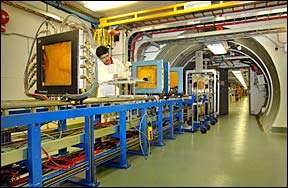
At the NASA Space Radiation Laboratory at DOE's Brookhaven National Laboratory, scientists have found that proton radiation is more damaging to cells than previously assumed - specifically, the cells' DNA. Since protons are the most abundant type of particle in deep space, this research may help scientists design spacecraft and spacesuits that can properly protect astronauts traveling far from Earth.
In deep space, protons are the most abundant type of charged particle. Therefore, before astronauts can safely travel far from Earth for long periods of time, it is important to know how protons affect cells — particularly the cells’ DNA. Now, at Brookhaven National Laboratory’s NASA Space Radiation Laboratory, scientists have found that protons are more damaging to DNA than previously assumed. The work is published in the February 2006 edition of the journal Radiation Research.
“Scientists have been assuming that protons damage cells in a way similar to x-rays, but our results indicate that these assumptions have been wrong. The new data show that protons produce more potentially lethal double-strand breaks, a type of severe DNA damage, than other kinds of DNA damages,” said Brookhaven biologist Betsy Sutherland, the study’s lead researcher. “This means that scientists don’t really know how human DNA is affected by the most numerous particles in space and, as a result, do not know how to design the proper protection for astronauts.”
Of the various radiation types, protons, like x-rays and gamma rays, are classified as low linear energy transfer (LET), meaning they do not lose much energy as they pass through matter. Therefore, scientists have assumed that protons would damage biological systems in the same way as other forms of low LET radiation. But Sutherland and Megumi Hada found that the protons produced a spectrum of damages that is very similar to that of high-energy iron ions and other heavy charged particles.
In their study, they investigated the levels and kinds of multiple damages, called damage clusters, produced by high-energy radiation beams. Damage clusters are dangerous because they are potentially mutagenic and can produce cancers, or can be converted to double-strand breaks.
The scientists used beams of high-energy charged particles (protons, as well as iron, carbon, titanium, and silicon ions) and exposed DNA in solution to each type of radiation. They then measured the levels of three kinds of damage clusters as well as double-strand breaks produced as a result of the exposure. Since these clusters and double strand breaks may have different effects on human cells, it is essential to know how many of each kind are produced by the radiation that a space traveler will encounter.
“Our study shows that we need to re-evaluate the effect of protons on biological systems, even the effects of low-energy protons,” said Sutherland. “For example, low-energy protons are routinely used in cancer-tumor therapy, but there has been almost no research done on the effect of protons in tumor cells because everyone has assumed that they act similarly to other low LET radiation types, like x-rays. Therefore, this work may help lead to improved cancer therapy.”
In further research, Sutherland and her group are now extending the research to human cells irradiated with the same beams. This will help them more accurately predict the effects of radiation on human cells and tissue.
This research was funded by the Office of Biomedical and Environmental Research within the U.S. Department of Energy’s Office of Science, the NASA Biomedical Research & Countermeasures Program, the National Institutes of Health, and the National Space Biomedical Institute.
Source: BNL (by Laura Mgrdichian)


