Bacterial motors could inspire nanotechnology
February 20, 2006
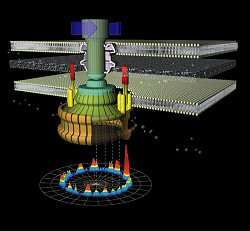
Artist's impression of the bacterial flagellar motor. Credit: Akihiko Ishijima.
An Oxford University physicist sees the future of nanotechnology in the workings of one of Nature's tiniest motors, that which allows some bacteria to swim by rotating slender filaments known as flagella.
'The bacterial flagellar motor is an example of finished bio-nanotechnology, and understanding how it works and assembles is one of the first steps towards making man-made machines on the same tiny scale,' said Dr Richard Berry, a Tutorial Fellow in Physics at Oxford University. 'The smallest man-made rotary motors so far are thousands of times bigger.'
This motor has the same power-to-weight ratio as an internal combustion engine, spins at up to 100,000 rpm and achieves near-perfect efficiency. Yet at only 50 nanometres across, one hundred million would fit onto a full-stop. The only other natural rotary electric motor is in the enzyme ATP-synthase.
Dr Berry is a member of the Rotary Molecular Motors Group in the Oxford Department of Physics. He presented his research at the Biophysical Society's Annual Meeting in Salt Lake City, Utah, on Sunday 19 February.
The physicist and his Japanese colleagues changed the proteins normally found in the motor of E Coli to make it run on sodium instead of hydrogen ions. This allowed them to reduce its speed of rotation by lowering the level of sodium ions present. They also made the actions of the motor more easily detectable by attaching tiny beads to stubs of flagella. Ultimately 26 distinct steps could be observed in each of its revolutions.
'The motor runs on electric current, the flow of hydrogen or sodium ions across the cell membrane, and each step may be caused by one or two sodium ions passing through the motor,' explained Dr Berry.
The tools involved included optical tweezers, which employ light beams to hold and to measure transparent particles, and a high-speed fluorescence microscope which can capture 2500 images per second.
Dr Berry and his colleagues have so far determined the torque-speed relationship of the motor, and that it can have up to twelve independent 'cylinders.'
'Our research will allow us to measure the performance of the motor when we vary things like the driving voltage and number of cylinders, and to understand the physics of the fundamental torque-generating process,' said Dr Berry.
Source: Oxford University
-
Will bubble-powered microrockets zoom through the human stomach?
3 hours ago |
not rated yet |
0
-
No future without scarce metals
Jan 31, 2012 |
4.5 / 5 (2) |
2
-
Scientists build working model of life's engine
Jan 31, 2012 |
5 / 5 (8) |
0
-
Detailed picture of how myoV 'walks' along actin tracks
Jan 30, 2012 |
not rated yet |
3
-
New California rules require cleaner cars
Jan 30, 2012 |
not rated yet |
1
-
Engineers build first sub-10-nm carbon nanotube transistor
Feb 01, 2012 |
4.9 / 5 (31) |
30
-
Something old, something new: Evolution and the structural divergence of duplicate genes
Jan 31, 2012 |
4.6 / 5 (7) |
1
-
The hidden nanoworld of ice crystals: Revealing the dynamic behavior of quasi-liquid layers
Jan 30, 2012 |
5 / 5 (3) |
1
-
Stock market network reveals investor clustering
Jan 27, 2012 |
3.9 / 5 (23) |
8
-
Of microchemistry and molecules: Electronic microfluidic device synthesizes biocompatible probes
Jan 26, 2012 |
5 / 5 (1) |
0
More news stories
New kind of solar cell could capture significantly more energy than current cells
New solar cells could increase the maximum efficiency of solar panels by over 25%, according to scientists from the University of Cambridge.
Feb 08, 2012 |
4.5 / 5 (12) |
14
|
Nanoshell whispering galleries improve thin solar panels
Visitors to Statuary Hall in the U.S. Capitol Building may have experienced a curious acoustic feature that allows a person to whisper softly at one side of the cavernous, half-domed room and for another on ...
Nanotechnology / Nanomaterials
Feb 07, 2012 |
4.3 / 5 (6) |
6
|
'Dark plasmons' transmit energy
Microscopic channels of gold nanoparticles have the ability to transmit electromagnetic energy that starts as light and propagates via "dark plasmons," according to researchers at Rice University.
Feb 09, 2012 |
4.8 / 5 (9) |
1
|
Revealing how a battery material works
Since its discovery 15 years ago, lithium iron phosphate (LiFePO4) has become one of the most promising materials for rechargeable batteries because of its stability, durability, safety and ability to deliver ...
Nanotechnology / Nanomaterials
Feb 08, 2012 |
5 / 5 (5) |
0
|
Nanotube therapy takes aim at breast cancer stem cells
Wake Forest Baptist Medical Center researchers have again proven that injecting multiwalled carbon nanotubes (MWCNTs) into tumors and heating them with a quick, 30-second laser treatment can kill them.
Nanotechnology / Bio & Medicine
Feb 09, 2012 |
5 / 5 (1) |
0
|
Walney offshore wind farm is world's biggest (for now)
(PhysOrg.com) -- The Walney wind farm on the Irish Sea--characterized by high tides, waves and windy weather--officially opened this week. The farm is treated in the press as a very big deal as the Walney ...
GPS court ruling leaves US phone tracking unclear
A US Supreme Court decision requiring a warrant to place a GPS device on the car of a criminal suspect leaves unresolved the bigger issue of police tracking using mobile phones, legal experts say.
Europeans protest controversial Internet pact
Tens of thousands of people marched in protests in more than a dozen European cities Saturday against a controversial anti-online piracy pact that critics say could curtail Internet freedom.
Anonymous briefly knocks CIA website offline (Update 2)
The website of the Central Intelligence Agency was briefly inaccessible on Friday after the hacker group Anonymous claimed to have knocked it offline.
Study finds that anti-diabetic medication can prevent the long-term effects of maternal obesity
In a study to be presented today at the Society for Maternal-Fetal Medicine's annual meeting, The Pregnancy Meeting, in Dallas, Texas, researchers will report findings that show that short therapy with the anti-diabetic medication ...
Europe stakes billion-dollar bet on new rocket
A pencil-slim rocket is scheduled to lift into space from South America on Monday, carrying a billion-dollar bet that Europe can grab a juicy slice of the market to place satellites in low orbit.