Physicists Step Closer to Understanding Origin of the Universe
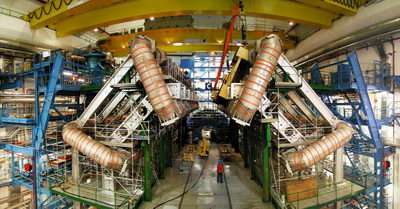
February 21st, 2006 The ATLAS project

The ATLAS project

The world’s largest particle detector is nearing completion following the construction of its ‘endcap’ at the University of Liverpool.

Its assembly of advanced apparatus, at the University’s Semiconductor Detector Centre, has been a joint effort by physicists, engineers and technicians from the Universities of Liverpool, Glasgow, Lancaster, Manchester and Sheffield as well as Daresbury and Rutherford Laboratories.

The endcap is part of a semiconductor tracker (SCT) based at the heart of ATLAS - a giant particle detector the size of a five-storey building. The SCT will become part of the world’s largest particle accelerator – the Large Hadron Collider (LHC), based at CERN, the European Centre for Particle Physics Research, in Switzerland.

The LHC is being constructed 100 metres underground in a 16-mile long circular tunnel, running under the Franco-Swiss border. Inside the tunnel two particle beams will be accelerated to extremely high energies, and will crash into each other forty million times a second, creating a snapshot of conditions that existed billionths of a second after the ‘Big Bang’. ATLAS, the culmination of 15 years’ work by over 150 European institutions, aims to find the Higgs particle that holds the key to understanding the origin of mass.

Dr Neil Jackson, from the University’s Department of Physics, explains: “Using the LHC we are aiming to discover the Higgs particle and hoping to find evidence for so-called Super-Symmetric particles, which we believe could offer an explanation for the ‘dark matter’ in the universe. At present the normal matter that we can see in the universe accounts for only 5% of its mass. The origin of the missing mass is unknown, but Super-Symmetric particles may account for some of it. If we discover these particles then we are on our way to explaining why the universe is made the way it is.

“At Liverpool we have tested 988 detector modules and assembled them into one of two SCT endcaps. The modules will detect the reactions produced as the accelerator collides billions of protons in the centre of ATLAS. The particles produced in these collisions are recorded as they pass through the endcaps. The collisions will be strong enough to recreate particles and reactions that were present fractions of a second after the Big Bang.”

The Big Bang theory is the dominant scientific theory about the origin of the universe. It suggests that the universe was created sometime between 10 billion and 20 billion years ago from a cosmic explosion that hurled matter in all directions.

The conditions that will be reproduced at LHC will correspond to approximately 1/10,000,000,000 of a second after the ‘Big Bang’ when the temperature was 1,000,000,000,000,000 degrees. Large detectors will electronically register the movement and position of charged particles allowing physicists to analyse the reactions that created
them.

The endcap will begin its journey to Switzerland later this month. Dr Jackson added: “We have to be extremely careful that the endcap we have constructed does not become damaged on its journey to Switzerland. We have just completed a trial run of the journey, using a dummy load to represent the endcap. Accelerometers and position-sensitive detectors were positioned on the transport frame to monitor the machine and we tested driving conditions with emergency stops, sleeping policemen, gradients and motorway driving. The results of the test were very encouraging.”

Source: University of Liverpool


print this article email this article download pdf blog this article bookmark this article     Digg this Stumble it share on Facebook share on Reddit add to delicious save to Yahoo! bookmarks
4.5/5 after 42 votes

Rank Filter

Move the slider to adjust rank threshold, so that you can hide some of the comments.


Display comments: newest first

  • marlowg - Aug 15, 2008
    • Rank: not rated yet
    The origin of mass of an electron is evident in Einstein%u2019s relativity equation for total energy: E^2 = Eo^2 (pc)^2. This is also the equation for the Pythagorean theorem. That means that the moving energy (pc) is perpendicular to the rest energy (Eo). If moving energy is apparent in our four space-time dimensions, rest energy must be in perpendicular dimensions, ones in which distances and the passage of time are not apparent to us. Thus an electron at rest can be viewed as a photon moving in these extra dimensions. The photon%u2019s frequency in these perpendicular dimensions gives rise to its mass in our dimensions. The photon%u2019s electric field wave appears frozen at a maximum in our dimensions giving rise to the property of charge.

February 21st, 2006 all stories
Physics /

Comments: 1
Rank: 4.5/5 after 42 votes

  • Stumble this up

  • Digg this

  • Share it:
  • share on Facebook
  • share on MySpace
  • share on Slashdot
  • rss-newsfeed
  • share on Google
  • share on Reddit
  • add to delicious
  • save to Yahoo! bookmarks
  • share on Windows Live
  • Add to Mixx!
Rating: 4.5/5 after 42 votes


Tags


  • Transform a ball into a rock -- or make it invisible -- using transformation optics
    Transform a ball into a rock -- or make it invisible -- using transformation optics
    Physics / General Physics
    created 9 hours ago | popularity 3 / 5 (2) | comments 0
  • Could a quantum motor do work?
    Physics / General Physics
    created Jul 07, 2009 | popularity 4 / 5 (12) | comments 0
  • Physicists Demonstrate Quantum Memory with Matter Qubits
    Physicists Demonstrate Quantum Memory with Matter Qubits
    Physics / General Physics
    created Jul 03, 2009 | popularity 4.5 / 5 (20) | comments 1
  • 'Holey' Nanosheets for Wastewater Dye Removal
    Nanotechnology / Nanomaterials
    created Jul 01, 2009 | popularity 5 / 5 (5) | comments 1
  • Jellyfish Robot Swims Like its Biological Counterpart
    Jellyfish Robot Swims Like its Biological Counterpart
    Electronics / Robotics
    created Jun 26, 2009 | popularity 4.4 / 5 (9) | comments 1
  • Other News

    Transform a ball into a rock -- or make it invisible -- using transformation optics

    Transform a ball into a rock -- or make it invisible -- using transformation optics

    Physics / General Physics

    created 9 hours ago | popularity 3 / 5 (2) | comments 0

    (PhysOrg.com) -- Science fiction and fantasy tales are full of the ability to "cloak" characters with invisibility. Whether it is a spaceship with a cloaking device, or a young wizard with an invisibility ...


    Physicists take first step towards super-fast search algorithms for quantum computers

    Physics / General Physics

    created 5 hours ago | popularity 5 / 5 (1) | comments 1

    When you toss a coin, you either get heads or tails. By contrast, things are not so definite at the microcosmic level. An atomic 'coin' can display a superposition of heads and tails when it has been thrown. However, this ...


    Simulations Illuminate Universe's First Twin Stars

    Simulations Illuminate Universe's First Twin Stars (w/ Video)

    Physics / General Physics

    created 3 hours ago | popularity 4 / 5 (1) | comments 0

    (PhysOrg.com) -- The earliest stars in the universe formed not only as individuals, but sometimes also as twins, according to a paper published today in Science Express. By creating robust simulations of the ...


    Physical reality of string theory demonstrated

    Physics / General Physics

    created Jul 06, 2009 | popularity 4.4 / 5 (49) | comments 38

    String theory has come under fire in recent years. Promises have been made that have not been lived up to. Leiden (The Netherlands) theoretical physicists have now for the first time used string theory to describe a physical ...


    UQ researchers break the law -- of physics

    UQ researchers break the law -- of physics

    Physics / General Physics

    created Jul 06, 2009 | popularity 4.6 / 5 (31) | comments 15

    (PhysOrg.com) -- Two UQ Science researchers have proved two famous physical laws that have been widely used for the past 25 years do not always work.