New technology identifies warped fingerprints at warp speed
October 1st, 2007 New technology identifies warped fingerprints at warp speed

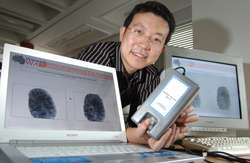
Researchers at the University of Warwick have devised a means of identifying partial, distorted, scratched, smudged, or otherwise warped fingerprints in just a few seconds.

Previous techniques have tried to identify a few key features on a finger print and laboriously match them against a database of templates. The University of Warwick researchers consider the entire detailed pattern of each print and transform the topological pattern into a standard co-ordinate system. This allows the researchers to "unwarp" any finger print that has been distorted by smudging, uneven pressure, or other distortion and create a clear digital representation of the fingerprint that can then be mapped on to an "image space" of all other finger prints held on a database.

This unwarping is so effective that it also for the first time allows comparison of the position of individual sweat pores on finger print. This has not previously been possible as the hundreds of pores on an individual finger are so densely packed that the slightest distortion prevented analysts from using them to differentiate finger prints.

The "unwarping" of distorted, damaged or partial prints is not the only benefit of the new technology. The system created by the Warwick researchers is also able to give almost instantaneous results. Instead of laboriously comparing a print against each entry in a database any new print scanned by the system is unwarped and over laid onto a virtual "image space" that includes all the fingerprints available to the database. It does not matter whether it’s a thousand or a million fingerprints in the database the result comes back in seconds.

The University of Warwick researchers have set up a spin out company "Warwick Warp" to take the technology to market. This summer they took part in a 3 day exhibition at the London Science Museum to test their technology. Dr Li Wang, Chief Technology Officer at Warwick Warp said:

"We tested our system on nearly 500 visitors from all over the world and achieved 100% accuracy. Many of the visitors were children and children's fingerprints are particularly challenging as they generally contain finer features on a smaller area than adult fingers. Children often tend to twist their finger when placing the finger on the scanner, creating an elastic deformation which provides a great testing ground for our technology. "

Dr Li Wang also said: "Our technology also provides high speed and more importantly, our system’s accuracy and speed doesn't degrade when the size of database increases."

The researchers are exploring a number of commercial opportunities for their new technology including commercial access control systems, financial transaction authorization systems and possibly even ID cards passports or border control systems and are now seeking venture capital to assist such commercial developments.

Source: University of Warwick


print this article email this article download pdf blog this article bookmark this article     Digg this Stumble it share on Facebook share on Reddit add to delicious save to Yahoo! bookmarks
5/5 after 5 votes


October 1st, 2007 all stories
Technology / Other

Comments: 0
Rank: 5/5 after 5 votes

  • Stumble this up

  • Digg this

  • Share it:
  • share on Facebook
  • share on MySpace
  • share on Slashdot
  • rss-newsfeed
  • share on Google
  • share on Reddit
  • add to delicious
  • save to Yahoo! bookmarks
  • share on Windows Live
  • Add to Mixx!
Rating: 5/5 after 5 votes

  • Related Stories

  • Stirred, not shaken: Bio-inspired cilia mix medical reagents at small scales
    created Jun 30, 2009 | popularity not rated yet | comments 0
  • Prehistoric flute in Germany is oldest known
    created Jun 24, 2009 | popularity not rated yet | comments 0
  • Could Texting and Mobile E-mail Be Bad For Your Health?
    created Jun 18, 2009 | popularity not rated yet | comments 0
  • Review: Dazzling Palm software beats the iPhone
    created Jun 04, 2009 | popularity not rated yet | comments 0
  • New device detects heart disease using less than one drop of blood
    created Jun 01, 2009 | popularity not rated yet | comments 0

Tags


  • Physicists Demonstrate Quantum Memory with Matter Qubits
    Physicists Demonstrate Quantum Memory with Matter Qubits
    Physics / General Physics
    created Jul 03, 2009 | popularity 4.4 / 5 (17) | comments 1
  • 'Holey' Nanosheets for Wastewater Dye Removal
    Nanotechnology / Nanomaterials
    created Jul 01, 2009 | popularity 5 / 5 (5) | comments 1
  • Jellyfish Robot Swims Like its Biological Counterpart
    Jellyfish Robot Swims Like its Biological Counterpart
    Electronics / Robotics
    created Jun 26, 2009 | popularity 4.4 / 5 (8) | comments 1
  • Could Maxwell's Demon Exist in Nanoscale Systems?
    Could Maxwell's Demon Exist in Nanoscale Systems?
    Physics / General Physics
    created Jun 24, 2009 | popularity 4.4 / 5 (18) | comments 29
  • Living Safely with Robots, Beyond Asimov's Laws
    Living Safely with Robots, Beyond Asimov's Laws
    Electronics / Robotics
    created Jun 22, 2009 | popularity 4.6 / 5 (52) | comments 40
  • Other News

    Japan demands 119 million dlrs in tax from Amazon: report

    Technology / Business

    created 9 hours ago | popularity 3.5 / 5 (2) | comments 0

    Japanese authorities told a sales affiliate of US retail giant Amazon.com to pay about 119 million dollars in tax for unreported income over a three-year period, a newspaper said Sunday.


    Geeks double as scourges and sages at media summit

    Technology / Business

    created 5 hours ago | popularity not rated yet | comments 0

    (AP) -- The media moguls attending an annual powwow staged by investment bank Allen & Co. used to be able to rest comfortably in the Idaho mountains as they mulled their next moves.


    Iconic skyscrapers find new luster by going green (AP)

    Iconic skyscrapers find new luster by going green

    Technology / Energy

    created 10 hours ago | popularity 1 / 5 (1) | comments 0

    (AP) -- When owners of the Empire State Building decided to blanket its towering facade this year with thousands of insulating windows, they were only partly interested in saving energy. They also needed ...


    UK spy chief's family details posted on Facebook

    Technology / Internet

    created 10 hours ago | popularity not rated yet | comments 0

    (AP) -- He's the spy who came in from the beach.


    Downturn dating: Hearts flutter as markets stutter (AP)

    Downturn dating: Hearts flutter as markets stutter

    Technology / Internet

    created 10 hours ago | popularity not rated yet | comments 0

    (AP) -- Credit the recession for "staycations" and bringing us more game-night parties at home. But also give it a shout for spurring more first dates.