Sign of 'embryonic planets' forming in nearby stellar systems
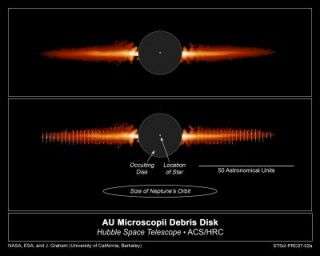
Astronomers at the University of Rochester are pointing to three nearby stars they say may hold “embryonic planets”—a missing link in planet-formation theories.
As scientists try to piece together how our own planet came to be, they look to the forming planets of other star systems for clues. But astronomers have been unable to find evidence for one of the key stages of planet development, a period early in the planet’s formation when it is only as large as tiny Pluto.
In an attempt to reveal this hidden phase of a planet’s life, Alice Quillen, associate professor of astronomy at the University of Rochester, employed new Hubble Space Telescope imagery to measure the thickness of the dust disks that surround forming stars, and to calculate the size of the planets growing within.
The results help paint a picture of a planet’s earliest years, and tell us how our own small planet probably began its life, says Quillen.
Scientists have inferred the presence of nearly 250 planets in the last decade, but Quillen’s method focuses on a unique aspect: the proto-planetary disk’s thickness.
Quillen explains that a disk of gritty dust usually surrounds forming stars, and provides the raw material for planet building. The cloud of dust thins as the system ages, but if enough dust has clumped together, the “embryonic planet,” as Quillen calls it, will knock the dust and grit into ever-more eccentric orbits. Over time, this will cause an otherwise razor-thin disk to appear puffed up.
“We’re able to determine for the first time how large the bodies must be in a disk to scatter the dust the way we’ve observed,” says Quillen, one of the world’s leading experts on the interaction between planets and stellar dust disks.
Using new Hubble images, Quillen measured the “puffiness” of AU Microscopii, Beta Pictoris, and Fomalhaut—three nearby stars with young disks positioned edge-on toward Earth. All three stars displayed a thicker disk than conventional models anticipated, so Quillen stepped beyond those models.
Dust disks have a lifespan determined by a balance of how quickly the solar wind blows the dust away, and how quickly the largest “grit clumps” replenish the dust through their collisions, says Quillen. Based on this balance, the size and age of a disk reveal how large the clumps inside must be.
But the conventional theory doesn’t take a disk’s thickness into account because until the Hubble images, astronomers had no way to measure it. Thus, the largest “clump” the model could predict was about a kilometer wide—a far cry from the fully grown planets that emerge from such disks.
Armed with the new images and her own models of dust dynamics, Quillen estimated how much mass was required to gravitationally scatter the dust to the thicknesses she observed.
“Those calculations pushed us into Pluto-sized bodies,” says Quillen. At roughly 1,000 kilometers in size—and owing to Pluto’s recent demotion from planethood—Quillen dubbed these new bodies, embryonic planets.
Quillen is now looking for more young star systems to investigate with her model, but the criteria for candidates is quite strict. The systems have to be young enough to still have their protostellar disks, but old enough to be forming the embryonic planets. The systems must also appear edge-on from Earth and be near enough that Hubble can accurately discern the thickness of their disks. At the moment, the three stars Quillen has already observed appear to be the only candidates that meet all the standards.
Source: University of Rochester


