The dark matter of the universe has a long lifetime
October 1, 2007 Bullet Cluster

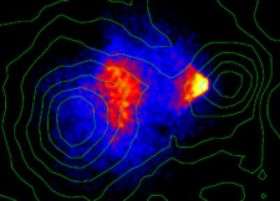
The two clusters of galaxies, called Bullet Cluster, are in the process of moving through each other. The red curves show gravitational measurements of the combined mass that consists of partly the visible matter of the galaxies and partly the invisible dark matter. X-ray measurements of the two clusters of galaxies show that the clouds of gas have been pushed out at the collision between the two clusters of galaxies. In the cluster of galaxies to the right there is a lot of dark matter, but very little x-ray, so the dark matter decays very slowly and thus has a very, very long lifetime. Credit: Photo: Chandra x-ray telescope

New research from the Niels Bohr Institute presents new information that adds another piece of knowledge to the jigsaw puzzle of the dark mystery of the universe – dark matter. The research has just been published in the scientific journal Physical Review Letters.

The universe consists not just of visible celestial bodies, stars, planets and galaxies. It also has a mystical fellow player – dark matter. The astronomers can measure that the dark matter exists in big quantities but no one knows what it is, nobody has seen it. It does not emit light and it does not reflect light. It is invisible. It is a mystery and the researchers have many theories.

The dark matter has caused the researchers headaches for decades since it was detected in the 1970s, and there is intense research into the phenomena. It is invisible but it has got mass, and thus it has got gravitation that can be measured. By analysing the galaxies it is possible to weigh them, and it turns out that by far the greatest matter of the collective mass of the galaxy is dark matter.

Just like stars get together in galaxies, the galaxies get together in clusters of galaxies of up to several thousand galaxies. The astrophysicist Signe Riemer-Sørensen, PhD student at the Niels Bohr Institute, has analysed two clusters of galaxies that collide.

Colliding clusters of galaxies are analysed

When the two clusters of galaxies meet neither the galaxies nor the dark matter collide. However, about 12 per cent of the mass of the cluster of galaxies consists of huge clouds of gas and dust and these clouds collide. The gas clouds are hot and emit x-ray that can be observed, and it is possible to see how the clouds are actually pushed out of the two clusters of galaxies at the collision. When the clouds of gas collide they become even hotter and emit more x-ray so that a whole chock front of warn gas is generated.

Observations indicate that the dark matter can be a new and still undetected type of particle. Among the suggestions for the dark matter, are particles that when they decay they emit x-ray. One is the so called axions that are particles which is explained in theories with extra dimensions. So to be able to look for x-ray from dark matter the researchers are looking in places where there is a big concentration of dark matter, but no gas. Such places are found in the two colliding clusters of galaxies where the gas clouds have been pushed out at the collision.

Signe Riemer-Sørensen has analysed the one of the two clusters of galaxies that are in the process of colliding. The analyses show that it is a very heavy cluster with many galaxies, and measurement of the gravitation show that there is a very big amount of dark matter, up to 85 per cent of the collective mass. However, no x-ray of any consequence was measured.

When the dark matter does not emit significant x-ray it is possible to calculate an upper limit to how quickly the particles decay and thus calculate their lifetime. The result is that if axions are to be the dark matter they must have a life span that is longer that 3.000.000 billion years. In that case there is not very much dark matter that has decayed yet if it was formed 13.7 billion years ago. The conclusion is that dark matter has a very, very long lifetime.

Source: University of Copenhagen


Rate this story - 4.2 /5 (34 votes)

Rank Filter

Move the slider to adjust rank threshold, so that you can hide some of the comments.


Display comments: newest first

  • gongii - Oct 02, 2007
    • Rank: not rated yet
    Why can't the dark matter decay into other than X-rays. Can the gamma ray bursts mean something?
  • s0cratus - Apr 23, 2009
    • Rank: not rated yet
    Matter and %u2018dark matter.%u2018
    Fact and Speculation.
    =========.
    1.
    Fact.
    The detected material mass of the matter in the Universe is so small
    (the average density of all substance in the Universe is approximately
    p=10^-30 g/sm^3) that it cannot %u201C close %u201C the Universe and therefore
    our Universe as whole is %u201C open%u201D, endless.
    But what to do with the infinite Universe the physicists don't know.
    The concept of infinite/ eternal means nothing
    to a scientists. They do not understand how they could
    draw any real, concrete conclusions from this characteristic.
    A notions of "more", "less", "equally, "similar" could not
    be conformed to a word infinity or eternity.
    The Infinity/Eternity is something, that has no borders,
    has no discontinuity; it could not be compared to anything.
    Considering so, scientists came to conclusion that the
    infinity/eternity defies to a physical and mathematical definition
    and cannot be considered in real processes.
    Therefore they have proclaimed the strict requirement
    (on a level of censor of the law):
    « If we want that the theory would be correct,
    the infinity/eternity should be eliminated ».
    Thus they direct all their mathematical abilities,
    all intellectual energy to the elimination of infinity.
    Therefore they invented an abstract "dark matter" and " dark energy".
    They say: " 90% or more of the matter in the Universe is unseen.
    And nobody knows what it is.
    2.
    Speculation.
    Unknown %u201Cdark matter %u201C it is matter which makes up the difference
    between observed mass of a galaxies and calculated mass%u2026%u2026
    which%u2026.will %u2026%u201D close %u201C %u2026.the Universe, as %u2026%u2026.
    as%u2026%u2026the astrophysicists want.
    #.
    The Dark Matter is another official dogma of our astronomy.
    / V. H. Vergon. /
    #
    "Dark energy, this mysterious stuff in the vacuum of space
    which makes the universe want to accelerate, is the basis
    for standard cosmology today because it explains much
    of what we see,"
    / Research by Dr David Wiltshire, from
    New Zealand's University of Canterbury /.
    #
    Dark Energy may be Vacuum
    http://www.eureka...1607.php
    ============= . .
    My opinion.

    The Dark Energy is the Vacuum.
    Vacuum is not a dead space as the Classic Physics says.
    Vacuum is some kind of Energetic Space as the
    Quantum Theory says.
    The Energetic Vacuum itself is %u2018 The Dark Energy %u2018.
    The physicists only invent new word %u2018Dark Energy %u2018 instead of
    to say %u2018 ENERGETIC VACUUM %u2019.
    ========== . .
    Everything began from Infinite Energetic Vacuum: T=0K.
    Somehow, the energy is extracted from the Vacuum
    (the Energetic Dirac Soup) and turned into particles.
    The Materialistic World gets its finite being
    from an Infinite Energetic Being %u2013 Vacuum: T=0K.

    To understand this %u2018speculation%u2019 we must know:
    1. What is Vacuum: T=0K ?
    2. Which virtual particles can exist in Vacuum?
    3. How can virtual particles turn into real particles?
    ======== .
    Until now the physicists ignore the Vacuum Energy T=0K
    because it is the Zero Point Energy for our measuring devices.
    Because the Absolute Zero Point Energy is border for our
    measuring devices.
    Can this fact be enough reason to stop our investigation?
    ==========..
    #
    When the next revolution rocks physics,
    chances are it will be about nothing%u2014the vacuum, that endless
    infinite void.
    http://discoverma...cs/space
    http://discoverma...erything
    ================ . .
    Please, have patience and wait %u201Cwhen the next revolution rocks physics.%u201D
    ===============. .
    Best wishes.
    Israel Sadovnik. / Socratus.
    http://www.physfo...pic=2548
    http://www.wbabin...vnik.htm
    http://www.socratus.com


October 1, 2007 all stories

Comments: 2

4.2 /5 (34 votes)

  • hide
  • Related Stories

  • Weak Lensing Gains Strength
    created Jan 19, 2010 | popularity not rated yet | comments 0
  • Astrophysicists unwind 'Cold Dark Matter Catastrophe' conundrum
    created Jan 14, 2010 | popularity not rated yet | comments 0
  • New research resolves conflict in theory of how galaxies form (w/ Video)
    created Jan 13, 2010 | popularity not rated yet | comments 0
  • How Galaxies Came To Be: Astronomers Explain Hubble Sequence
    created Jan 12, 2010 | popularity not rated yet | comments 0
  • Top 10 Sci-Tech Stories Of The Decade
    created Jan 11, 2010 | popularity not rated yet | comments 0


  • hide
  • Relevant PhysicsForums posts

  • How to find static friction
    created 4 hours ago
  • Calculating decible increases
    created 11 hours ago
  • Coefficients of friction
    created 11 hours ago
  • Deduction of centripetal force
    created 11 hours ago
  • More from Physics Forums - General Physics

Other News

Extra large carbon

Extra large carbon

Physics / General Physics

created 11 hours ago | popularity 4.7 / 5 (12) | comments 5 | with audio podcast

An exotic form of carbon has been found to have an extra large nucleus, dwarfing even the nuclei of much heavier elements like copper and zinc, in experiments performed in a particle accelerator in Japan. ...


Scientist explore future of high-energy physics

Scientist explore future of high-energy physics

Physics / General Physics

created 17 hours ago | popularity 4.9 / 5 (11) | comments 7 | with audio podcast

In a 1954 speech to the American Physical Society, the University of Chicago's Enrico Fermi fancifully envisioned a particle accelerator that encircled the globe. Such would be the ultimate theoretical outcome, ...


Leaf veins inspire a new model for distribution networks (w/ Video)

Physics / General Physics

created 14 hours ago | popularity 5 / 5 (3) | comments 0 | with audio podcast

(PhysOrg.com) -- Following the straight and narrow may be good moral advice, but it’s not a great design principle for a distribution network. In new research, a team of biophysicists describe a complex netting of interconnected ...


New magnetic tuning method enhances data storage

New magnetic tuning method enhances data storage

Physics / General Physics

created 17 hours ago | popularity 4.5 / 5 (4) | comments 0 | with audio podcast

Researchers in Chicago and London have developed a method for controlling the properties of magnets that could be used to improve the storage capacity of next-generation computer hard drives.


High-performance microring resonator developed by INRS researchers

Physics / Optics & Photonics

created 9 hours ago | popularity 1 / 5 (1) | comments 0

A new, more efficient low-cost microring resonator for high speed telecommunications systems has been developed and tested by Professor Roberto Morandotti's INRS team in collaboration with Canadian, American, and Australian ...