Physicists Tackle Knotty Puzzle
October 1st, 2007 Physicists Tackle Knotty Puzzle

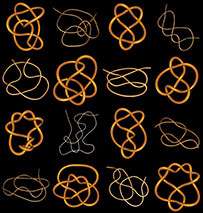
Digital photos of knots with computer-generated drawings based on mathematical calculations. Image credit: Dorian Raymer, UCSD

Electrical cables, garden hoses and strands of holiday lights seem to get themselves hopelessly tangled with no help at all. Now research initiated by an undergraduate student at the University of California, San Diego has resulted in the first model of how knots form.

The study, published this week in the journal Proceedings of the National Academy of Sciences, investigated the likelihood of knot formation and the types of knots formed in a tumbled string. The researchers say they were interested in the problem because it has many applications, including to the biophysics research questions their group usually studies.

“Knot formation is important in many fields,” said Douglas Smith, an assistant professor of physics who was the senior author on the paper. “For example, knots often form in DNA, which is a long string-like molecule. Cells have enzymes that undo the knots by cutting the DNA strands so that they can pass through each other. Certain anti-cancer drugs stop tumor cells from dividing by blocking the unknotting of DNA.”

Dorian Raymer, a research assistant working with Smith, initiated the study because he was interested in knot theory—the branch of mathematics that uses formulae to distinguish unique knots. Raymer was an undergraduate major in physics when he did the work. Smith said his own interest was piqued when he discovered that no one really knew how knots formed.

“Very little experimental work had been done to apply knot theory to the analysis and classification of real, physical knots,” said Smith. “For mathematicians, the problem is very abstract. They imagine the types of knots that can form and then classify them. In our experiments, we produced thousands of different knots, used mathematical knot theory to analyze them, and then developed a simple physics model to explain our findings.”

The experimental set up consisted of a plastic box that was spun by a computer-controlled motor. A piece of string was dropped into the box and tumbled around like clothes in a dryer. Knots formed very quickly, within 10 seconds. The researchers repeated the experiment more than 3,000 times varying the length and stiffness of string, box size and speed of rotation. They classified the resulting knots.

“It is virtually impossible to distinguish different knots just by looking at them,” said Raymer. “So I developed a computer program to do it. The computer program counts each crossing of the string. It notes whether the crossing is under or over, and whether the string follows a path to the left or to the right. The result is a bunch of numbers that can be translated into a mathematical fingerprint for a knot.

“We used the Jones polynomial—a famous math formula developed by Vaughn Jones, a mathematics professor at U.C. Berkeley—because it automatically simplifies mirror images and other knots that are identical, but look different.”

Rather than getting just a few types of knots, Smith and Raymer got all the types that mathematicians had enumerated, at least up to a certain complexity level. The longer the string, the greater was the probability of getting complex knots.

Based on these observations, the researchers proposed a simplified model for knot formation. The string forms concentric coils, like a looped garden hose, due to its stiffness and the confinement of the box. The free end of the string weaves through the coils, with a 50 percent probability of going under or over any coil. A computer simulation based on this model produced a similar pattern of simple and complex knots as observed in their experiments.

Smith and Raymer said that the model can also explain why confining a stiff string in a smaller box decreases the probability of knot formation. Increased confinement reduces the tumbling motion that facilitates the weaving of the string end through the coils. The paper cites other researchers who have proposed a similar effect to explain why knotting of the umbilical cord of fetuses is relatively rare, occurring only about one percent of the time. Confinement to the amniotic sac may restrict the probability of knotting.

Smith said that their results do not point to any magic solution to prevent knots from forming, but the project did inspire some advice for young people interested in science.

“Even today, there are still interesting scientific problems that can be studied in your garage with inexpensive, off-the-shelf materials like the ones we used in our experiments,” he said. “The most important thing is to be curious and ask good questions.”

Source: UCSD


print this article email this article download pdf blog this article bookmark this article     Digg this Stumble it share on Facebook share on Reddit add to delicious save to Yahoo! bookmarks
4.5/5 after 38 votes

Rank Filter

Move the slider to adjust rank threshold, so that you can hide some of the comments.


Display comments: newest first

  • earls - Oct 01, 2007
    • Rank: 3.8 / 5 (4)
    What's interesting is the knots above remind me of Brownian motion.
  • gopher65 - Oct 01, 2007
    • Rank: 4.3 / 5 (3)
    This article's topic doesn't really float my boat, but I like comment by one of the researches:

    "Even today, there are still interesting scientific problems that can be studied in your garage with inexpensive, off-the-shelf materials like the ones we used in our experiments," he said. "The most important thing is to be curious and ask good questions."

October 1st, 2007 all stories
Physics / General Physics

Comments: 2
Rank: 4.5/5 after 38 votes

  • Stumble this up

  • Digg this

  • Share it:
  • share on Facebook
  • share on MySpace
  • share on Slashdot
  • rss-newsfeed
  • share on Google
  • share on Reddit
  • add to delicious
  • save to Yahoo! bookmarks
  • share on Windows Live
  • Add to Mixx!
Rating: 4.5/5 after 38 votes

  • Related Stories

  • Mathematician's insight helps unravel knotty problem
    created Dec 05, 2005 | popularity not rated yet | comments 0
  • Ground-Breaking Arctic Expedition
    created Sep 28, 2004 | popularity not rated yet | comments 0
  • First riser-drilling research operations undertaken in Nankai Trough Seismogenic Zone
    created Jun 29, 2009 | popularity not rated yet | comments 0
  • QuikScat Finds Tempests Brewing In 'Ordinary' Storms
    created Jun 26, 2009 | popularity not rated yet | comments 0
  • Keck Study Sheds New Light on "Dark" Gamma-ray Bursts
    created Jun 08, 2009 | popularity not rated yet | comments 0

Tags


  • Physicists Demonstrate Quantum Memory with Matter Qubits
    Physicists Demonstrate Quantum Memory with Matter Qubits
    Physics / General Physics
    created Jul 03, 2009 | popularity 4.4 / 5 (17) | comments 1
  • 'Holey' Nanosheets for Wastewater Dye Removal
    Nanotechnology / Nanomaterials
    created Jul 01, 2009 | popularity 5 / 5 (5) | comments 1
  • Jellyfish Robot Swims Like its Biological Counterpart
    Jellyfish Robot Swims Like its Biological Counterpart
    Electronics / Robotics
    created Jun 26, 2009 | popularity 4.4 / 5 (8) | comments 1
  • Could Maxwell's Demon Exist in Nanoscale Systems?
    Could Maxwell's Demon Exist in Nanoscale Systems?
    Physics / General Physics
    created Jun 24, 2009 | popularity 4.4 / 5 (18) | comments 29
  • Living Safely with Robots, Beyond Asimov's Laws
    Living Safely with Robots, Beyond Asimov's Laws
    Electronics / Robotics
    created Jun 22, 2009 | popularity 4.6 / 5 (52) | comments 40
  • Other News

    Scientists create first electronic quantum processor

    Scientists create first electronic quantum processor

    Physics / General Physics

    created Jun 28, 2009 | popularity 4.8 / 5 (53) | comments 40

    A team led by Yale University researchers has created the first rudimentary solid-state quantum processor, taking another step toward the ultimate dream of building a quantum computer.


    Science journals

    How to Spot an Influential Paper Based on its Citations

    Physics / General Physics

    created Jul 04, 2009 | popularity 4 / 5 (9) | comments 6

    (PhysOrg.com) -- At first it may seem that the number of citations received by a published scientific paper is directly related to that paper's quality of content. The higher the quality, the more people read ...


    Fermilab's CDF observes Omega-sub-b baryon

    Fermilab's CDF observes Omega-sub-b baryon

    Physics / General Physics

    created Jun 29, 2009 | popularity 4.7 / 5 (17) | comments 7

    (PhysOrg.com) -- At a recent physics seminar at the Department of Energy’s Fermi National Accelerator Laboratory, Fermilab physicist Pat Lukens of the CDF experiment announced the observation of a new particle, ...


    New insights, and a new angle, on high-temperature superconductivity

    New insights, and a new angle, on high-temperature superconductivity

    Physics / Superconductivity

    created Jun 29, 2009 | popularity 4.8 / 5 (13) | comments 6

    (PhysOrg.com) -- A Princeton-led research team has revealed surprising information about how electron behavior influences the conduction of electricity in a class of high-temperature superconductors. An increased ...


    The art of invisibility and the perfect cat's eye

    The art of invisibility and the perfect cat's eye

    Physics / Optics & Photonics

    created Jun 30, 2009 | popularity 4 / 5 (8) | comments 6

    (PhysOrg.com) -- In recent years scientists have explored the impossible by developing invisibility or 'cloaking' devices, but can the same technology also help make things more visible?