Thumb-size microsystem enables cell culture and incubation
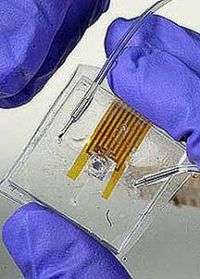
Integrating silicon microchip technology with a network of tiny fluid channels, some thinner than a human hair, researchers at The Johns Hopkins University have developed a thumb-size micro-incubator to culture living cells for lab tests.
In a recent edition of the journal IEEE Transactions on Biomedical Circuits and Systems, the Johns Hopkins researchers reported that they had successfully used the micro-incubator to culture baby hamster kidney cells over a three-day period. They said their system represents a significant advance over traditional incubation equipment that has been used in biology labs for the past 100 years.
“We don’t believe anyone has made a system like this that can culture cells over a period of days autonomously,” said Jennifer Blain Christen, lead author of the journal article. “Once it’s set up, you can just walk away.”
The incubator’s microchannels, fabricated in soft silicone polymer material, allow researchers to easily insert and guide cells and nutrients during experiments, while the computer-controlled electronics keep the cells at the precise temperature that enables them to multiply and thrive. The tiny incubator’s transparent design makes it easy to view the cells through a microscope or camera equipment without disrupting the conditions that help the cells to flourish.
Blain Christen spent the past three years working on the device as the focus of her doctoral dissertation in the Department of Electrical and Computer Engineering in Johns Hopkins’ Whiting School of Engineering. She received her degree in May and has continued to fine-tune the device while working as a postdoctoral fellow.
Andreas G. Andreou, a professor in the Department of Electrical and Computer Engineering who served as Blain Christen’s doctoral adviser, said, “This device represents a unique blend of two technologies, and we believe it will have a great impact on biology lab testing and research.” Andreou was co-author on the journal article.
Since the early 20th century, cell culture techniques in biology labs have remained largely unchanged. Living cells and nutrients are put into a lab dish and then are placed inside a traditional incubator, a heating compartment that is typically the size of a small refrigerator. Within the unit, the researcher must maintain a constant temperature, an environment free of contaminants and the proper levels of humidity, oxygen and carbon dioxide. Whenever the lab dish is removed for observation or experiments, however, these optimal conditions are disrupted, and the cells begin to die.
In contrast, the thumb-size system developed by the Johns Hopkins engineers is self-contained and requires no external heating source. A drop of liquid containing living cells is injected into a port and flows through one of the microfluidic channels. A nutrient solution — the cells’ food – is also added in this manner.
The cells gravitate toward and stick to the surface of the microchip. The chip contains a simple heating unit – a miniature version of the type found in a common toaster – and is equipped with a sensor that continually checks to make sure the proper temperature is maintained. For human cells, this is usually 37 degrees Celsius or 98.6 degrees Fahrenheit. The chip is connected to a computer that controls the sensing and heating process. The prototype is connected to a computer via a hard wire, but the inventors say a wireless version would be the next step.
A gas-permeable membrane on the incubator allows the microsystem to exchange carbon dioxide and oxygen but keeps out bacteria that could contaminate the cell culture. If a cell colony grows too large, an enzyme can be injected into one of the microfluidic ports to detach and flush away surplus cells without destroying the primary cell culture.
The incubator’s small size provides several advantages, the researchers say. The unit can easily be moved to different microscopes, imaging devices or other experimental tools without jeopardizing the health of the cell culture. Its size and relatively low cost should allow biologists to run numerous experiments simultaneously in a small space. Because it can be powered by batteries, the micro-incubator could be used outside a traditional lab for field tests. “Also,” said Blain Christen, “because it’s so small, we can change the temperature of the cell culture environment very quickly. We can go from room temperature to 98.6 degrees in less than a 10th of a second.”
The device was designed not only to provide these capabilities but to do so in an eco-friendly manner. This was achieved by minimizing the size of components whose fabrication affects the environment in an adverse way. These components were also designed so that they can easily be re-used in other devices. Blain Christen and Andreou said environmental impacts should be an important consideration in all types of research. “In our own field, among researchers who are working at the interface between electronics and biology, we believe our approach – making ecological considerations integral to our design – is rather uncommon,” said Blain Christen. “But we also believe this approach is one that all engineers should be adopting.”
Blain Christen and Andreou are continuing to refine and enhance the micro-incubator. They say they hope to enable it to image the cells and tissue using optical light guides, and that they wish to give it the ability to stimulate and gather information about the electrical activity of cells.
Source: Johns Hopkins University


