Engineer develops technology to quickly find leaks in spacecraft
October 2, 2007
Engineer develops technology to quickly find leaks in spacecraft

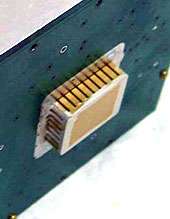
This sensor developed by Iowa State University researchers can detect leaks on spacecraft.

Tiny meteors flash through space. There's spacecraft debris flying around, too. And so there's a risk that objects just a few millimeters across could pierce the thin aluminum skin of spacecraft such as the International Space Station orbiting 220 miles above Earth.

A tiny hole means a tiny leak of pressurized air.

"NASA wants to be able to find these leaks," said Dale Chimenti, an Iowa State University professor of aerospace engineering. "Fixing them is easy. But the question is, 'Where is the leak?"'

Leaks are hard to find because spacecraft are full of life-support systems, computers, controls, gear and research equipment. All those things can hide a leak. Leaks are also hard to find because astronauts can't hear the telltale hiss of escaping air. That hiss is blowing outside the spacecraft and away from searching ears.

But astronauts had better find that leak as quickly as they can, Chimenti said. A spacecraft can only produce so much oxygen. NASA can't afford for it to slowly and steadily blow into the cold vacuum of space.

And so the National Aeronautics and Space Administration asked an Iowa State research team led by Chimenti to develop a sensor that can find leaks by detecting the small vibrations in a spacecraft's skin caused by escaping air. NASA has so far supported the work with $600,000. The Iowa State engineers are working with Invocon Inc. of Conroe, Texas, to use their sensor with the company's wireless electronics.

Chimenti and his research team -- Stephen Holland, an assistant professor of aerospace engineering; Ronald Roberts, a scientist for Iowa State's Center for Nondestructive Evaluation; Ricky Reusser, a recent Iowa State graduate who earned his bachelor's degree in aerospace engineering; and Steven Sulhoff, a senior in aerospace engineering from Avoca -- developed a square sensor that's an inch across. The sensor includes an array of 64 elements that detect vibrations as they radiate along the spacecraft.

The different elements pick up the vibrations at different times. Those differences can be analyzed by a computer to determine the direction of the leak. Add information from multiple sensors and a leak can be found in about a minute. It can take weeks to find a leak with NASA's current handheld, ultrasonic detection devices.

But it wasn't easy to improve the technology. Chimenti said a major challenge was accounting for a reinforcing grid that rises from the back of a spacecraft's shell and affects the travel of vibrations. He said the researchers solved the puzzle by targeting the frequency range measured by the sensors. They focus on lower frequencies and that reduces the effects of the reinforcing grid.

The sensor is now with researchers at Invocon, a company that built three kinds of electronic sensors for the June 8 space shuttle mission that carried Iowa State graduate Clayton Anderson to the International Space Station. One of the sensors was designed to record any impacts to the leading edge of the space shuttle's wing during liftoff.

Kevin Champaigne, a program director for Invocon, said company researchers led by Jonathan Sumners, a senior design engineer, are working to connect the Iowa State sensor with new Invocon electronics. That work will be completed over the next few months.

Chimenti and the company will submit a joint proposal for Phase II funding from NASA's Small Business Technology Transfer Program. If NASA funds that proposal, Iowa State and Invocon researchers would develop a prototype of the leak detection system for NASA.

"This project has gone very well," Chimenti said. "We've created a low-cost sensor. But the whole thing works. This is a very robust system."

Source: Iowa State University

4.7 /5 (7 votes)  

Rank 4.7 /5 (7 votes)
Tags

Relevant PhysicsForums posts
  • Titan's lack of impact craters
    createdFeb 09, 2012
  • Real pictures of black hole eating a star?
    createdFeb 08, 2012
  • Hypothetical way to travel faster than light, but not technically exceed lightspeed
    createdFeb 06, 2012
  • How do scientists monitor the Sun's activity?
    createdFeb 05, 2012
  • Search patterns in observational studies
    createdFeb 05, 2012
  • Derivation of Pogson's law
    createdFeb 03, 2012
  • More from Physics Forums - General Astronomy

More news stories

Could Venus be shifting gear?

(PhysOrg.com) -- ESA’s Venus Express spacecraft has discovered that our cloud-covered neighbour spins a little slower than previously measured. Peering through the dense atmosphere in the infrared, the ...

Space & Earth / Space Exploration

created 4 hours ago | popularity 5 / 5 (4) | comments 6 | with audio podcast

Humans may have helped the decline of African rainforests 3000 years ago

(PhysOrg.com) -- Large areas of rainforests in Central Africa mysteriously disappeared over three thousand years ago, to be replaced by savannas. The prevailing theory has been that the cause was a change ...

Space & Earth / Environment

created 8 hours ago | popularity 5 / 5 (3) | comments 8 | with audio podcast report

Mars Science Laboratory computer issue resolved

(PhysOrg.com) -- Engineers have found the root cause of a computer reset that occurred two months ago on NASA's Mars Science Laboratory and have determined how to correct it.

Space & Earth / Space Exploration

created 5 hours ago | popularity 5 / 5 (5) | comments 3 | with audio podcast

Clam fields found at deep, low-temperature Mariana vents

(PhysOrg.com) -- Scientists have marveled at the unusual life forms thriving at high temperature hydrothermal vents of the deep ocean.

Space & Earth / Earth Sciences

created 4 hours ago | popularity not rated yet | comments 0 | with audio podcast

Two new moons for Jupiter

Advances in technology have lead to the discovery of new planets outside of our Solar System, and now even new moons in our own backyard.

Space & Earth / Space Exploration

created 4 hours ago | popularity not rated yet | comments 2


Hovering not hard if you're top-heavy, researchers find

Top-heavy structures are more likely to maintain their balance while hovering in the air than are those that bear a lower center of gravity, researchers at New York University's Courant Institute of Mathematical Sciences ...

Grass to gas: Researchers' genome map speeds biofuel development

Researchers at the University of Georgia have taken a major step in the ongoing effort to find sources of cleaner, renewable energy by mapping the genomes of two originator cells of Miscanthus x giganteus, a large perenn ...

Drug halts organ damage in inflammatory genetic disorder

A new study shows that Kineret (anakinra), a medication approved for the treatment of rheumatoid arthritis, is effective in stopping the progression of organ damage in people with neonatal-onset multisystem inflammatory disease ...

Cochlear implants may be safe, effective for organ transplant patients

Cochlear implants may be a safe, effective option for some organ transplant patients who've lost their hearing as an unfortunate consequence of their transplant-related drug regime, researchers report.

Researchers develop new method for creating tissue engineering scaffolds

Researchers at Northwestern University have developed a new method for creating scaffolds for tissue engineering applications, providing an alternative that is more flexible and less time-intensive than current technology.

Molecular profiling reveals differences between primary and recurrent ovarian cancers

There is a need to analyze tumor specimens at the time of ovarian cancer recurrence, according to a new study published in Molecular Cancer Therapeutics. Researchers used a diagnostic technology called molecular profiling to examine ...