Origin of Galactic X-rays Explained
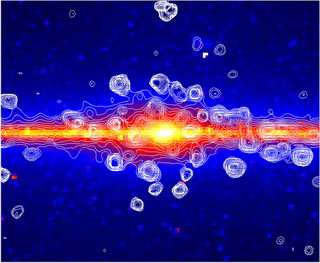
New Map of the Milky Way Reveals Millions of Unseen Objects
Using the most sensitive X-ray map of the Galaxy, obtained combining 10 years of data of Rossi XTE orbital observatory, scientists from the Max Planck Institute for Astrophysics have discovered the origin of the galactic background emission. They show that it consists of emission from a million accreting white dwarf binaries and hundreds of millions of normal stars with active coronas.
Nearly 400 years after Galileo determined that the wispy Milky Way actually comprises a multitude of individual stars, scientists using NASA's Rossi X-ray Timing Explorer have done the same for the X-ray Milky Way.
The origin of the so-called galactic X-ray background has been a long-standing mystery. Scientists now say that this blanket of X-ray light is not diffuse, as many have thought, but emanates from untold hundreds of millions of individual sources dominated by a type of dead star called a white dwarf.
If confirmed, this new finding would have a profound impact on our understanding of the history of our galaxy, from star-formation and supernova rates to stellar evolution. The results solve major theoretical problems, yet point to a surprising undercounting of stellar objects.
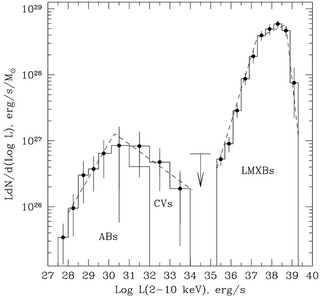
Scientists from the Max Planck Institute for Astrophysics (MPA) in Garching, Germany, and the Space Research Institute of the Russian Academy of Sciences in Moscow discuss these results in two papers published in Astronomy & Astrophysics.
"From an airplane you can see a diffuse glow from a city at night," said Dr. Mikhail Revnivtsev of MPA, lead author on one of the papers. "To say a city produces light is not enough. Only when you get closer do you see individual sources that make up that glow - the house lights, street lamps and automobile headlights. In this respect, we have identified the individual sources of local X-ray light. What we found will surprise many scientists."
X-rays are a high-energy form of light, invisible to our eyes and far more energetic than optical and ultraviolet light. Our eyes see individual stars sprinkled in a largely dark sky. In X-ray bandwidths the sky is never dark; there is a pervasive and constant glow.
Previous observations could not reveal enough X-ray sources to account for the "X-ray milky way." This led to theoretical problems. If the X-ray glow were from hot and diffuse gas, it would ultimately "rise" and escape the confines of the galaxy. Furthermore, all that hot gas would need to have come from millions of past star explosions called supernovae, which would imply that estimates of star formation and star death were way off.
"X-ray telescopes can resolve the emission into discrete sources but can only account for about 30 percent of the emission," said Dr. Jean Swank, project scientist for the Rossi Explorer at NASA Goddard Space Flight Center in Greenbelt, Maryland, USA. "Many have thought that the lion's share was truly diffuse, for example, from hot gas between the stars. Now it seems that it can all be accounted for a combination of two types of stars."
The new study is based on nearly 10 years of data collected by the Rossi Explorer and constitutes the most thorough map of the galaxy in X-ray bandwidths. The science team concluded that the Milky Way galaxy is indeed teeming with X-ray stars, most of them not very bright, and that scientists over the years had underestimated their numbers by perhaps a hundredfold.
Surprisingly, the usual suspects of X-ray emission - black holes and neutron stars - are not implicated here. At higher X-ray energies, the X-ray glow arises almost entirely from sources called cataclysmic variables.
A cataclysmic variable is a binary star system containing a relatively normal star and a white dwarf, which is a stellar ember of a star like our sun that has run out of fuel. On its own, a white dwarf is dim. In a binary, it can pull away matter from its companion star to heat itself in a process called accretion. The accreted gas is very hot, a source of considerable X-rays.
At slightly lower X-ray energies, the glow is a mix of about one-third cataclysmic variables and two-thirds active stellar coronas. Most of the stellar corona activity also takes place in binaries, where a nearby companion effectively stirs up the outer parts of the star. This energizes the stellar analogue to produce solar flares, which emits X-rays. The science team says there are upwards of a million cataclysmic variables in our galaxy and close to a billion active stars. Both of these numbers reflect a major undercounting in previous estimates.
"Like a medical x-ray, the chart of the galactic X-ray background reveals details of the Milky Way's structure," said Revnivtsev. "We can see through the whole galaxy and count X-ray sources. This is very important to astronomers who calculate the lives of stars."
NASA Goddard Space Flight Center in Greenbelt, Maryland, USA manages the Rossi Explorer, which was launched in December 1995.
Original work:
M.Revnivtsev, S.Sazonov, M.Gilfanov, E.Churazov, R.Sunyaev
Origin of the Galactic ridge X-ray emission
Astron. & Astrophys., in Print; astro-ph/0510050
S. Sazonov, M. Revnivtsev, M. Gilfanov, E. Churazov, R. Sunyaev
X-ray luminosity function of faint point sources in the Milky Way
Astron. & Astrophys., in Print; astro-ph/0510049
Source: Max Planck Institute for Astrophysics


