Astronomer spies conditions 'just right' for building an Earth
October 3rd, 2007 Earth-like Planet Likely Forming

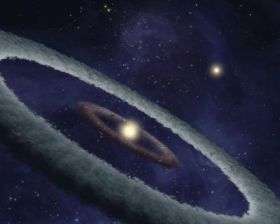
This artist's conception shows a binary-, or two-star, system, called HD 113766, where astronomers suspect a rocky Earth-like planet is forming around one of the stars. The system is located approximately 424 light-years away. At approximately 10 to 16 million years old, the star is also at just the right age for forming rocky planets. Credit: NASA/JPL-Caltech/JHUAPL

An Earth-like planet is likely forming 424 light-years away in a star system called HD 113766, say astronomers using NASA's Spitzer Space Telescope.

Scientists have discovered a huge belt of warm dust – enough to build a Mars-size planet or larger – swirling around a distant star that is just slightly more massive than our sun. The dust belt, which they suspect is clumping together into planets, is located in the middle of the system's terrestrial habitable zone. This is the region around a star where liquid water could exist on any rocky planets that might form. Earth is located in the middle of our sun's terrestrial habitable zone.

At approximately 10 million years old, the star is also at just the right age for forming rocky planets.

"The timing for this system to be building an Earth is very good," says Dr. Carey Lisse, of the Johns Hopkins University Applied Physics Laboratory, Laurel, Md. "If the system was too young, its planet-forming disk would be full of gas, and it would be making gas-giant planets like Jupiter instead. If the system was too old, then dust aggregation or clumping would have already occurred and all the system's rocky planets would have already formed."

According to Lisse, the conditions for forming an Earth-like planet are more than just being in the right place at the right time and around the right star – it's also about the right mix of dusty materials.

Using Spitzer's infrared spectrometer instrument, he determined that the material in HD 113866 is more processed than the snowball-like stuff that makes up infant solar systems and comets, which are considered cosmic "refrigerators" because they contain pristine ingredients from the early solar system. However, it is also not as processed as the stuff found in mature planets and the largest asteroids. This means the dust belt must be in a transitional phase, when rocky planets are just beginning to form.

How do scientists know the material is more processed than that of comets" From missions like NASA's Deep Impact – in which an 820-pound impactor spacecraft collided with comet Tempel 1 – scientists know that early star systems contain a lot of fragile organic material. That material includes polycyclic aromatic hydrocarbons (carbon-based molecules found on charred barbeque grills and in automobile exhaust on Earth), water ice, and carbonates (chalk). Lisse says that HD 113766 does not contain any water ice, carbonates or fragile organic materials.

From meteorite studies on Earth, scientists also have a good idea of what makes up asteroids, the more processed rocky leftovers of planet formation. These studies tell us that metals began separating from rocks in Earth's early days, when the planet's body was completely molten. During this time, almost all the heavy metals fell to Earth's center in a process called "differentiation." Lisse says that, unlike planets and asteroids, the metals in HD 113766 have not totally separated from the rocky material, suggesting that rocky planets have not yet formed.

"The material mix in this belt is most reminiscent of the stuff found in lava flows on Earth. I thought of Mauna Kea material when I first saw the dust composition in this system; it contains raw rock and is abundant in iron sulfides, which are similar to fool's gold," says Lisse, referring to a well-known Hawaiian volcano.

"It is fantastic to think we are able to detect the process of terrestrial planet formation. Stay tuned; I expect lots more fireworks as the planet in HD 113766 grows," he adds.

Lisse has written a paper on his research that will be published in an upcoming issue of Astrophysical Journal; he will also present his findings next week at the American Astronomical Society Division for Planetary Sciences meeting in Orlando, Fla.

Source: Johns Hopkins University


print this article email this article download pdf blog this article bookmark this article     Digg this Stumble it share on Facebook share on Reddit add to delicious save to Yahoo! bookmarks
4.4/5 after 26 votes


October 3rd, 2007 all stories
Space & Earth / Astronomy

Comments: 0
Rank: 4.4/5 after 26 votes

  • Stumble this up

  • Digg this

  • Share it:
  • share on Facebook
  • share on MySpace
  • share on Slashdot
  • rss-newsfeed
  • share on Google
  • share on Reddit
  • add to delicious
  • save to Yahoo! bookmarks
  • share on Windows Live
  • Add to Mixx!
Rating: 4.4/5 after 26 votes

  • Related Stories

  • Life in the universe? Almost certainly. Intelligence? Maybe not
    created May 12, 2009 | popularity not rated yet | comments 0
  • Scientists discover a nearly Earth-sized planet (Update)
    created Apr 21, 2009 | popularity not rated yet | comments 0
  • Solar systems around dead Suns?
    created Apr 20, 2009 | popularity not rated yet | comments 0
  • Dead Stars Tell Story of Planet Birth
    created Jan 05, 2009 | popularity not rated yet | comments 0
  • Baby Jupiters must gain weight fast
    created Jan 05, 2009 | popularity not rated yet | comments 0

Tags


  • Physicists Demonstrate Quantum Memory with Matter Qubits
    Physicists Demonstrate Quantum Memory with Matter Qubits
    Physics / General Physics
    created Jul 03, 2009 | popularity 4.4 / 5 (17) | comments 1
  • 'Holey' Nanosheets for Wastewater Dye Removal
    Nanotechnology / Nanomaterials
    created Jul 01, 2009 | popularity 5 / 5 (5) | comments 1
  • Jellyfish Robot Swims Like its Biological Counterpart
    Jellyfish Robot Swims Like its Biological Counterpart
    Electronics / Robotics
    created Jun 26, 2009 | popularity 4.4 / 5 (8) | comments 1
  • Could Maxwell's Demon Exist in Nanoscale Systems?
    Could Maxwell's Demon Exist in Nanoscale Systems?
    Physics / General Physics
    created Jun 24, 2009 | popularity 4.4 / 5 (18) | comments 29
  • Living Safely with Robots, Beyond Asimov's Laws
    Living Safely with Robots, Beyond Asimov's Laws
    Electronics / Robotics
    created Jun 22, 2009 | popularity 4.6 / 5 (53) | comments 40
  • Other News

    California to require sun-blocking car windows

    Space & Earth / Environment

    created 1hour ago | popularity 5 / 5 (1) | comments 1

    New cars sold in California must include windshields that block or absorb the sun's rays beginning in 2012, the state's Air Resources Board recently ruled.


    Scientists: Silent tremors may foretell next Big One

    Space & Earth / Earth Sciences

    created 1hour ago | popularity not rated yet | comments 0

    The seismometer is snugged in its hole and tamped over with dirt. Now it's time for the stomp test.


    Steam billows from the cooling towers at a nuclear power generating station in Byron

    Tropical zone expanding due to climate change: study

    Space & Earth / Earth Sciences

    created 3 hours ago | popularity 5 / 5 (2) | comments 0

    Climate change is rapidly expanding the size of the world's tropical zone, threatening to bring disease and drought to heavily populated areas, an Australian study has found.


    The least sea ice in 800 years

    The least sea ice in 800 years

    Space & Earth / Earth Sciences

    created Jul 01, 2009 | popularity 4.1 / 5 (65) | comments 60

    New research, which reconstructs the extent of ice in the sea between Greenland and Svalbard from the 13th century to the present indicates that there has never been so little sea ice as there is now. The ...


    Gas around young galaxy

    Intense heat killed the Universe's would-be galaxies, researchers say

    Space & Earth / Astronomy

    created Jul 01, 2009 | popularity 3.4 / 5 (21) | comments 29

    (PhysOrg.com) -- Our Milky Way galaxy only survived because it was already immersed in a large clump of dark matter which trapped gases inside it, scientists led by Durham University's Institute for Computational ...