Mathematicians defy gravity
October 3, 2007 Mathematicians defy gravity

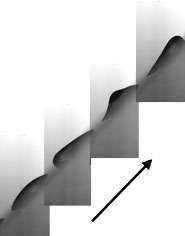
A droplet moving uphill. Photo by Philippe Brunet

Droplets of liquid have been shown to travel uphill, rather than sliding down as expected, when the surface they are on is vigorously shaken up and down.

We are all familiar with raindrops on our wind screens. The small ones stay in place while the big ones roll down the window. This is because surface tension holds the small drops onto the screen until they get to a size where the force of gravity is greater than the surface tension.

But mathematicians at the University of Bristol have shown that the small drops can defy gravity and travel up hill – even on an incline as steep as 85 degrees – if the surface vibrates up and down sufficiently strongly.

Dr Philippe Brunet, in the Department of Mathematics said, “Moving small droplets – such as thousands of spots of DNA arranged on a solid surface (a DNA microarray) – is very difficult as their small size causes them to stick to the surface. So improving our understanding of what causes droplets to move on surfaces will help with this and similar problems.”

Professor Jens Eggers, also from the University’s Maths Department added: “As the shaking plate rises the drop is compressed, while it bulges upward as the plate falls. If the shaking is vigorous enough to overcome the surface tension experienced as the drop is compressed, the drop will tend to lean forward, producing a net force which drives the drop uphill.”

The research will be published online this week in Physical Review Letters.

Since the droplet must withstand a fair amount of force, alternately pushing and pulling, it is in danger of breaking apart. Thus the droplet cannot be too large and the fluid has to be a bit thicker than water. Pure water droplets will break apart before the forces are strong enough to cause them to climb. On the other hand, the drops move very slowly if the fluid is too thick.

This method for moving droplets using vibrations may prove useful in understanding the small-scale manipulation of fluids.

Watch a video of a droplet moving uphill. (36.3 Mb)

Source: University of Bristol


print this article email this article download pdf blog this article bookmark this article     Stumble it Digg this share on Facebook retweet share on Reddit add to delicious
Rate this story - 4.1 /5 (31 votes)


October 3, 2007 all stories

Comments: 0

4.1 /5 (31 votes)
  • Stumble this up

  • Digg this

  • share this

  • hide
  • Related Stories

  • New Nanochemistry Technique Encases Single Molecules in Microdroplets
    created Sep 22, 2009 | popularity not rated yet | comments 0
  • Researchers Develop Flow Sensors Based on Blind Fish Hair Structures
    created Mar 24, 2009 | popularity not rated yet | comments 0
  • Spinning Water Droplets Could Provide Insights into Black Holes, Atomic Nuclei
    created Dec 15, 2008 | popularity not rated yet | comments 0
  • Nanojewels made easy
    created Jul 30, 2008 | popularity not rated yet | comments 0
  • Scientists solve gravity-defying bird beak mystery
    created May 15, 2008 | popularity not rated yet | comments 0


  • hide
  • Relevant PhysicsForums posts

Other News

Solving big problems

Solving big problems with new quantum algorithm

Physics / Quantum Physics

created 6 hours ago | popularity 4.4 / 5 (11) | comments 0

(PhysOrg.com) -- In a recently published paper, Aram Harrow at the University of Bristol and colleagues from MIT in the United States have discovered a quantum algorithm that solves large problems much faster ...


The LHC tunnel

Peckish bird briefly downs big atom smasher

Physics / General Physics

created 18 hours ago | popularity 3.8 / 5 (9) | comments 11

A peckish bird briefly knocked out part of the world's biggest atom smasher by causing a chain reaction with a piece of bread, the European Organisation for Nuclear Research (CERN) said Monday.


First Bose-Einstein condensation of strontium

First Bose-Einstein condensation of strontium

Physics / Quantum Physics

created 12 hours ago | popularity 5 / 5 (4) | comments 1

In an international first, scientists from the Institute of Quantum Optics and Quantum Information (IQOQI, Austria) produced a Bose-Einstein condensate of the alkaline-earth element strontium, thus narrowly ...


Contracts Awarded for Production of NSLS-II Storage Ring Magnets

Physics / General Physics

created 4 hours ago | popularity not rated yet | comments 0

(PhysOrg.com) -- All seven contracts for the production of the NSLS-II storage ring magnets have now been awarded -- a significant milestone for the project. The magnets -- 750 in total -- will be made by vendors in the United ...


Ginzburg helped develop the Soviet Union's hydrogen bomb in the late 1940s and early 1950s

Russian bomb physicist Ginzburg dead at 93

Physics / General Physics

created 20 hours ago | popularity 5 / 5 (4) | comments 0

Nobel Physics prize winner Vitaly Ginzburg, who helped develop the Soviet hydrogen bomb, has died at age 93, the Russian Academy of Sciences said Monday.