Stomach stem cell discovery could bring cancer insights
Scientists have identified and described stem cells specific to several tissues and organs of the body — key master cells that give rise to the specialized cell types characteristic of that organ. But to date, it hasn’t been possible to pinpoint functioning stem cells in the stomach, either in laboratory animals or people.
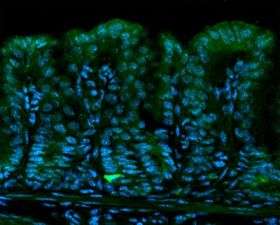
Now, a group of University of Michigan Medical School researchers has succeeded in finding and manipulating a population of cells that strongly resemble stem cells in the stomachs of mice. They have been able to show that these cells, which they call “gastric progenitor cells,” can give rise to all the different types (or lineages) of specialized cells needed to form the functional stomach glands that line the lower portion of the stomach. This property of “multi-lineage potential” is considered a key stem cell property.
”The identification of these progenitor cells will not only aid in our understanding of normal cell turnover in the stomach, but could potentially open some new and exciting doors in our investigation of the origins of gastric cancer,” says Deborah Gumucio, Ph.D., a U-M developmental biologist and senior author of a study which appears online ahead of print in the journal Gastroenterology.
The epithelial cells that make up the millions of glands of the stomach are constantly turning over. Most of the mature functioning cells live only 20 to 60 days before being replaced by progeny of dividing resident stem cells. These stem cells are not only a constant source of new cells, but they represent an important reservoir for repair of damage to the stomach caused by injury or inflammation. In addition, since the stem cells are the longest-lived of the gastric cells, it is thought that these are the only cells that live long enough to accumulate the multiple mutations that can cause cancers. For these reasons, the ability to identify and manipulate stomach progenitor cells has been an important goal for decades.
“Before this work, we knew that stem cells existed in the stomach, but we had no way to precisely identify them,” says Gumucio, who directs the U-M Center for Organogenesis and is a professor in the Department of Cell and Developmental Biology at the U-M Medical School.
“There were no effective markers or tags that we could use to clearly discriminate the stem or progenitor cells from other cells. Now, for the first time, we have the experimental tools to ask important questions, like, ‘Does stomach cancer really arise from mutations in this progenitor cell population"’”
Stomach cancer is a major cancer killer outside the United States. It is the most common
cause of cancer deaths in much of East Asia and Latin America. In the United States, it is estimated that 21,260 people will be diagnosed with stomach cancer and 11,210 will die of it in 2007.
There are several types of stomach cancer, but one very prevalent type, called intestinal-type gastric adenocarcinoma, progresses through a defined series of steps. Initially, the insult is an inflammatory one, usually through infection by an acid-tolerant bacterium called Helicobacter pylori. The chronic inflammation eventually leads to changes in the character of the surrounding stomach cells and ultimately, over several years, to tumors. These tumors often arise in one particular area of the stomach. Interestingly, the progenitor cells that the Gumucio lab has identified are concentrated precisely in this tumor-prone area.
To spot and watch the progenitor cells at work, Gumucio’s team, under lead author Xiaotan T Qiao, Ph.D., a U-M Medical School research associate, had to get past the hurdle that has deterred the search for stomach stem cells so far – finding effective markers, which act like identification tags to make tracing possible. Qiao was able to identify the gastric progenitor cells and later explore their behavior because the cells could be effectively marked using a mouse model developed earlier in Gumucio’s lab.
“Since gastric cancers often occur in the context of inflammation, we were interested to determine whether these progenitor cells are affected by inflammatory conditions,” says Qiao.
“We were amazed to see that though these cells are normally very quiescent, that is, they don’t divide, inflammatory signaling proteins such as interferon gamma provide a potent stimulus for multiplication of these cells.”
Just what specific role these progenitor cells may play in inflammation and cancer is not clear yet.
“Are these cells good guys, bad guys or innocent bystanders" We just don’t know,” Gumucio says. They could be cells that are in some ways predisposed to being cancer cells. Alternatively, they could be important reservoirs for repair of damage caused by injury or inflammation. In that case, having more of them could be a good thing, she says.
“These are probably not the only stem-like cells in the stomach,” adds Qiao. “This must be a subset of such cells, but they certainly represent an interesting subset, given their location in the stomach and their response to inflammation.” The Gumucio lab is working with additional new markers to find other stem-like cells in the stomach.
The researchers suspect the effort to understand stomach stem cells and their possible relationship to cancer will take many more twists and turns. Any therapies or prevention methods resulting from this early research are years away. An important next immediate step is to look in human stomachs to see if this type of stem or progenitor cell can be identified.
Source: University of Michigan


