Unveiling the structure of microcrystals
October 4, 2007 Unveiling the structure of microcrystals

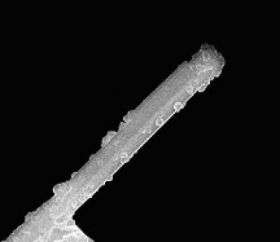
A one cubic micron sample of a microporous aluminium carboxylate. Credit: T. Loiseau, CNRS 2007

Microcrystals take the form of tiny grains resembling powder, which is extremely difficult to study. For the first time, researchers from the European Synchrotron Radiation Facility (ESRF) and the Centre National de Recherche Scientifique used X-ray diffraction at the synchrotron to determine the structure of microcrystal grains of one cubic micrometre. They gained a factor of a thousand on the size of the analysable samples, opening up new research possibilities to chemists, physicists and biologists.

The properties of a crystal are determined by the arrangement of its atom in space, its crystalline structure. Scientists use X-ray or neutron diffraction to study crystalline structure when the size of the crystal is more than 10 cubic micrometres. Below this limit, the solid material is considered a powder.

Scientists can apply powder diffraction to analyse such a material but this technique is not easy to exploit. Moreover, powder diffraction can only be used for materials with grain sizes of less than three millionths of a cubic micrometre. Due to these limitations, a determination of the structure of new synthetic solids in powder form is not always possible because the crystals are too small.

The teams from the ESRF and the Institute Lavoisier (CNRS/Université de Versailles Saint-Quentin) have used new set-up permitting X-ray diffraction on crystals of a size of one cubic micrometre, a volume a thousand times smaller than that ever attainable before. This new set-up consists of a focussing system for the ESRF beam, coupled with a goniometer, an instrument to position the sample with maximum precision.

The researchers studied the structure of an organic-inorganic hybrid compound (a microporous aluminium carboxylate), which could be used for gas absorption or to encapsulate various organic molecules. This study confirms that the new set-up allows pushing back the limits in crystal dimension accessible to X-ray diffraction.

“It is a revolution: what was considered a powder in the past has become a crystal today. Researchers can now bring forward samples left in their cupboards because the sizes had previously prevented their study. Now they will be able to elucidate the structures of these samples, with potentially great scientific advances on the horizon”, explains Thierry Loiseau, from the Institut Lavoisier.

Source: European Synchrotron Radiation Facility


print this article email this article download pdf blog this article bookmark this article     Stumble it Digg this share on Facebook retweet share on Reddit add to delicious
Rate this story - 4.3 /5 (6 votes)


October 4, 2007 all stories

Comments: 0

4.3 /5 (6 votes)
  • Stumble this up

  • Digg this

  • share this

  • hide
  • Related Stories

  • Safer, Denser Acetylene Storage in an Organic Framework
    created Aug 26, 2009 | popularity not rated yet | comments 0
  • Jet-propelled Imaging for an Ultrafast Light Source
    created Aug 04, 2009 | popularity not rated yet | comments 0
  • Crystal clear savings for drug giants
    created Jun 06, 2008 | popularity not rated yet | comments 0
  • Researchers mimic bacteria to produce magnetic nanoparticles
    created Apr 14, 2008 | popularity not rated yet | comments 0
  • Powders show their strength
    created Oct 09, 2007 | popularity not rated yet | comments 0


  • hide
  • Relevant PhysicsForums posts

  • largest and smallest structures
    created 6 hours ago
  • Geothermal power entering atmosphere?
    created 9 hours ago
  • A quick question about startling forces?
    created 10 hours ago
  • speed of propagation of waves
    created 15 hours ago
  • More from Physics Forums - General Physics

Other News

Sculptured materials allow multiple channel plasmonic sensors

Physics / Optics & Photonics

created 4 hours ago | popularity 5 / 5 (1) | comments 0

(PhysOrg.com) -- Sensors, communications devices and imaging equipment that use a prism and a special form of light -- a surface plasmon-polariton -- may incorporate multiple channels or redundant applications if manufacturers ...


Ionic Liquid's Makeup Measurably Non-Uniform at the Nanoscale

Physics / Condensed Matter

created 3 hours ago | popularity not rated yet | comments 0

(PhysOrg.com) -- Researchers at Texas Tech University, Queen's University in Belfast, Ireland, the University of Rome and the National Research Council in Italy recently made a discovery about the non-uniform chemical compositions ...


NSLS-II Project Beamline Conceptual Designs

Physics / General Physics

created 11 hours ago | popularity 5 / 5 (1) | comments 0

(PhysOrg.com) -- The NSLS-II Experimental Facilities Division achieved an important milestone in September when the conceptual design reports for the initial six project beamlines were completed and submitted to NSLS-II management.


Stars Fueled by Dark Matter Could Hold Secrets to the Universe

Stars Fueled by Dark Matter Could Hold Secrets to the Universe

Physics / General Physics

created Nov 03, 2009 | popularity 4.4 / 5 (54) | comments 43

(PhysOrg.com) -- The first stars in the universe may have been very different from the stars we see today, yet they may hold clues to understanding some of the mysterious features of the universe. These "dark ...


Second Law of Thermodynamics May Explain Economic Evolution

Second Law of Thermodynamics May Explain Economic Evolution

Physics / General Physics

created Nov 02, 2009 | popularity 4.3 / 5 (31) | comments 28

(PhysOrg.com) -- Terms such as the "invisible hand," laissez-faire policy, and free-market principles suggest that economic growth and decline in capitalist societies seem to be somehow self-regulated. Now, ...