Researchers shed light on light-emitting nanodevice
October 4, 2007 Researchers shed light on light-emitting nanodevice

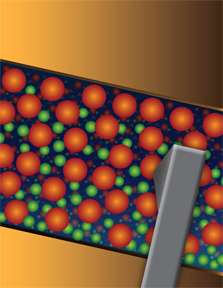
Top view of the ruthenium tris-bipyridine light-emitting device created by Cornell researchers. The ruthenium metal complex is represented by red spheres, and counter ions are represented by green spheres. The material is sandwiched between two gold electrodes. Also visible is the probe of the electron force microscope used to measure the electric field of the device. Source: CU

An interdisciplinary team of Cornell nanotechnology researchers has unraveled some of the fundamental physics of a material that holds promise for light-emitting, flexible semiconductors. The discovery, which involved years of perfecting a technique for building a specific type of light-emitting device, is reported in the Sept. 30 online publication of the journal Nature Materials.

The interdisciplinary team had long studied the molecular semiconductor ruthenium tris-bipyridine. For many reasons, including its ability to allow electrons and holes (spaces where electrons were before they moved) to pass through it easily, the material has the potential to be used for flexible light-emitting devices. Sensing, microscopy and flat-panel displays are among its possible applications.

The researchers set out to understand the fundamental physics of the material -- that is, what happens when it encounters an electric field, both at the interfaces and inside the film. By fabricating a device out of the ruthenium metal complex that was spin-coated onto an insulating substrate with pre-patterned gold electrodes, the scientists were able to use electron force microscopy to measure directly the electric field of the device.

A long-standing question, according to George G. Malliaras, associate professor of materials science and engineering, director of the Cornell NanoScale Science and Technology Facility and one of the co-principal investigators, was whether an electric field, when applied to the material, is concentrated at the interfaces or in the bulk of the film.

The researchers discovered that it was at the interfaces -- two gold metal electrodes sandwiching the ruthenium complex film -- which was a huge step forward in knowing how to build and engineer future devices.

"So when you apply the electric field, ions in the material move about, and that creates the electric fields at the interfaces," Malliaras explained.

Essential to the effort was the ability to pattern the ruthenium complex using photolithography, a technique not normally used with such materials and one that took the researchers more than three years to perfect, using the knowledge of experts in nanofabrication, materials and chemistry.

The patterning worked by laying down a gold electrode and a polymer called parylene. By depositing the ruthenium complex on top of the parylene layer and filling in an etched gap between the gold electrodes, the researchers were then able to peel the parylene material off mechanically, leaving a perfect device.

Ruthenium tris-bipyridine has energy levels well suited for efficient light emission of about 600 nanometers, said Héctor D. Abruña, the E.M. Chamot Professor of Chemistry, and a principal co-investigator. The material, which has interested scientists for many years, is ideal for its stability in multiple states of oxidation, which, in turn, allows it to serve as a good electron and hole transporter. This means that a single-layer device can be made, simplifying the manufacturing process.

"It's not fabulous, but it has a reasonable emission efficiency," Abruña said. "One of the drawbacks is it has certain instabilities, but we have managed to mitigate most of them."

Among the other authors were co-principal investigators Harold G. Craighead, the C.W. Lake Jr. Professor of Engineering, and John A. Marohn, associate professor of chemistry and chemical biology.

Source: Cornell University


print this article email this article download pdf blog this article bookmark this article     Stumble it Digg this share on Facebook retweet share on Reddit add to delicious
Rate this story - 3.9 /5 (18 votes)


October 4, 2007 all stories

Comments: 0

3.9 /5 (18 votes)
  • Stumble this up

  • Digg this

  • share this

  • hide
  • Related Stories

  • Multiferroic compounds used to produce smaller and cheaper digital memories
    created Nov 27, 2009 | popularity not rated yet | comments 0
  • Battery Research Aims To Store Renewable Energy
    created Nov 19, 2009 | popularity not rated yet | comments 0
  • Crashing the size barrier
    created Nov 18, 2009 | popularity not rated yet | comments 0
  • New study confirms exotic electric properties of graphene
    created Nov 17, 2009 | popularity not rated yet | comments 0
  • Researchers take the lead out of piezoelectrics
    created Nov 13, 2009 | popularity not rated yet | comments 0


  • hide
  • Relevant PhysicsForums posts

  • Ceramic Powder processing progress - urgent
    created Nov 27, 2009
  • Thin Film Laboratory resources
    created Nov 27, 2009
  • Theoretical air URGENT
    created Nov 26, 2009
  • photoconductivity of polymers
    created Nov 25, 2009
  • More from Physics Forums - Materials & Chemical Engineering

Other News

Tiny magnetic discs could kill cancer cells: study

Nanotechnology / Bio & Medicine

created 10 hours ago | popularity 3.8 / 5 (12) | comments 2

Tiny magnetic discs just a millionth of a metre in diameter could be used to used to kill cancer cells, according to a study published on Sunday.


Nanowire Formation

Nanowires key to future transistors, electronics

Nanotechnology / Nanophysics

created Nov 26, 2009 | popularity 4.6 / 5 (9) | comments 2

(PhysOrg.com) -- A new generation of ultrasmall transistors and more powerful computer chips using tiny structures called semiconducting nanowires are closer to reality after a key discovery by researchers ...


Water droplets direct self-assembly process in thin-film materials

Nanotechnology / Nanomaterials

created Nov 23, 2009 | popularity 5 / 5 (4) | comments 2

You can think of it as origami - very high-tech origami. Researchers at the University of Illinois have developed a technique for fabricating three-dimensional, single-crystalline silicon structures from thin films by coupling ...


Peptides control crystal growth with 'switches, throttles and brakes'

Peptides control crystal growth with 'switches, throttles and brakes'

Nanotechnology / Bio & Medicine

created Nov 23, 2009 | popularity 4.8 / 5 (5) | comments 0

(PhysOrg.com) -- By producing some of the highest resolution images of peptides attaching to mineral surfaces, scientists have a deeper understanding how biomolecules manipulate the growth crystals. This research ...


Fast, easy, and highly sensitive arsenic detection with gold nanoparticles

Nanotechnology / Nanomaterials

created Nov 25, 2009 | popularity 5 / 5 (1) | comments 0

(PhysOrg.com) -- Mention of arsenic poisoning usually brings to mind underhanded murder. However, the danger of arsenic poisoning from contaminated drinking water is far greater. Low concentrations of arsenic are found in ...