Subatomic particles and giant magnets
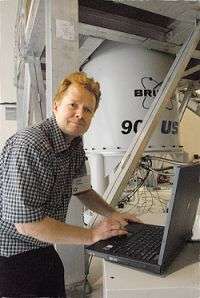
Lest anyone be tempted to think of Stanley Hall’s giant magnet as a $5 million toy for fun-starved quantitative scientists, Jeff Pelton is eager to set the record straight. Pelton, a spectroscopist who manages the nuclear magnetic resonance (NMR) facility in the building’s basement, takes a decidedly no-nonsense view of the 7-ton, 900 MHz device, which produces a magnetic field of 21 Tesla — 400,000 times that of Earth.
“They’re not playthings,” says Pelton, who earned his Ph.D. in the lab of chemist Dave Wemmer, now the facility’s director, and was a staff scientist at Lawrence Berkeley National Lab before moving to work with QB3. “I’m sure some people have that mindset. But the focus is really on doing good research. And that’s what drives me.”
Above the background roar of the new, specially built NMR facility — it houses three other magnets of 500, 600, and 800 MHz, in addition to the recently purchased 900 MHz machine — Pelton explains that, like Stanley Hall itself, the mega-magnet is already helping to draw together biochemists, biophysicists, physical chemists, and other scientists, as well as people skilled in things like computer science and data analysis.
“We’re trying to bridge that gap” between different disciplines, Pelton says. “We’re using chemistry to understand biology.” Bringing the magnet to Berkeley, he adds, “makes us the focal point for this type of research” throughout the Bay Area and creates “a critical mass of researchers — more than when we were all working in our own separate labs.”
And just what is going on in the basement of Stanley Hall? Pelton presses a button on a computer console a short distance away from the 900 MHz magnet, beyond the broken yellow line marking the point at which ATM and credit cards become useless pieces of plastic. That increases the air pressure in the bore tube that runs through the center of the magnet, and we climb a metal ladder to a platform where Pelton retrieves a small vial containing a solution of molecules.
“Protons are like little bar magnets,” explains Pelton. When the “magnets” in an atom’s nucleus interact with the powerful magnetic field generated by an NMR device, researchers gain a deeper understanding of the structure and dynamics of biological molecules, including the ways they react to different drugs, for example. It takes an enormous piece of equipment to generate the energy needed to “flip” these subatomic particles, and, hopefully, to acquire crucial information about the workings of proteins, DNA, and RNA with the aid of computer manipulation.
Proteins, says Pelton, “are really the machines of the cell,” responsible for turning on and turning off genes involved in cancer and other diseases. Because different cancer drugs can behave differently with the same protein, for example, “We’re trying to understand those differences using the language of chemistry. So it’s physics and chemistry pushing into biology.”
Pelton and many of his QB3 colleagues have experience with NMR magnets, particularly the facility’s three smaller magnets, which were brought here from LBNL and Calvin Lab. Researchers have been able to use the new 900 MHz machine for the past year at a facility managed by the manufacturer in Fremont.
The new magnet was installed here in June, after being lowered by crane three stories down an airshaft. Pelton, who helps principal investigators design experiments for particular research problems, insists that despite its impressive girth, the magnet is a gentle giant.
“You can’t walk around outside this room and have your credit card de-magnetized,” he insists. “I try to squelch those rumors, because I’ve had researchers come in saying, ‘Your magnets are affecting my experiments.’”
The facility is, however, increasing Berkeley’s profile and influence as a leader in cutting-edge science. “What this does,” Pelton says, “is make us a focal point for all the groups that are using this technique. Together we’re going to be able to do experiments more efficiently than we were before, when we were all working our own separate paths. And one of my jobs as facility manager is to bring all those people together.”
Source: UC Berkeley


