Trick of Nature Allows Hubble and Keck to Find Tiny Galaxy
October 5, 2007 Trick of Nature Allows Hubble and Keck to Find Tiny Galaxy

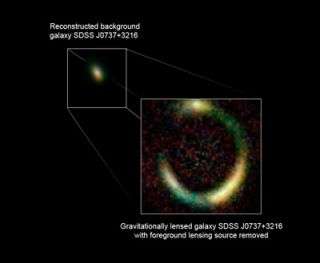
This photo illustration shows a tiny galaxy 6 billion light-years away that is smaller than any galaxy ever seen at that distance. Credit: NASA, ESA, and P. Marshall and T. Treu (University of California, Santa Barbara)

A team of astronomers at the University of California at Santa Barbara report that they have resolved a dwarf galaxy 6 billion light-years away. Weighing only 1/100 as much as our Milky Way Galaxy, the dwarf is much smaller than anything studied before in any detail at this distance.

They report in the Dec. 20 issue of the Astrophysical Journal that the galaxy looks very similar to one of the dwarf galaxies in the Virgo cluster, which is located only 60 million light-years away.

"We believe we may have identified the progenitors of local dwarf galaxies," says Tommaso Treu. "We see them as clearly as we would see dwarfs in the Virgo cluster using ground-based telescopes. The sharp view of NASA's Hubble Space Telescope, and the laser guide stars adaptive optics system on the W.M. Keck Telescope, were aimed at a natural lens in space, called a gravitational lens, to study the dwarf.

The researchers took advantage of the fact that the distant dwarf galaxy lies behind a massive foreground galaxy that bends light rays much as a glass lens does. This gravitational lensing amplifies the image of the much farther dwarf galaxy, making it appear 10 times brighter and 10 times larger than it would normally be seen by either Hubble or Keck.

Source: STScI


print this article email this article download pdf blog this article bookmark this article     Stumble it Digg this share on Facebook retweet share on Reddit add to delicious
Rate this story - 4.1 /5 (14 votes)


October 5, 2007 all stories

Comments: 0

4.1 /5 (14 votes)
  • Stumble this up

  • Digg this

  • share this

  • hide
  • Related Stories

  • World's observatories watching 'cool' star
    created May 15, 2009 | popularity not rated yet | comments 0
  • Hubble Sees Double Einstein Ring
    created Jan 10, 2008 | popularity not rated yet | comments 0
  • Scientists 'weigh' tiny galaxy halfway across universe
    created Oct 04, 2007 | popularity not rated yet | comments 0
  • New type of supernova explosion reported; predicted by theoretical physicists at UCSB
    created Nov 05, 2009 | popularity not rated yet | comments 0
  • Rapid supernova could be new class of exploding star
    created Nov 05, 2009 | popularity not rated yet | comments 0


  • hide
  • Relevant PhysicsForums posts

  • Consistency of Meteor Shower Dates (i.e. the peak of Perseids always on Aug 13th)
    created 16 hours ago
  • Favourite Astronomy Book?
    created Nov 10, 2009
  • dark energy
    created Nov 10, 2009
  • The shape of our solar system's orbits.
    created Nov 07, 2009
  • More from Physics Forums - General Astronomy

Other News

A bubbling ball of gas

A bubbling ball of gas (w/ Video)

Space & Earth / Space Exploration

created 38 minutes ago | popularity not rated yet | comments 0

The Sun is a bubbling mass. Packages of gas rise and sink, lending the sun its grainy surface structure, its granulation. Dark spots appear and disappear, clouds of matter dart up - and behind the whole thing ...


NOAA deploys new 'smart buoy' off Annapolis

Space & Earth / Environment

created 2 hours ago | popularity 5 / 5 (1) | comments 0

NOAA deployed the seventh in a series of "smart buoys" to monitor weather conditions and water quality in the Chesapeake Bay today. The buoy, located at the mouth of Severn River near Annapolis, Md., will be used by commercial ...


Rapid star formation spotted in 'stellar nurseries' of infant galaxies

Rapid star formation spotted in 'stellar nurseries' of infant galaxies

Space & Earth / Astronomy

created 7 hours ago | popularity 5 / 5 (1) | comments 0

The Universe's infant galaxies enjoyed rapid growth spurts forming stars like our sun at a rate of up to 50 stars a year, according to scientists at Durham University.


Reducing greenhouse gases may not be enough to slow climate change

Space & Earth / Environment

created 6 hours ago | popularity 2.3 / 5 (3) | comments 3

Georgia Tech City and Regional Planning Professor Brian Stone publishes a paper in the December edition of Environmental Science and Technology that suggests policymakers need to address the influence of global deforestation ...


The Stars My Destination

The Stars My Destination

Space & Earth / Space Exploration

created 20 hours ago | popularity 4.9 / 5 (20) | comments 0

The Voyager spacecraft are now in the outermost layer of the heliosphere, traveling toward interstellar space - the first man-made spacecraft to travel such a vast distance from Earth.