Hubble Confirms Two New Moons of Pluto
February 22, 2006 Hubble Confirms Two New Moons of Pluto

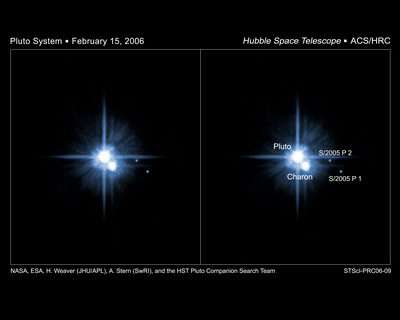
Astronomers using NASA´s Hubble Space Telescope have confirmed the presence of two new moons around the distant planet Pluto. The moons were first discovered with Hubble´s Advanced Camera for Surveys in May 2005, but the science team probed even deeper into the Pluto system on Feb. 15, 2006 to look for additional satellites and to characterize the orbits of the moons. In addition to verifying the reality of the moons, the observations also rule out the possibility of other satellites of roughly similar size orbiting Pluto inside the orbits of the two moons. The moons, provisionally designated S/2005 P 1 and S/2005 P 2, are approximately 40,000 and 30,000 miles away from Pluto, respectively. In the Hubble image, Pluto is in the center and Charon is just below it. P 1 is to the right and just below Charon. P 2 is to the right of Pluto and Charon. Credit: NASA, ESA, H. Weaver (Johns Hopkins University/Applied Physics Laboratory), A. Stern (Southwest Research Institute) and the HST Pluto Companion Search Team

Anxiously awaited follow-up observations with NASA's Hubble Space Telescope have confirmed the presence of two new moons around the distant planet Pluto. The moons were first discovered by Hubble in May 2005, but the science team probed even deeper into the Pluto system last week to look for additional satellites and to characterize the orbits of the moons.

Though the team had little doubt the moons are real, they were happy to see the moons show up very close to the locations predicted from the earlier Hubble observations. The initial discovery is being reported today in this week's edition of the British science journal Nature.

The confirmation reinforces the emerging view that the Kuiper Belt, a swarm of icy bodies encircling the solar system beyond Neptune, may be more complex and dynamic than astronomers once thought. Pluto resides inside the Kuiper Belt and is about 3 billion miles from the Sun. Pluto was discovered in 1930.

The moons' orbits are in the same plane as the orbit of the much larger satellite Charon (discovered in 1978). This likely means the moons were not captured, but instead were born, along with Charon, in what is commonly theorized to have been a titanic collision between two Pluto-sized objects over 4 billion years ago.

A team of astronomers, led by Hal Weaver of the Johns Hopkins Applied Physics Laboratory in Laurel, Md., and Alan Stern of the Southwest Research Institute in Boulder, Colo., made the new observations on Feb. 15, 2006, with Hubble's Advanced Camera for Surveys (ACS).

The team used the sharp vision of the ACS to do a targeted search of the region around and inside the orbits of the twin moons. In addition to confirming the reality of the new moons, the observations also rule out the possibility of other satellites of roughly similar size orbiting Pluto inside the orbits of the two moons. The moons, provisionally designated S/2005 P 1 and S/2005 P 2, are approximately 40,000 and 30,000 miles away from Pluto, respectively.

Astronomers believe that the formation of the Pluto system is similar to that of our Earth and Moon. In both cases a comparable-sized body slammed into the parent planet. Simulations show that debris from the collision would go into an orbit around the planet and coalesce to form one or more satellites. Investigating how Pluto ended up with three moons while the Earth has only one should yield valuable insights into the processes by which satellite systems form around planets.

The team will use Hubble again on March 2 to study the new moons. They hope the follow-up observations will provide information on the moons' color, as well as their size and shape, which could yield further clues about the formation and evolution of the Pluto system.

In the Hubble image, Pluto is in the center and Charon is just below it. P 1 is to the right and just below Charon. P 2 is to the right of Pluto and Charon.

Source: Space Telescope Science Institute


print this article email this article download pdf blog this article bookmark this article     Stumble it Digg this share on Facebook retweet share on Reddit add to delicious
Rate this story - 4.7 /5 (25 votes)


February 22, 2006 all stories

Comments: 0

4.7 /5 (25 votes)
  • Stumble this up

  • Digg this

  • share this

  • hide
  • Related Stories

  • Hubble directly observes planet orbiting Fomalhaut
    created Nov 13, 2008 | popularity not rated yet | comments 0
  • New Horizons Spacecraft Gets Boost From Jupiter for Pluto Encounter
    created Feb 28, 2007 | popularity not rated yet | comments 0
  • New Hubble images show similar colors for Pluto's moons
    created Mar 10, 2006 | popularity not rated yet | comments 0
  • Measuring the size of a small, frost world
    created Jan 04, 2006 | popularity not rated yet | comments 0
  • Hubble Reveals Possible New Moons Around Pluto
    created Oct 31, 2005 | popularity not rated yet | comments 0


Other News

Monster Waves on the Sun are Real

Monster Waves on the Sun are Real (w/ Video)

Space & Earth / Astronomy

created 7 hours ago | popularity 5 / 5 (8) | comments 1

Sometimes you really can believe your eyes. That's what NASA's STEREO (Solar Terrestrial Relations Observatory) spacecraft are telling researchers about a controversial phenomenon on the sun known as the "solar ...


Cosmic 'dig' reveals vestiges of the Milky Way's building blocks

Cosmic 'Dig' Reveals Vestiges of the Milky Way's Building Blocks

Space & Earth / Astronomy

created 12 hours ago | popularity 4.9 / 5 (13) | comments 1

(PhysOrg.com) -- Peering through the thick dust clouds of our galaxy's "bulge" (the myriads of stars surrounding its center), a team of astronomers has unveiled an unusual mix of stars in the stellar grouping ...


No Wheel Stall in Diagnostic Drive

Spirit Mars Rover: No Wheel Stall in Diagnostic Drive

Space & Earth / Space Exploration

created 7 hours ago | popularity 4.5 / 5 (2) | comments 0

(PhysOrg.com) -- On Sol 2095 (Tuesday, Nov. 24), Spirit performed a set of diagnostic actions related to a stall of the right-rear wheel on the previous drive, three days earlier.


Climate experts debate strategies for reducing atmospheric carbon and future warming

Climate experts debate strategies for reducing atmospheric carbon and future warming

Space & Earth / Environment

created 8 hours ago | popularity 2.8 / 5 (6) | comments 7

(PhysOrg.com) -- Reducing carbon dioxide to safe levels may require extracting carbon from the air, says Cornell climate researcher.


Oceanic crust formation is dynamic after all

Oceanic crust formation is dynamic after all

Space & Earth / Earth Sciences

created 11 hours ago | popularity 4.6 / 5 (5) | comments 0

Imagine the Earth's crust as the planet's skin: Some areas are old and wrinkled while others have a fresher, more youthful sheen, as if they had been regularly lathered with lotion.