Taming tiny, unruly waves for nano optics
October 8th, 2007 Taming tiny, unruly waves for nano optics

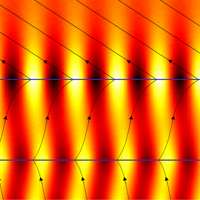
Waves of electromagnetic energy passing through a vacuum between two plates of silicon carbide just 100 nanometers apart, one at an elevated temperature. The lines represent the energy stream, bending the light as it is pushed through the small gap. Credit: Georgia Institute of Technology

Nanoscale devices present a unique challenge to any optical technology -- there’s just not enough room for light to travel in a straight line.

On the nanoscale, energy may be produced by radiating photons of light between two surfaces very close together (sometimes as close as 10 nanometers), smaller than the wavelength of the light. Light behaves much differently on the nanoscale as its wavelength is interrupted, producing unstable waves called evanescent waves. The direction of these unpredictable waves can’t be calculated, so researchers face the daunting task of designing nanotechnologies to work with the tiny, yet potentially useful waves of light.

Researchers at Georgia Tech have discovered a way to predict the behavior of these unruly waves of light during nanoscale radiation heat transfer, opening the door to the design of a spectrum of new nanodevices (or NEMS) and nanotechnologies, including solar thermal energy technologies. Their findings were featured on the cover of the Oct. 8 issue of Applied Physics Letters.

“This discovery gives us the fundamental information to determine things like how far apart plates should be and what size they should be when designing a technology that uses nanoscale radiation heat transfer,” said Zhuomin Zhang, a lead researcher on the project and a professor in the Woodruff School of Mechanical Engineering. “Understanding the behavior of light at this scale is the key to designing technologies to take advantage of the unique capabilities of this phenomenon.”

The Georgia Tech research team set out to study evanescent waves in nanoscale radiation energy transfer (between two very close surfaces at different temperatures by means of thermal radiation). Because the direction of evanescent waves is seemingly unknowable (an imaginary value) in physics terms, Zhang’s group instead decided to follow the direction of the electromagnetic energy flow (also known as a Poynting vector) to predict behavior rather than the direction of the photons.

“We’re using classic electrodynamics to explain the behavior of the waves, not quantum mechanics,” Zhang said. “We’re predicting the energy propagation -- and not the actual movement -- of the photons.”

The challenge is that electrodynamics work differently on the nanoscale and the Georgia Tech team would need to pinpoint those differences. Planck’s law, a more than 100-year-old theory about how electromagnetic waves radiate, does not apply on the nanoscale due to fact that the space between surfaces is smaller than a wavelength.

The Georgia Tech team observed that instead of normal straight line radiation, the light was bending as protons tunneled through the vacuum in between the two surfaces just nanometers apart. The team also noticed that the evanescent waves were separating during this thermal process, allowing them to visualize and predict the energy path of the waves.

Understanding the behavior of such waves is critical to the design of many devices that use nanotechnology, including near-field thermophotovoltaic systems, nanoscale imaging based on thermal radiation scanning tunneling microscopy and scanning photon-tunneling microscopy, said Zhang.

Source: Georgia Institute of Technology


print this article email this article download pdf blog this article bookmark this article     Digg this Stumble it share on Facebook share on Reddit add to delicious save to Yahoo! bookmarks
4.3/5 after 26 votes


October 8th, 2007 all stories
Nanotechnology / Nanophysics

Comments: 0
Rank: 4.3/5 after 26 votes

  • Stumble this up

  • Digg this

  • Share it:
  • share on Facebook
  • share on MySpace
  • share on Slashdot
  • rss-newsfeed
  • share on Google
  • share on Reddit
  • add to delicious
  • save to Yahoo! bookmarks
  • share on Windows Live
  • Add to Mixx!
Rating: 4.3/5 after 26 votes

  • Related Stories

  • Revolutionizing the diagnosis of serious disease
    created Jun 02, 2009 | popularity not rated yet | comments 0
  • Terahertz Waves Are Effective Probes for IC Heat Barriers
    created May 06, 2009 | popularity not rated yet | comments 0
  • Bridging the gap in nanoantennas
    created Apr 20, 2009 | popularity not rated yet | comments 0
  • New organic material may speed Internet access
    created Mar 15, 2009 | popularity not rated yet | comments 0
  • Engineers tune a nanoscale grating structure to trap and release a variety of light waves
    created Feb 17, 2009 | popularity not rated yet | comments 0

Tags


  • Physicists Demonstrate Quantum Memory with Matter Qubits
    Physicists Demonstrate Quantum Memory with Matter Qubits
    Physics / General Physics
    created Jul 03, 2009 | popularity 4.4 / 5 (17) | comments 1
  • 'Holey' Nanosheets for Wastewater Dye Removal
    Nanotechnology / Nanomaterials
    created Jul 01, 2009 | popularity 5 / 5 (5) | comments 1
  • Jellyfish Robot Swims Like its Biological Counterpart
    Jellyfish Robot Swims Like its Biological Counterpart
    Electronics / Robotics
    created Jun 26, 2009 | popularity 4.4 / 5 (8) | comments 1
  • Could Maxwell's Demon Exist in Nanoscale Systems?
    Could Maxwell's Demon Exist in Nanoscale Systems?
    Physics / General Physics
    created Jun 24, 2009 | popularity 4.4 / 5 (18) | comments 29
  • Living Safely with Robots, Beyond Asimov's Laws
    Living Safely with Robots, Beyond Asimov's Laws
    Electronics / Robotics
    created Jun 22, 2009 | popularity 4.6 / 5 (54) | comments 40
  • Other News

    Physics research with atomic force microscope could lead to better health care

    Atomic force microscope research could lead to better health care

    Nanotechnology / Nanophysics

    created 26 minutes ago | popularity not rated yet | comments 0

    Where biology, chemistry and physics intersect, a Kansas State University professor expects to find applications to improve human health.


    Canadian researchers set to study impact of nanomaterials on aquatic ecosystems

    Nanotechnology / Bio & Medicine

    created 2 hours ago | popularity 5 / 5 (1) | comments 0

    A team of Canadian scientists and engineers, led by the University of Alberta and the National Research Council of Canada, will collaborate on a $3.39 million, three-year study to assess the potential effects of nanoparticles ...


    Nano Measurement in the 3rd Dimension

    Nano Measurement in the 3rd Dimension

    Nanotechnology / Nanophysics

    created 3 hours ago | popularity 3 / 5 (1) | comments 0

    From the motion sensor to the computer chip - in many products of daily life components are used whose functioning is based on smallest structures of the size of thousandths - or even millionths - of millimetres. ...


    A 'quantum of sol' -- how nanotechnology could hold the key to a solar-powered future

    A 'quantum of sol' -- how nanotechnology could hold the key to a solar-powered future

    Nanotechnology / Nanomaterials

    created Jun 30, 2009 | popularity 3.9 / 5 (16) | comments 17

    (PhysOrg.com) -- A new generation of 'nano-structured' millimetre-sized solar cells that could convert the sun's energy to electricity more than twice as efficiently as current technology, is the subject of ...


    Australian researchers are set to begin human trials of a tiny nano-cell that acts as a "Trojan horse" against cancer

    Hi-tech 'Trojan horse' can kill cancer cells: researchers

    Nanotechnology / Bio & Medicine

    created Jun 29, 2009 | popularity 4.7 / 5 (12) | comments 7

    Australian researchers are set to begin human trials of a tiny nano-cell that acts as a "Trojan horse" against cancer cells, a breakthrough they say may curb the need for debilitating chemotherapy.