Plant viruses from past provide ecological clues
Taking the medical history of a grassland may seem a bit esoteric – after all, how sick can grass be? However, scientists have discovered plant viruses from as early as 1917 containing information crucial not only for plant scientists, but for those in ecology, human health and bioterrorism.
Carolyn Malmstrom, assistant professor of plant biology at Michigan State University, isolated historical viral RNA sequences in native and invasive grasses revealing a complex picture of struggles of species, interactions of insects and implications for the ways viruses behave today. The findings are reported in the Oct. 16th edition of the Journal of Ecology.
“This work points out that the virus world does have an active, long-term role in nature, not just in agriculture,” Malmstrom said. “We very much need to understand how viruses can move and influence our crops. If we care about our crops, we need to care about what’s happening in nature.”
When living in northern California, Malmstrom noticed that a walk through grasslands dominated by nonnative annual plants meant getting covered in aphids, an infestation that wasn’t seen in typically perennial grasses indigenous to the area.
It made her wonder what the differences were – and what that meant to the overall health of those ecosystems.
Those questions ultimately led to viruses, which can be spread among plants by aphids the way mosquitoes spread disease among humans. Malmstrom explained little is known about viruses in nature – that’s usually a discussion reserved for agricultural crops. But recent advances in molecular techniques have unveiled natural systems teeming with viruses – and thus raising the question of what the impact of those viruses is.
“We’ve always assumed viruses largely are manifested in agricultural systems, because the system is unbalanced due to human interaction,” Malmstrom said. “But now we are understanding viruses are more common in nature than people realize – and that there’s a whole class of biological interactions going on out there that we know hardly anything about.”
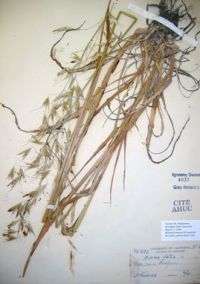
This paper deals with historical virus ecology – understanding how viruses have affected grasslands years ago. The team examined dried California grasses in plant collections from the early 1900s. Unprotected, RNA typically degenerates quickly, but Malmstrom’s group discovered that the old RNA in these descendents of common grain viruses had been protected by the viruses’ exterior proteins – and could still be recovered almost a century later.
“These are the oldest plant viruses anyone has gotten out of plant material in North America,” Malmstrom said.
The work suggests that these barley and cereal yellow dwarf viruses may have helped invasive grasses take over California in the 18th and 19th centuries.
The history, Malmstrom said, is important in understanding how viruses spread and change. People have been bringing in new species of plants to the New World since Columbus arrived in the 15th century, and these invasions rock the ecological world. In California, native perennial grasses gave way to new annual grasses, which make aphid populations larger. Because aphids can carry viruses over long distances, increases in their numbers can alter disease dynamics over a large area. In California more native grasses likely got sick after Europeans arrived, just as Native Americans did.
“We are able to take modern and historical viruses and put them in a family tree so we can start investigating how far back different virus groups split from each other,” Malmstrom said. “Our work suggests that some of the big branching of viruses happened during early global exploration by humans. We want to understand how human influence shapes how viruses evolve.”
Understanding what impact humans have on natural systems is especially important as the human world has much of natural ecology reined in. Malmstrom described human influence in terms of a net – one in which natural systems are increasingly hemmed in by a grid of roads, urban areas and fences.
“At night, the view of North America from outer space reveals a grid of lights that shows how we have built a net over the landscape – one that doesn’t let large controlling agents – be they stampedes of buffalos or fires – move across the landscape like they used to; they get caught in our net,” she said. “But those little aphids can still move through those nets and the viruses with them. The importance of viruses and small pathogens is going to be increasingly dominant as other forces have been controlled.”
Source: Michigan State University


