A Positive Spin
February 22, 2006
Beams with polarized particles greatly boost the physics output of high energy physics colliders. While it has been straightforward to make polarized electron beams, polarizing positrons is more difficult, especially in the case of linear colliders. The E-166 experiment has successfully demonstrated a technology to make a polarized beam of positrons for a future linear collider.
For decades, Stanford Linear Accelerator Center (SLAC) has been making positrons—the antimatter equivalent of electrons—but this is the first polarized positron beam at SLAC. Polarized means the particles are oriented to spin in the same direction; imagine most of the golf balls at a driving range rotating clockwise as they fly toward the net. Beams never reach 100 percent polarization, but the more polarized the beams, the more information they reveal in collisions.
E-166 proves that the proposed International Linear Collider (ILC) could be designed with a polarized positron beam. The collaboration is still analyzing the results to determine the precise amount of polarization achieved. “Let’s say the beam is definitely polarized, sufficient for a linear collider,” said Bill Bugg (University of Tennessee, Knoxville).
In two runs during June and September 2005, the collaboration used SLAC’s two-mile linac to deliver electrons to the Final Focus Test Beam (FFTB). There the electrons travel through a helical undulator, a one-meter-long magnet that forces the electrons to spiral, thus emitting polarized gamma rays. The gamma rays strike a tungsten target, producing showers of polarized positrons with an average energy of 5 to 6 million electron volts (MeV). Alexander Mikhailichenko (Cornell), who built the undulator for the experiment, was one of the people to originally propose the technique in 1979.
The electrons travel through the undulator in a tiny beam pipe—a stainless steel tube with a 0.9-millimeter inside diameter. The pipe is cut from the same hollow metal used for hypodermic needles and cheap, too, at $1 per foot. Even though the electron beam is 20 times narrower than the pipe aperture, some feared the small pipe would be a showstopper. The beam needed to go cleanly through the undulator without touching the pipe wall. Any beam loss at all would have saturated the detectors with background noise.
“The undulator performance was superb, like flipping a switch,” said experiment spokesman John Sheppard (ILC).
The results put to rest doubts that helical undulators would produce circularly polarized gamma rays or that polarized gamma rays would in turn produce polarized positrons.
“SLAC was the only place we could possibly do this experiment,” Sheppard said. “We needed a 50 GeV low-emittance (transversely small) beam, small enough to fit through the undulator beam pipe. The success of the experiment in large part was due to the excellent beam quality and stability delivered by the SLAC operations staff.”
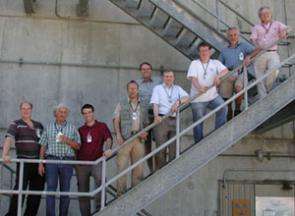
Collaborators who took shifts at SLAC came from the University of Tennessee, DESY Hamburg, DESY Zeuthen, Humboldt University Berlin, Cornell, Daresbury, RWTH Aachen, Princeton and Tel-Aviv University.
Source: Stanford Linear Accelerator Center (Heather Rock Woods)
-
All-optical quantum computation, step 1: A controlled-NOT photonic gate
Jun 24, 2011 |
4 / 5 (6) |
0
-
Putting a spin on light and atoms: How to build a better magnetometer
Sep 15, 2010 |
5 / 5 (5) |
0
-
Nano-sized light mill drives micro-sized disk (w/ Video)
Jul 05, 2010 |
4.7 / 5 (25) |
8
-
First X-ray laser's early success brings approval for next-phase facility
May 05, 2010 |
4.6 / 5 (10) |
2
-
Jet-propelled Imaging for an Ultrafast Light Source
Aug 04, 2009 |
5 / 5 (3) |
1
-
Engineers build first sub-10-nm carbon nanotube transistor
Feb 01, 2012 |
4.9 / 5 (31) |
30
-
Something old, something new: Evolution and the structural divergence of duplicate genes
Jan 31, 2012 |
4.6 / 5 (7) |
1
-
The hidden nanoworld of ice crystals: Revealing the dynamic behavior of quasi-liquid layers
Jan 30, 2012 |
5 / 5 (3) |
1
-
Stock market network reveals investor clustering
Jan 27, 2012 |
3.9 / 5 (23) |
8
-
Of microchemistry and molecules: Electronic microfluidic device synthesizes biocompatible probes
Jan 26, 2012 |
5 / 5 (1) |
0
More news stories
Explained: Sigma
It's a question that arises with virtually every major new finding in science or medicine: What makes a result reliable enough to be taken seriously? The answer has to do with statistical significance -- but ...
Feb 09, 2012 |
5 / 5 (18) |
59
Quantum physicist explains $100K offer for proof scaled-up quantum computing is impossible
(PhysOrg.com) -- MIT researcher Scott Aaronson has certainly riled the physics community with his offer this past Friday, of $100,000 to anyone who can prove that scaled-up quantum computing is impossible. ...
Diamond light, brighter than the sun
Its the size of five football pitches and generates light 10 billion times brighter than the sun. As the Diamond Light Source celebrates its tenth anniversary this year, Penny Bailey visits one of the ...
Feb 07, 2012 |
4.3 / 5 (7) |
15
|
Physicists 'record' magnetic breakthrough
An international team of scientists has demonstrated a revolutionary new way of magnetic recording which will allow information to be processed hundreds of times faster than by current hard drive technology.
Feb 07, 2012 |
4.5 / 5 (39) |
14
|
Hints of the Higgs - papers are submitted
Back in December 2011, the ATLAS and CMS experiments at CERN presented some exciting results that provided tantalising hints of the Higgs boson.
Feb 08, 2012 |
4.7 / 5 (6) |
10
Walney offshore wind farm is world's biggest (for now)
(PhysOrg.com) -- The Walney wind farm on the Irish Sea--characterized by high tides, waves and windy weather--officially opened this week. The farm is treated in the press as a very big deal as the Walney ...
GPS court ruling leaves US phone tracking unclear
A US Supreme Court decision requiring a warrant to place a GPS device on the car of a criminal suspect leaves unresolved the bigger issue of police tracking using mobile phones, legal experts say.
Anonymous briefly knocks CIA website offline (Update 2)
The website of the Central Intelligence Agency was briefly inaccessible on Friday after the hacker group Anonymous claimed to have knocked it offline.
Europeans protest controversial Internet pact
Tens of thousands of people marched in protests in more than a dozen European cities Saturday against a controversial anti-online piracy pact that critics say could curtail Internet freedom.
Study finds that anti-diabetic medication can prevent the long-term effects of maternal obesity
In a study to be presented today at the Society for Maternal-Fetal Medicine's annual meeting, The Pregnancy Meeting, in Dallas, Texas, researchers will report findings that show that short therapy with the anti-diabetic medication ...
Europe stakes billion-dollar bet on new rocket
A pencil-slim rocket is scheduled to lift into space from South America on Monday, carrying a billion-dollar bet that Europe can grab a juicy slice of the market to place satellites in low orbit.