One shot of gene therapy spreads through brain in animal study
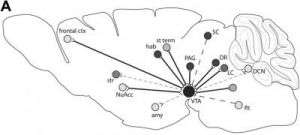
By targeting a site in a mouse brain well connected to other areas, researchers successfully delivered a beneficial gene to the entire brain—after one injection of gene therapy. If these results in animals can be realized in people, researchers may have a potential method for gene therapy to treat a host of rare but devastating congenital human neurological disorders, such as Tay-Sachs disease.
Researchers from The Children’s Hospital of Philadelphia and the University of Pennsylvania reported their findings in the September 12 issue of the Journal of Neuroscience.
“After a single injection, this technique succeeded in correcting diseased areas throughout the brain,” said study leader John H. Wolfe, V.M.D., Ph.D., a neurology researcher at The Children’s Hospital of Philadelphia and a professor of pathology and medical genetics at the Penn School of Veterinary Medicine. “This may represent a new strategy for treating genetic diseases of the central nervous system.”
Wolfe and Penn graduate student Cassia N. Cearley performed the study in mice specially bred to have the neurogenetic disease mucopolysaccharidosis type VII (MPS VII). In people, MPS VII, also called Sly syndrome, is a rare, multisystem disease causing mental retardation and death in childhood or early adulthood.
Sly syndrome is one of a class of some 60 disorders called lysosomal storage diseases that collectively cause disabilities in about one in 5,000 births. Those diseases account for a significant share of childhood mental retardation and severe, often fatal, disabilities. In each of the lysosomal storage diseases, a defect in a specific gene disrupts the production of an enzyme that cleans up waste products from cells. Cellular debris builds up within cell storage sites called lysosomes, and the waste deposits interfere with basic cell functions. Other examples of lysosomal storage diseases are Tay-Sachs disease, Hunter disease and Pompe disease.
In some types of the lysosomal storage disorder Gaucher disease, physicians can supply the missing enzyme to patients and successfully relieve disease symptoms. However, for Sly syndrome and most other lysosomal storage diseases, enzyme replacement, when available, is not very effective in treating the brain component of the disease. “Enzymes delivered to the circulation do not cross the blood-brain barrier very well,” said Dr. Wolfe.
Therefore, some strategies for treating these diseases have focused on gene therapy—delivering DNA sequences that can enter cells and produce the needed enzyme. Researchers have also sought to deliver gene therapy directly to the brain rather than to the bloodstream, but there are practical limitations to making multiple injections into a child’s brain.
In the current study, Wolfe targeted a particular region of the mouse brain called the ventral tegmental area (VTA), which has numerous connections with the rest of the brain. He used a neutralized virus called adeno-associated virus (AAV) as a vector—the delivery vehicle for the gene that carries coded instructions to produce the desired enzyme.
“We found that one subtype of AAV was particularly effective for transporting the gene,” said Wolfe. “The neural pathways carried the virus throughout the brain, where the gene produced the enzyme. The enzyme then cleaned up the storage lesions to the point that these storage lesions were indistinguishable from those found in the brains of normal mice.” One advantage of lysosomal enzymes, said Wolfe, is that cells receiving the delivered gene secrete beneficial enzymes to neighboring cells, creating a “sphere of correction.”
The level of correction resulting from a single injection was “unprecedented,” said Wolfe, but he cautioned that direct human treatments might be years away. In future studies, he will investigate whether this technique is effective in animals larger than mice. Such results might conceivably resemble a 2005 study in which Wolfe used gene therapy to successfully treat another lysosomal storage disease, called alpha-mannosidosis, in cats. In that study, a treated cat showed dramatic improvement in walking, compared to an untreated cat with the disease.
If the animal results can be successfully extrapolated to humans, Wolfe estimates that 2 milliliters of injected gene therapy might treat a one-year-old child. That amount might be administered with a reasonably limited number of injections, he added, although a great deal of work would be needed to reach that goal.
Source: Children's Hospital of Philadelphia


