October 9, 2007 feature
'Snowdrift' game tops 'Prisoner's Dilemma' in explaining cooperation
When it comes to explaining the evolution of human cooperation, researchers have traditionally looked to the iterated Prisoner’s Dilemma (IPD) game as the paradigm. However, the observed degree of cooperation among humans is generally higher than predicted by mathematical models using the IPD, leaving unanswered the question of why humans cooperate to the extent they do.
A group of researchers from the University of Lausanne in Switzerland and the University of Edinburgh in the UK suggests that a different game, called the “iterated Snowdrift game” (ISD), may more realistically reflect social situations that humans face, compared with the IPD. In experimental tests, the proportion of cooperative acts in the ISD game (48%) was significantly higher than those in the IPD (29%).
The cause for this difference is due to the higher risks of being exploited in the IPD compared with the ISD, where the risk of being exploited by someone who doesn’t cooperate when you do is lower.
“In principle, natural selection predicts individuals to behave selfishly,” Rolf Kümmerli, co-author of the study, told PhysOrg.com. “However, we observe cooperation in humans and other organisms, where cooperation is costly for the actor but benefits another individual. The question is why does natural selection favor such cooperation? One solution to this problem is given by the ‘Snowdrift’ game (but not by the PD), where individuals gain direct benefits from their cooperative acts.”
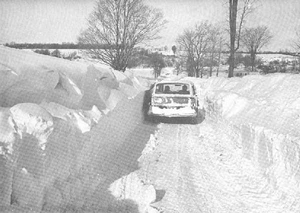
The situation of the Snowdrift game involves two drivers who are trapped on opposite sides of a snowdrift. Each has the option of staying in the car or shoveling snow to clear a path. Letting the opponent do all the work is the best option (with a pay-off of 300 used in this study), but being exploited by shoveling while the opponent sits in the car still results in a pay-off of 100. (The other two possibilities, both shoveling and both sitting, have pay-offs of 200 and 0, respectively.)
Compare this with the Prisoner’s Dilemma. For a quick synopsis, two prisoners being questioned each have the choice to either defend the other’s innocence or betray the other’s guilt. As in the Snowdrift game, the best option is to betray your opponent while he defends you (pay-off of 400), and next for both of you to defend each other (pay-off of 300). Also, as in the Snowdrift game, both of you betraying results in a pay-off of 0.
However, the significant difference is in the greater risk in the Prisoner’s Dilemma when you cooperate while your opponent defects: while shoveling snow always helps you out, even when the opponent sits (100 pay-off), defending an opponent who betrays you results in the worst outcome for you—a pay-off of -100. In the study, participants cooperated more in the ISD because they could always obtain individual benefits by cooperating, while the costs of cooperating were shared between cooperators.
The researchers noticed other interesting trends in the study, which involved 96 participants (38 female and 58 male) divided into 16 groups and arranged in 48 pairs, not knowing their partner’s identity or gender. Each pair repeated (“iterated”) both games 12 times, though were initially told the number of repetitions was randomly determined. The researchers created global competition by revealing that the players with the four highest pay-offs would receive monetary awards.
Players who employed “Tit-for-Tat” and “Pavlovian” strategies—known to increase pay-offs in the IPD—had better pay-offs in both games than players who did not use these strategies. Further, the researchers found that female participants were twice as likely to use one of these strategies as male participants in the ISD (but not the IPD), resulting in both greater cooperation in female-female pairs compared with male-male pairs, as well as greater pay-offs for individual females. Interestingly, these results contrast with the theory of social sciences, suggesting that there is no simple rule on how males and females behave in different social dilemmas.
“The most significant result is that humans adapt the degree of cooperation according to the social context (ISD or IPD) and the behavior and gender of their partner,” Kümmerli said.
Besides offering a potential explanation for the high levels of cooperation among humans, the ISD may also have more real-life associations than the IPD. For example, as the researchers point out, two scientists collaborating on a report would benefit if the other worked harder. But when your collaborator doesn’t do any work, it’s probably better for you to do all the work yourself. You’ll still end up with a completed project, rather than life in prison.
“Many natural situations of cooperation are much more similar to the SD than to the PD,” Kümmerli said. “For that reason, I think that the SD can provide more indications why cooperation is favored by natural selection than the PD. However, the PD is still a useful tool for mathematical models and to demonstrate differences in cooperation between two groups and in treatment of the gender differences in our study.”
Citation: Kümmerli, Rolf, Colliard, Caroline, Fiechter, Nicolas, Petitpierre, Blaise, Russier, Flavien, and Keller, Laurent. “Human cooperation in social dilemmas: comparing the Snowdrift game with the Prisoner’s Dilemma.” Proc. R. Soc. B, doi:10.1098/rspb.2007.0793.
Copyright 2007 PhysOrg.com.
All rights reserved. This material may not be published, broadcast, rewritten or redistributed in whole or part without the express written permission of PhysOrg.com.


