New Horizons Spacecraft Sees Changes in Jupiter System
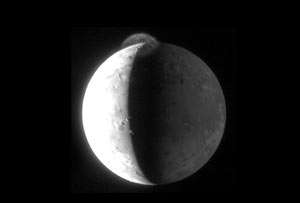
NASA's New Horizons spacecraft provided a new bird's-eye view of the dynamic Jupiter system as it traveled through the planet's orbit on Feb. 28.
New Horizons used Jupiter's gravity to boost its speed and shave three years off its trip to Pluto. Although the eighth spacecraft to visit Jupiter, New Horizons' combination of trajectory, timing and technology allowed it to explore details never before observed.
The spacecraft revealed lightning near the Jupiter's poles, the life cycle of fresh ammonia clouds, boulder-size clumps speeding through the planet's faint rings, the structure inside volcanic eruptions on its moon Io, and the path of charged particles traversing the previously unexplored length of the planet's long, magnetic tail.
"The Jupiter encounter was successful beyond our wildest dreams," said Alan Stern, principal investigator for the New Horizons mission, NASA Headquarters, Washington. "Not only did it prove our spacecraft and put it on course to reach Pluto in 2015, it was a chance for us to take sophisticated instruments to places in the Jovian system where other spacecraft could not go. It returned important data that adds tremendously to our understanding of the solar system's largest planet and its moons, rings and atmosphere."
The New Horizons team presented its latest, most detailed analyses of those data Tuesday at the American Astronomical Society's Division for Planetary Sciences meeting in Orlando, Fla. Results also will appear in a special section of the Oct. 12 issue of the journal Science.
From January through June, New Horizons' seven science instruments made more than 700 separate observations of the Jovian system. Jupiter's weather was high on the list, as New Horizons' visible light, infrared and ultraviolet remote-sensing instruments probed the planet's atmosphere for data on cloud structure and composition.
Instruments saw clouds form from ammonia welling up from the lower atmosphere. Heat-induced lighting strikes in the polar regions also were observed. This was the first polar lighting ever seen beyond Earth, demonstrating that heat moves through water clouds at virtually all latitudes across Jupiter.
New Horizons made the most-detailed size and speed measurements yet of "waves" that run the width of the planet and indicate violent storm activity below. Additionally, New Horizons snapped the first close-up images of the Little Red Spot, gathering new information on storm dynamics. The spot is a nascent storm about half the size of Jupiter's larger Great Red Spot, or about 70 percent of Earth's diameter.
The spacecraft captured the clearest images to date of the tenuous Jovian ring system, showing clumps of debris that may indicate a recent impact inside the rings or some more exotic phenomenon. Movies made from New Horizons images offer an unprecedented look at ring dynamics, showing the tiny inner moons Metis and Adrastea shepherding the materials around the rings. A search for smaller moons inside the rings, and possible new sources of the dusty material, found no bodies wider than a mile.
The mission's investigations of Jupiter's four largest moons focused on Io, the closest to Jupiter, which has active volcanoes that blast tons of material into the Jovian magnetosphere and beyond. New Horizons spied 11 different volcanic plumes of varying size, three of which were seen for the first time. One, a spectacular 200-mile-high eruption rising above the volcano Tvashtar, provided a unique opportunity to trace plume structure and motion. New Horizons' global map of Io's surface confirms the moon's status as the solar system's most active body, showing more than 20 geological changes since the Galileo Jupiter orbiter provided the last close-up look in 2001.
New Horizons' flight down Jupiter's magnetic tail offered a look at the vast region dominated by the planet's strong magnetic field. Specifically observing the fluxes of charged particles that flow hundreds of millions of miles beyond the giant planet, spacecraft particle detectors saw evidence that tons of material from Io's volcanoes move down the tail in large, dense, slow-moving blobs.
Source: NASA


