Astronomers Find Dust in the Wind of Black Holes
October 9, 2007 Astronomers Find Dust in the Wind of Black Holes

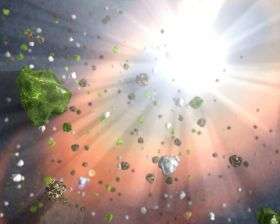
Artist concept of dusty grains being blown in the winds of a quasar. Image credit: NASA/JPL-Caltech

The hit song that proclaimed, "All we are is dust in the wind," may have some cosmic truth to it. New findings from NASA's Spitzer Space Telescope suggest that space dust – the same stuff that makes up living creatures and planets – was manufactured in large quantities in the winds of black holes that populated our early universe.

The findings are a significant new clue in an unsolved mystery: where did all the dust in the young universe originate?
Astronomers Find Dust in the Wind of Black Holes

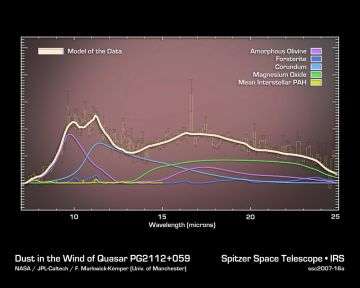
Plot of data captured by NASA's Spitzer Space Telescope. Image credit: NASA/JPL-Caltech/University of Manchester

"We were surprised to find what appears to be freshly made dust entrained in the winds that blow away from supermassive black holes," said Ciska Markwick-Kemper of the University of Manchester, U.K. Markwick-Kemper is lead author of a new paper appearing in an upcoming issue of the Astrophysical Journal Letters. "This could explain where the dust came from that was needed to make the first generations of stars in the early universe."

Space dust is essential to the formation of planets, stars, galaxies and even life as we know it. The dust in our corner of the universe was piped out by dying stars that were once a lot like our sun. But, when the universe was less than a tenth of its present age of 13.7 billion years, sun-like stars hadn't been around long enough to die and make dust. So, what produced the precious substance back when the universe was just a toddler?

Theorists have long-postulated that short-lived, massive exploding stars, or supernovae, might be the source of this mysterious dust, while others have proposed that a type of energetic, growing supermassive black hole, called a quasar, could be a contributing factor. A quasar consists of a supermassive black hole surrounded by a dusty doughnut-shaped cloud that feeds it. Theoretically, dust could form in the outer portion of the winds that slowly blow away from this doughnut cloud.

"Quasars are like the Cookie Monster," said co-author Sarah Gallagher of the University of California at Los Angeles, who is currently a visiting astronomer at the University of Western Ontario, Canada. "They are messy eaters, and they can consume less matter than they spit out in the form of winds."

Nobody has found conclusive proof that either quasar winds or supernovae can create enough dust to explain what is observed in the early universe. Markwick-Kemper and her team decided to test the former theory and investigate a quasar, called PG2112+059, located in the center of a galaxy about 8 billion light-years way. Although this particular quasar is not located in the early universe, because it is closer, it is an easier target for addressing the question of whether quasars can make dust. The team used Spitzer's infrared spectrograph instrument to split apart infrared light from the quasar and look for signs of various minerals.

They found a mix of the ingredients that make up glass, sand, marble and even rubies and sapphires. While the mineral constituting glass was expected, the minerals for sand, marble and rubies were a surprise. Why? These minerals are not typically detected floating around galaxies, suggesting they could have been freshly formed in the winds rushing away from the quasar.

For instance, the ingredient that makes up sand, crystalline silicate, doesn't survive for long free-floating in space. Radiation from stars zaps the minerals back to an amorphous, glass-like state. The presence of crystalline silicate therefore suggests something – possibly the quasars winds – is churning out the newly made substance.

Markwick-Kemper and her team say the case of the missing dust is not firmly shut. They hope to study more quasars for further evidence of their dust-making abilities. Also, according to the astronomers, quasars may not be the only source of dust in the early universe. "Supernovae might have been more important for creating dust in some environments, while quasars were more important in others," said Markwick-Kemper. "For now, we are very excited to have identified the different species of dust in a quasar billions of light-years away."

Source: NASA


print this article email this article download pdf blog this article bookmark this article     Stumble it Digg this share on Facebook retweet share on Reddit add to delicious
Rate this story - 4.4 /5 (22 votes)

Rank Filter

Move the slider to adjust rank threshold, so that you can hide some of the comments.


Display comments: newest first

  • Ragtime - Oct 09, 2007
    • Rank: not rated yet
    The formation of freshly made dust entrained in the winds that blow away from supermassive black holes is not very surprising, 'cause this dust is generated by these quasars itself! These quasars are emanating the radiation, which materialize whenever the intensity of gravitational field decrease by sufficient way with distance. Literally speaking, the quasars are evaporating itself into radiation under formation of sparse matter cloud like the warm dropplet on the cold glass plate will become surrounded by droplets of condensed dew - it's quite common adiabatic process.

    This is because the condensation of matter from radiation is driven by dynamic equillibrium between intensity of gravitational field and the intensity of electromagnetic field of radiation. If we increase the density of gravitational field, the matter dissolves into radiation. If we increase the energy density of electromagnetic field, the radiation will condense back again, like the droplets in saturated vapor.

October 9, 2007 all stories

Comments: 1

4.4 /5 (22 votes)
  • Stumble this up

  • Digg this

  • share this

  • hide
  • Related Stories

  • Colors of Quasars Reveal a Dusty Universe
    created Feb 26, 2009 | popularity not rated yet | comments 0
  • Infant galaxies -- small and hyperactive
    created Feb 05, 2009 | popularity not rated yet | comments 0
  • Colossal black holes common in early universe
    created Oct 16, 2008 | popularity not rated yet | comments 0
  • Hubble Survey Finds Missing Matter, Probes Intergalactic Web
    created May 20, 2008 | popularity not rated yet | comments 0
  • Hidden Population of Powerful Black Holes Revealed in Large Sky Survey
    created Jan 09, 2008 | popularity not rated yet | comments 0


  • hide
  • Relevant PhysicsForums posts

  • The shape of our solar system's orbits.
    created Nov 07, 2009
  • Above or Below the Line of Nodes
    created Nov 07, 2009
  • Supernova vs. Nova?
    created Nov 07, 2009
  • Supernova's Gamma Rays and Comets
    created Nov 06, 2009
  • Our Moon
    created Nov 06, 2009
  • Question about a Carl Zeiss lens
    created Nov 05, 2009
  • More from Physics Forums - General Astronomy

Other News

Deep creep means milder, more frequent earthquakes along Southern California's San Jacinto fault

Deep creep means milder, more frequent earthquakes along Southern California's San Jacinto fault

Space & Earth / Earth Sciences

created 10 hours ago | popularity 4.7 / 5 (3) | comments 0

With an average of four mini-earthquakes per day, Southern California's San Jacinto fault constantly adjusts to make it a less likely candidate for a major earthquake than its quiet neighbor to the east, the ...


Success in 'space elevator' competition (AP)

Success in 'space elevator' competition (Update 3)

Space & Earth / Space Exploration

created Nov 05, 2009 | popularity 4.3 / 5 (33) | comments 50

(AP) -- A robot powered by a ground-based laser beam climbed a long cable dangling from a helicopter on Wednesday to qualify for prize money in a $2 million competition to test the potential reality of the ...


In a Galaxy Far, Far Away...

In a Galaxy Far, Far Away...

Space & Earth / Astronomy

created Nov 06, 2009 | popularity 4.8 / 5 (5) | comments 15

(PhysOrg.com) -- Astronomers have published the discovery of the farthest known object in the cosmos: a star that exploded when the universe was only 630 million years old -- only 4.6% of its current age. ...


'Dropouts' pinpoint earliest galaxies

'Dropouts' pinpoint earliest galaxies

Space & Earth / Astronomy

created Nov 06, 2009 | popularity 4.2 / 5 (10) | comments 13

Astronomers, conducting the broadest survey to date of galaxies from about 800 million years after the Big Bang, have found 22 early galaxies and confirmed the age of one by its characteristic hydrogen signature ...


Space hotel taking bookings for 2012 opening

Space hotel taking bookings for 2012 opening

Space & Earth / Space Exploration

created Nov 05, 2009 | popularity 4.4 / 5 (20) | comments 11

(PhysOrg.com) -- The first orbiting space hotel is on track to open for its first customers in 2012, but hurry, as bookings are filling fast.