Herding aphids -- how 'farmer' ants keep control of their food
October 10, 2007 Herding aphids -- how 'farmer' ants keep control of their food

Chemicals on ants’ feet tranquilise and subdue colonies of aphids, keeping them close-by as a ready source of food, says new research published today. The study throws new light on the complex relationship between ants and the colonies of aphids whose sugary secretions the ants eat.

Scientists had previously established that certain types of aphids live in colonies where they are used as a food source by a neighbouring colony of ants. The ants have been known to bite the wings off the aphids in order to stop them from getting away and depriving the ants of one of their staple foods: the sugar-rich sticky honeydew which is excreted by aphids when they eat plants.

Chemicals produced in the glands of ants can also sabotage the growth of aphid wings. The new study shows, for the first time, that ants’ chemical footprints – which are already known to be used by ants to mark out their territory - also play a key role in manipulating the aphid colony, and keeping it nearby.

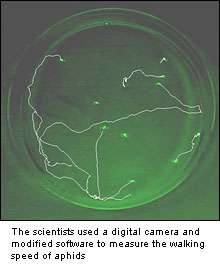
The research, which was carried out by a team from Imperial College London, Royal Holloway University of London, and the University of Reading, used a digital camera and specially modified software to measure the walking speed of aphids when they were placed on filter paper that had previously been walked over by ants. The data showed that the aphids’ movement was much slower when they were on paper that had been walked on by ants, than on plain paper.

Furthermore, when placed on a dead leaf, where the aphid’s instinct is to walk off in search of healthy leaves for food, the scientists found that the presence of ants significantly slowed the aphids’ dispersal from the leaf. Lead author Tom Oliver from Imperial’s Department of Life Sciences explains how ants could use this manipulation in a real-life scenario:

“We believe that ants could use the tranquillising chemicals in their footprints to maintain a populous ‘farm’ of aphids close their colony, to provide honeydew on tap. Ants have even been known to occasionally eat some of the aphids themselves, so subduing them in this way is obviously a great way to keep renewable honeydew and prey easily available.”

However, Tom points out that the relationship between the ants and the aphids might not be that straightforward: “There are some definite advantages for aphids being ‘farmed’ like this by ants for their honeydew. Ants have been documented attacking and fighting off ladybirds and other predators that have tried to eat their aphids. It’s possible that the aphids are using this chemical footprint as a way of staying within the protection of the ants.”

Professor Vincent Jansen of Royal Holloway’s School of Biological Sciences, concludes: “Although both parties benefit from the interaction, this research shows is that all is not well in the world of aphids and ants. The aphids are manipulated to their disadvantage: for aphids the ants are a dangerous liaison.”

Source: Imperial College London


print this article email this article download pdf blog this article bookmark this article     Stumble it Digg this share on Facebook retweet share on Reddit add to delicious
Rate this story - 3.3 /5 (4 votes)


October 10, 2007 all stories

Comments: 0

3.3 /5 (4 votes)
  • Stumble this up

  • Digg this

  • share this

  • hide
  • Related Stories

  • Study links success of invasive Argentine ants to diet shifts
    created Dec 18, 2007 | popularity not rated yet | comments 0
  • New insights into the physiology of cockroaches
    created Nov 13, 2009 | popularity not rated yet | comments 0
  • Day care next frontier in fighting kids' obesity
    created Oct 12, 2009 | popularity not rated yet | comments 0
  • How Social Insects Recognize Dead Nestmates
    created May 05, 2009 | popularity not rated yet | comments 0
  • Ants and Avalanches: Insects on Coffee Plants Follow Widespread Natural Tendency
    created Jan 23, 2008 | popularity not rated yet | comments 0


Other News

The six elephants in Sierra Leone were shot and "crudely butchered"

S.Leone elephants 'wiped out' by poachers: official

Biology / Ecology

created 14 hours ago | popularity 5 / 5 (4) | comments 5

Poachers "wiped out" the entire elephant herd in Sierra Leone's only wildlife park, wildlife managers said Thursday after police said they had arrested a gang of 10 poachers.


First-ever blueprint of a minimal cell is more complex than expected

First-ever blueprint of a minimal cell is more complex than expected

Biology / Cell & Microbiology

created 12 hours ago | popularity 5 / 5 (14) | comments 1

What are the bare essentials of life, the indispensable ingredients required to produce a cell that can survive on its own? Can we describe the molecular anatomy of a cell, and understand how an entire organism ...


Ecological speciation by sexual selection on good genes: Is speciation adaptive?

Biology / Ecology

created 12 hours ago | popularity 5 / 5 (1) | comments 0

Darwin suggested that the action of natural selection can produce new species, but 150 years after the publication of his famous book, 'On the Origin of Species', debate still continues on the mechanisms of speciation. New ...


Whiteflies sabotage alarm system of plant in distress

Whiteflies sabotage alarm system of plant in distress

Biology / Plants & Animals

created 16 hours ago | popularity 5 / 5 (2) | comments 0

(PhysOrg.com) -- When spider mites attack a bean plant, the plant responds by producing odours which attract predatory mites. These predatory mites then exterminate the spider mite population, thus acting ...


Knockouts in human cells point to pathogenic targets

Knockouts in human cells point to pathogenic targets

Biology / Cell & Microbiology

created 16 hours ago | popularity not rated yet | comments 0

(PhysOrg.com) -- Whitehead researchers have developed a new approach for genetics in human cells and used this technique to identify specific genes and proteins required for pathogens.