Landmark modeling study reveals how ferroelectric computer memory works
October 10, 2007 Molecular Dynamics Simulations of Nucleation on 1806 Domain Walls

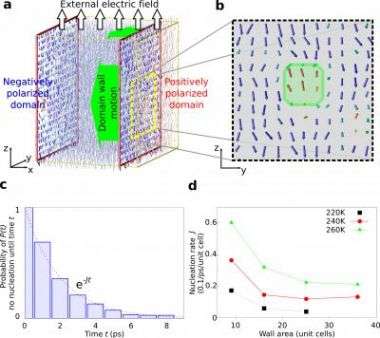
a) A snapshot of the polarization from an molecular dynamics simulation of PbTiO3 at 220 K and 0.5 MV cm21. The local polarization vectors are shown by the red and blue arrows. The two domain walls are outlined with red lines. b) A critical nucleus on the domain wall on the y–z plane. The green solid line shows the boundary of the critical nucleus. c) The fraction of the simulations exhibiting no nucleation by time t. The exponent of the fit function corresponds to the nucleation rate J. d) Size dependence of the nucleation rates on the (100) 180u domain wall. Credit: Nature and the University of Pennsyvlania

A collaboration of University of Pennsylvania chemists and engineers has performed multi-scale modeling of ferroelectric domain walls and provided a new theory of behavior for domain-wall motion, the “sliding wall” that separates ferroelectric domains and makes high-density ferroelectric RAM (FeRAM) possible.

The new theory, supported by a novel modeling study developed specifically for this research, confirms experimental data long at odds with existing theories of domain-wall behavior. Most notable is that, Penn’s simulations reproduced experimental domain growth rates and revealed small, square critical nuclei with a diffuse interface. Researchers also found that small dipoles play a key role in smoothing the transition between up and down regions as the wall moves.

Scaling up, they created a model of how millions of atoms in ferroelectric material respond collectively to a domain wall, extending their theoretical view to the micron and millisecond.

“Now that we know how domain walls in FeRAM move, we can use this understanding to design higher speed and higher density memory materials,” Andrew M. Rappe, professor of chemistry in the Makineni Theoretical Laboratories at Penn, said.

According to the study, the speed at which memory can be saved and erased on this material, called domain-wall velocity, is faster than previously thought. Also, the activation barrier of the material, the energy needed to save or erase memory, is lower than previously thought. Both findings are good news for the future of computer memory using ferroelectric material.

Rappe joined engineers at Penn’s Laboratory for Research on the Structure of Matter to develop the new model of domain-wall behavior. The team started with first principles calculations, the concept that all material properties derive from interactions between electrons and are therefore described by the laws of quantum physics. Later, using Newton’s atomistic molecular dynamics and coarse-grained Monte Carlo simulations — a computational algorithm that simulates the behavior of complex systems with the assistance of random numbers — researchers arrived at the new multi-scale model.

The motion of domain walls is critical to many applications involving ferroelectric materials, such as fast, high-density non-volatile random access memory. In memories of this kind, storing a data bit means increasing the size of one polar region at the expense of another, hence shifting the movement of the domain wall that separates these regions. A better understanding of its behavior may lead to faster, higher-density forms of memory.

Experimental measurements of domain growth rates in PbTiO3 and BaTiO3 have been performed, but the development of new materials has been hampered by a lack of microscopic understanding of how domain walls move. Despite some success in interpreting domain-wall motion in terms of classical nucleation and growth models, these models were formulated without insight from first-principles-based calculations and they portray a large, triangular nucleus with unrealistically large depolarization and nucleation energies, inhibiting practical applications of the materials that save and erase memory.

At Penn, two vital steps in the domain wall motion process were studied: nucleation, when the first part of each plane is flipped, and growth, when the nuclei spread out. Researchers performed finite-size scaling to extract the true nucleation rate from varying system size simulations and extracted the temperature and electric field dependence of the domain wall dynamics.

The study appears online in the journal Nature and in the Oct. 18 print edition.

Source: University of Pennsylvania


print this article email this article download pdf blog this article bookmark this article     Stumble it Digg this share on Facebook retweet share on Reddit add to delicious
Rate this story - 4.7 /5 (20 votes)

Rank Filter

Move the slider to adjust rank threshold, so that you can hide some of the comments.


Display comments: newest first


October 10, 2007 all stories

Comments: 1

4.7 /5 (20 votes)
  • Stumble this up

  • Digg this

  • share this

  • hide
  • Related Stories

  • Electric Switches Hold Promise for Data Storage
    created May 22, 2009 | popularity not rated yet | comments 0
  • Domain walls that conduct electricity
    created Jan 29, 2009 | popularity not rated yet | comments 0
  • Researchers Resolve 40-Year Dispute Over Disappearing Physical Property
    created Oct 21, 2008 | popularity not rated yet | comments 0
  • Shimmering ferroelectric domains
    created Jul 18, 2008 | popularity not rated yet | comments 0
  • Electromechanical imaging in liquid environments: a pathway toward molecular-level resolution of biological systems
    created Jul 01, 2006 | popularity not rated yet | comments 0


  • hide
  • Relevant PhysicsForums posts

  • Need Book Recommendation
    created 1hour ago
  • Rocket Experiment Help
    created 4 hours ago
  • Coulomb's Law
    created 8 hours ago
  • Laser spots
    created 13 hours ago
  • More from Physics Forums - General Physics

Other News

Aquatic creatures mix ocean water

Physics / General Physics

created 14 hours ago | popularity 5 / 5 (3) | comments 0

Understanding mixing in the ocean is of fundamental importance to modeling climate change or predicting the effects of an El Niño on our weather. Modern ocean models primarily incorporate the effects of winds and tides. However, ...


Generating electricity from air flow

Physics / General Physics

created 17 hours ago | popularity 3.9 / 5 (8) | comments 2

A group of researchers at the City College of New York is developing a new way to generate power for planes and automobiles based on materials known as piezoelectrics, which convert the kinetic energy of motion into electricity. ...


Nuclear weapons: Predicting the unthinkable

Physics / General Physics

created 17 hours ago | popularity 2.3 / 5 (4) | comments 1

If a nuclear weapon were detonated in a metropolitan area, how large would the affected area be? Where should first responders first go? According to physicist Fernando Grinstein, we have some initial understanding to address ...


Butterfly proboscis to sip cells

Physics / General Physics

created 15 hours ago | popularity not rated yet | comments 0

A butterfly's proboscis looks like a straw -- long, slender, and used for sipping -- but it works more like a paper towel, according to Konstantin Kornev of Clemson University. He hopes to borrow the tricks of this piece ...


Restored machine to explore mysteries of Big Bang (AP)

Restored machine to explore mysteries of Big Bang

Physics / General Physics

created Nov 21, 2009 | popularity 4.6 / 5 (18) | comments 19

(AP) -- Scientists are preparing the world's largest atom smasher to explore the depths of matter after successfully restarting the $10 billion machine following more than a year of repairs.