New membrane strips carbon dioxide from natural gas faster and better
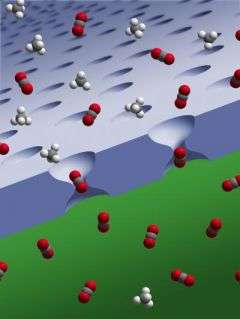
A modified plastic material greatly improves the ability to separate global warming-linked carbon dioxide from natural gas as the gas is prepared for use, according to engineers at The University of Texas at Austin who have analyzed the new plastic’s performance.
Like a sponge that only soaks up certain chemicals, the new plastic permits carbon dioxide or other small molecules to go through hour-glass shaped pores within it, while impeding natural gas (methane) movement through these same pores. The thermally rearranged (TR) plastic works four times better than conventional membranes at separating out carbon dioxide through pores.
Dr. Ho Bum Park, a postdoctoral student in the laboratory of Professor Benny Freeman, also found that TR plastic membranes act quicker. They permit carbon dioxide to move through them a few hundred times faster than conventional membranes do – even as they prohibit natural gas and most other substances from traveling through their pores for separation purposes.
“If this material was used instead of conventional cellulose acetate membranes, processing plants would require 500 times less space to process natural gas for use because of the membranes’ more efficient separation capabilities, and would lose less natural gas in their waste products,” said Freeman, noting that, pound for pound, natural gas has a worse global warming impact on the atmosphere than carbon dioxide.
When developed for commercial use, the plastic could also be used to isolate natural gas from decomposing garbage, the focus of several experimental projects nationally. The TR plastic described in tomorrow’s issue of Science could also help recapture carbon dioxide being pumped into oil reservoirs in West Texas and elsewhere, where it serves as a tool for removing residual oil.
Freeman is a co-author on the Science article about the research. He holds the Kenneth A. Kobe Professorship and Paul D. and Betty Robertson Meek & American Petrofina Foundation Centennial Professorship of Chemical Engineering. Elizabeth Van Wagner, a graduate student in chemical engineering, also is a co-author in Austin.
Park, lead author of the article, initially engineered the membrane while at Hanyang University in Korea. As a research assistant in the lab of Professor Young Moo Lee, Park investigated whether plastics made of rings of carbon and certain other elements could work well at separating carbon dioxide out of gas wastes produced by power plants. Separating the greenhouse gas from other gases at power plants must occur at high temperatures, which usually destroy plastic membranes.
Lee and Park not only found that the TR plastic could handle temperatures above 600 degrees Fahrenheit, but that the heat transformed the material into the better performing membrane described in Science. That membrane breaks a performance barrier thought to affect all plastic membranes.
“I didn’t expect that the TR plastic would work better than any other plastic membranes because thermally stable plastics usually have very low gas transport rates through them,” Park said. “Everyone had thought the performance barrier for plastic membranes could not be surpassed.”
Park joined Freeman’s laboratory in Austin because of the professor’s expertise in evaluating membranes. Park then verified that the TR plastic separated carbon dioxide and natural gas well. Natural gas that is transported in pipelines can only contain 2 percent carbon dioxide, yet often comes out of the ground with higher levels of the gas, requiring this separation step.
“This membrane has enormous potential to transform natural gas processing plants,” Freeman said, “including offshore platforms, which are especially crunched for space.”
To better understand how the plastic works, Dr. Anita Hill and her group at Australia’s national science agency analyzed the material using positron annihilation lifetime spectroscopy. The method used at the Commonwealth Scientific and Industrial Research Organization suggested the hour-glass shape of the pores within the plastic, which are much more consistent in size than in most plastics.
The pores appear and disappear depending on how often the chains of chemicals that make up the plastic move.
“The plastic chains move, and as they do, they open up gaps that allow certain gas molecules to wiggle through the plastic,” Freeman said.
Freeman and Park intend to learn more about how these mobile pores behave as they develop the TR plastic for commercial purposes.
Park said, “These membranes also show the ability to transport ions since they are doped with acid molecules, and therefore could be developed as fuel cell membranes. However, a lot of research still needs to be done to understand gas and ion transport through these membranes.”
Source: University of Texas at Austin


