NIST Light Source Illuminates Fusion Power Diagnostics
October 11, 2007
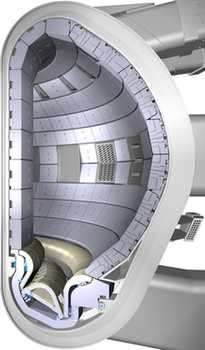
Engineering design image shows a cross-section of part of the planned ITER fusion reaction vessel. Diverter section (pale gray elements at the bottom) are sheathed in tungsten. Credit: Published with permission of ITER
Using a device that can turn a tiny piece of laboratory space into an ion cloud as hot as those found in a nuclear fusion reactor, physicists at the National Institute of Standards and Technology are helping to develop one of the most exotic “yardsticks” on earth, an instrument to monitor conditions in the plasma of an experimental fusion reactor. Their measurement tool also is used in incandescent light bulbs–it’s the element tungsten.
The intended beneficiary of this research is ITER, a multinational project to build the world’s most advanced fusion test reactor. ITER, now under construction in Cadarache, France, will operate at high power in near-steady-state conditions, incorporate essential fusion energy technologies and demonstrate safe operation of a fusion power system.
It will be a tokamak machine, in which a hot—250 million degrees Celsius—plasma of hydrogen isotope ions, magnetically confined in a huge toroidal shape, will fuse to form helium nuclei and generate considerable amounts of energy, much the same way energy is generated in the sun.
One major issue is how to measure accurately the temperature and density of the plasma, both of which must reach critical values to maintain the fusion process. Any conventional instrument would be incinerated almost instantly. The usual solution would be to use spectroscopy: monitor the amount and wavelengths of light emitted by the process to deduce the state of the plasma. But light comes from electrons as they change their energies, and at tokamak temperatures the hydrogen and helium nuclei are completely ionized—no electrons left.
The answer is to look at a heavier element, one not completely ionized at 250 million degrees, and the handy one is tungsten. The metal with the highest melting point, tungsten is used for critical structures in the walls of the tokamak torus, so some tungsten atoms always are present in the plasma.
To gather accurate data on the spectrum of highly ionized tungsten, as it would be in the tokamak, NIST physicists use an electron beam ion trap (EBIT), a laboratory instrument which uses a tightly focused electron beam to create, trap and probe highly charged ions. An ion sample in the EBIT is tiny—a glowing thread about the width of a human hair and two to three centimeters long—but within that area the EBIT can produce particle collisions with similar energies to those that occur in a fusion plasma or a star.
In a pair of papers, the NIST researchers uncovered previously unrecognized features of the tungsten spectrum, effects only seen at the extreme temperatures that produce highly charged ions. The NIST team has reported several previously unknown spectral lines for tungsten atoms with 39 to 47 of their 74 electrons removed. One particularly significant discovery was that an anomalously strong spectral line that appears at about the energies of an ITER tokamak is in fact a superposition of two different lines that result from electron interactions that, under more conventional plasma conditions, are too insignificant to show up.
Team member John Gillaspy observes, “That’s part of the fascination of these highly charged ions. Things become very strange and bizarre. Things that are normally weak become amplified, and some of the rules of thumb and scaling laws that you learned in graduate school break down when you get into this regime.” The team has proposed a possible new fusion plasma diagnostic based on their measurements of the superimposed lines and supporting theoretical and computational analyses.
Follow this link to read more on the NIST EBIT facility: http://physics.nis … IT/ebit.html
Citations: Yu. Ralchenko. Density dependence of the forbidden lines in Ni-like tungsten. J. Phys. B: At. Mol. Opt. Phys. 40 (2007) F175-F180
Yu. Ralchenko, J. Reader, J.M. Pomeroy, J.N. Tan and J.D. Gillaspy. Spectra of W(39+)-W(47+) in the 12-20 nm region observed with an EBIT light source. J. Phys. B: At. Mol. Opt.Phys. 40 (2007) 3861-3875.
Source: NIST
-
Engineers build first sub-10-nm carbon nanotube transistor
Feb 01, 2012 |
4.9 / 5 (32) |
30
-
Something old, something new: Evolution and the structural divergence of duplicate genes
Jan 31, 2012 |
4.6 / 5 (7) |
1
-
The hidden nanoworld of ice crystals: Revealing the dynamic behavior of quasi-liquid layers
Jan 30, 2012 |
5 / 5 (4) |
1
-
Stock market network reveals investor clustering
Jan 27, 2012 |
3.9 / 5 (23) |
8
-
Of microchemistry and molecules: Electronic microfluidic device synthesizes biocompatible probes
Jan 26, 2012 |
5 / 5 (2) |
0
-
What would happen when a jet travelling at Mach 10 experiences engine failure
5 hours ago
-
Rust from my microwave ruined a nice bowl of soup and also my day
7 hours ago
-
gas leaks in space
10 hours ago
-
Weight required to balance a boom stand?
12 hours ago
-
Questions about Equivalence principle & Einstein Elevator?
13 hours ago
-
Kinetic energy of gas
15 hours ago
- More from Physics Forums - General Physics
More news stories
Explained: Sigma
It's a question that arises with virtually every major new finding in science or medicine: What makes a result reliable enough to be taken seriously? The answer has to do with statistical significance -- but ...
Feb 09, 2012 |
5 / 5 (19) |
76
Quantum physicist explains $100K offer for proof scaled-up quantum computing is impossible
(PhysOrg.com) -- MIT researcher Scott Aaronson has certainly riled the physics community with his offer this past Friday, of $100,000 to anyone who can prove that scaled-up quantum computing is impossible. ...
Diamond light, brighter than the sun
Its the size of five football pitches and generates light 10 billion times brighter than the sun. As the Diamond Light Source celebrates its tenth anniversary this year, Penny Bailey visits one of the ...
Feb 07, 2012 |
4.4 / 5 (9) |
18
|
Physicists 'record' magnetic breakthrough
An international team of scientists has demonstrated a revolutionary new way of magnetic recording which will allow information to be processed hundreds of times faster than by current hard drive technology.
Feb 07, 2012 |
4.6 / 5 (43) |
14
|
Hints of the Higgs - papers are submitted
Back in December 2011, the ATLAS and CMS experiments at CERN presented some exciting results that provided tantalising hints of the Higgs boson.
Feb 08, 2012 |
4.3 / 5 (8) |
10
Scientists discover molecular secrets of 2,000-year-old Chinese herbal remedy
For roughly two thousand years, Chinese herbalists have treated Malaria using a root extract, commonly known as Chang Shan, from a type of hydrangea that grows in Tibet and Nepal. More recent studies suggest that halofuginone, ...
New method to examine batteries -- MRI from the inside
There is an ever-increasing need for advanced batteries for portable electronics, such as phones, cameras, and music players, but also to power electric vehicles and to facilitate the distribution and storage of energy derived ...
A mitosis mystery solved: How chromosomes align perfectly in a dividing cell
Although the process of mitotic cell division has been studied intensely for more than 50 years, Whitehead Institute researchers have only now solved the mystery of how cells correctly align their chromosomes during symmetric ...
Starve a virus, feed a cure? Findings show how some cells protect themselves against HIV
A protein that protects some of our immune cells from the most common and virulent form of HIV works by starving the virus of the molecular building blocks that it needs to replicate, according to research published online ...
Researchers find extensive RNA editing in human transcriptome
In a new study published online in Nature Biotechnology, researchers from BGI, the world's largest genomics organization, reported the evidence of extensive RNA editing in a human cell line by analysis of RNA-seq data, demons ...
The proteins ensuring genome protection
Researchers from the University of Geneva (UNIGE), Switzerland, have discovered the crucial role of two proteins in developing a cell 'anti-enzyme shield'. This protection system, which operates at the level of molecular ...