Astronomers find most powerful supernova
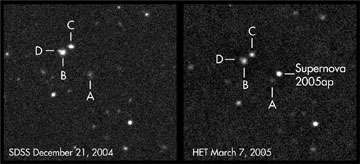
Astronomer Robert Quimby has again found the most luminous supernova. Quimby discovered the current record holder, supernova 2006gy, last year as part of his Texas Supernova Search project. Now he has announced that a supernova he has discovered earlier in the project is actually twice as luminous. Using follow-up studies to pinpoint its distance, supernova 2005ap peaked at more than 100 billion times the brightness of the Sun.
The result has been accepted for publication in the Oct. 20 edition of The Astrophysical Journal Letters.
This supernova is a Type II, Quimby said, because it contains hydrogen. Most Type II supernovae are thought to result when the cores of massive stars, those seven to eight times or more heavy than the Sun, collapse under their own weight and trigger an explosion. This particular Type II is 300 times brighter than average, Quimby said, and lies in a dwarf galaxy in the constellation Coma Berenices, well behind the famous Coma cluster of galaxies.
"It's clearly not the same as 2006gy," Quimby's colleague and supernova expert J. Craig Wheeler of The University of Texas at Austin said. "It's a puzzle."
Quimby completed his Ph.D. under Wheeler's supervision at Texas in May, and has just begun a post-doctoral appointment at the California Institute of Technology. His Texas Supernova Search uses the 18-inch ROTSE-IIIb robotic telescope on McDonald Observatory's Mount Fowlkes, a tiny neighbor to the giant 10-meter-class Hobby-Eberly Telescope (HET).
Quimby studied 2005ap with HET just a few days after its discovery. The results were intriguing, Quimby said. The supernova's spectrum hinted at the presence of a highly shifted absorption line of oxygen III (an oxygen atom that has lost two of its electrons). Quimby knew that if the feature was oxygen III, then 2005ap was "possibly very far away and thus very luminous."
Follow-up observations with the Keck Telescope in Hawaii by Quimby's colleague Greg Aldering of Lawrence Berkeley National Lab not only confirmed Quimby's HET detection of oxygen III, but added another, equally shifted element to the spectrum: magnesium.
Together, the studies confirmed 2005ap's distance of 4.7 billion light-years. (In astronomical terms, this equates to a redshift of z = 0.2832.)
It was this distance measurement, combined with measurements of the supernova's apparent brightness that allowed the calculation of its intrinsic brightness, or "luminosity," and uncovered 2005ap as the most powerful supernova yet.
"Before 2006gy, I thought this should not be plausible," Quimby said. "There I was finding my first supernovae—I was just happy to get anything. It turned out to be the most luminous supernova ever found."
How is that Quimby has found the brightest supernova yet, twice in a row?
"I've worked too damn hard for this to be luck," he said. "I'm searching a huge volume of space, comparable to all previous nearby supernova surveys combined."
Also, Quimby will find supernovae that other studies ignore: he doesn't filter out non-Type Ia supernovae, as do many studies that are searching for supernovae for cosmology studies, and he searches dwarf galaxies as well as galaxies with active black holes at their centers, which other studies avoid. Others also avoid supernovae near the cores of galaxies.
In fact, 2006gy was found in the core of a galaxy, and that galaxy has a weakly active central black hole, Wheeler said.
"There's no question that [his results] have gotten everybody's attention," Wheeler said.
The University of Michigan-run ROTSE collaboration, whose main mission is the search for gamma-ray bursts, has decided to expand the supernova search to its entire network. Its robotic telescopes in Australia, Turkey and Namibia will soon join the unit at McDonald Observatory in this search. The Sloan Digital Sky Survey Supernova Search, for which the HET provides confirming spectra, is also reconsidering its search filters in response to these discoveries, Wheeler said.
Source: University of Texas at Austin


