IBM scientists demonstrate single-atom magnetic measurements
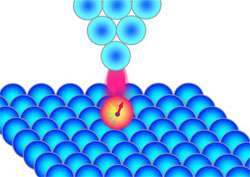
IBM scientists have measured a fundamental magnetic property of a single atom -- the energy required to flip its magnetic orientation. This is the first result by a promising new technique they developed to study the properties of nanometer-scale magnetic structures that are expected to revolutionize future information technologies. From spintronics to quantum computing, a large number of dramatically new ideas for electronic, computing and data storage devices are emerging to exploit the remarkable properties resulting from the magnetic orientations of electrons and atoms.
To engineer the anticipated nanoscale features of these new types of circuits, we will need fundamental knowledge of the magnetic properties of small numbers of atoms in various environments," said Andreas Heinrich, research staff member at IBM's Almaden Research Center in San Jose, California. "Our new technique provides this information in much more detail and precision than had been possible before."
Spintronics is an emerging class of new electronic circuits that exploit the magnetic orientation of electrons and atoms -- a quantum property called "spin." An electron's spin has two possible conditions, either "up" or "down." Aligning spins in a material creates magnetism. Most materials are non-magnetic because they have equal numbers of up and down electron spins, which cancel each other. But materials such as iron, or cobalt have an unequal numbers of up and down electron spins and are magnetic. In their new result, the IBM researchers measured the energy required to flip the spin of a single manganese atom from "up" to "down."
This result is published in a paper by Heinrich and colleagues Jay A. Gupta, Christopher P. Lutz and Donald M. Eigler that appears in the September 9 issue of Science Express, the web edition of the scientific journal Science, published by the American Association for the Advancement of Science. (Gupta is now an assistant professor at Ohio State University.)
Technical details
The new technique is a magnetic version of "inelastic electron tunneling spectroscopy" that the IBM scientists call "single-atom spin-flip spectroscopy." To use it, the scientists first place a magnetic atom on a surface and use a strong magnetic field to orient its spin. Next, they position a non-magnetic tip of a scanning tunneling microscope (STM) above the atom being studied. By applying a voltage to the tip, electrons are made to flow, or "tunnel," from the tip to the magnetic atom.
Most of the time, the electrons pass right through the atom. However, if the voltage is great enough, some electrons can transfer energy to the atom, causing a spin flip and the flow of electrons to increase. By measuring the voltage at which the electron flow begins to increase, the scientists can determine the energy required to flip the spin.
The experiments are conducted within a vacuum and at very low temperature -- less than one degree Kelvin -- to achieve enough resolution to measure the very small energy required to flip the single spin of a lone manganese atom. resolution to measure the very small energy required to flip the single spin of a lone manganese atom. They found the energy, which varies somewhat with the strength of the orienting magnetic field, to be about 0.0005 electron-volts -- some 10,000 times less than the energy of a single molecular hydrogen bond.
IBM's technique is so sensitive that the scientist learned that it takes 6 percent more energy to flip the spin of atoms positioned near the edge of an insulating patch on the surface than for atoms in the middle of the patch. Such detail will be valuable in understanding and engineering the properties of future nanoscale spintronic devices.
Upcoming experiments will explore how magnetic properties change when atoms are brought together into small groups and in different geometries.
Background
This announcement is the latest in a series of achievements in nanoscale science by IBM Fellow Don Eigler and colleagues. Over the past 15 years, Eigler has led a group of young scientists who have pioneered the use of atom manipulation in wide-ranging experiments aimed at building and understanding of the properties of atomic-scale structures and exploring their potential for use in information technologies such as digital logic and data storage. The group's results include:
Positioning individual atoms on surfaces,
Inventing an electrical switch with a single atom as the active element,
Building molecules one atom at a time,
Discovering that magnetic impurity atoms alter the electronic structure of superconductors over a surprisingly short range,
Measuring for the first time how electrical conductance through single- and double-atom wires varies with chemical element,
Demonstrating the ability to image electron density waves on metal surfaces,
Inventing a new kind of electron trap called a "quantum corral,"
Discovering the "quantum mirage" effect, in which an electron's quantum wave pattern is used to project information, and
Demonstrating a complete functional computational circuit based on the "molecule cascade" motion of individual molecules that is 260,000 times smaller than that which could be made by the best contemporary chip-making methods.
Source: IBM


