Wanted: the right wall material for ITER
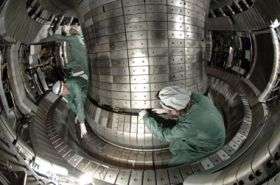
ASDEX Upgrade at Max Planck Institute of Plasma Physics (IPP) in Garching, Germany, recently became the world's first and only device allowing experiments with a wall completely clad with metal, viz. tungsten. The results are highly promising: Tungsten as wall material could also afford an attractive solution for the ITER international fusion experiment.
The objective of IPP is to develop a power plant that, like the sun, derives energy from fusion of atomic nuclei. Its feasibility is to be demonstrated by the ITER (Latin for "the way") international experimental reactor with a fusion power of 500 megawatts. Construction will start next year at Cadarache in France. The aim here is to confine the fuel – an ionised low-density hydrogen gas, a "plasma" – in a magnetic field cage without letting it touch the wall and then heat it to ignition temperatures of over 100 million degrees. One of the major challenges involved is to achieve tolerable interaction between the hot plasma and the wall of the enclosing vessel.
The problem here is that high-energy plasma particles can dislodge atoms from the wall, which then penetrate the plasma and contaminate it. Unlike the light hydrogen, the heavy atoms from the wall are not completely ionised, even at the high fusion temperatures needed. The more electrons that are still bound to the atomic nuclei, the more energy they extract from plasma, emitting it then as ultraviolet or X-ray light. In this way they cool the plasma and rarefy it, thus reducing the fusion yield. Whereas light impurities in concentrations of a few per cent are still tolerable, the limit for heavy impurities such as iron or chromium are much lower. Present-day devices therefore all use light materials for the wall, such as beryllium or carbon. These two are also envisaged for the wall of the ITER test reactor.
For ITER, however, beryllium and carbon are no longer without problems: Sputtering of these when bombarded with hydrogen is relatively high. The high hydrogen fluxes from the large ITER plasma would therefore cause severe material erosion. Furthermore, hydrogen particles readily accumulate in carbon, and in ITER so also does its radioactive version, tritium, this being highly undesirable for safety reasons. A wall completely clad with tungsten would obviate these problems with light elements: Tungsten affords advantageous thermal properties, low sputtering caused by hydrogen, and no long-term accumulation of tritium. This leaves the critical question how many of the heavy tungsten particles can penetrate to the core of the plasma. Recent estimates for ITER indicate that it may not be more than a few hundred thousandths.
The pioneer in testing tungsten as wall material is the ASDEX Upgrade experiment at Garching.
Despite bad experience in other laboratories, IPP started in 1996 to apply tungsten to special areas of the wall otherwise completely clad with carbon tiles. This relied on the differently chosen, ITER-like, i.e. cold plasma edge of ASDEX Upgrade. The positive result prompted a further reduction of carbon. The aim was to check how this affected the plasma and its interaction with the tungsten components. In order not to jeopardise other research objectives, the tungsten surface was only successively enlarged. Reliably determining the particular tungsten concentration amassing in the plasma is not a simple matter, the less so when the emission losses are attributable not only to a single impurity. Once the necessary measuring methods were developed it was found, however, that even an extensive tungsten surface does not unduly affect the plasma of ASDEX Upgrade.
It remains to prove that even complete metal cladding of the vessel is compatible with the favourable plasma states wanted for ITER – such as the high-confinement regime developed at IPP. After the last carbon tiles had been replaced and all surfaces carefully cleaned, experiments were recently resumed with a purely tungsten wall. To ensure clean experimental conditions no resort was made to the otherwise standard pretreatment of the vessel with boron. In order to reduce losses due to impurity radiation, this process serves to coat the wall surfaces with a thin layer of boron by means of a glow discharge in a boron hydrogen gas. However, in ITER or a subsequent power plant this will no longer be possible.
ASDEX Upgrade has therefore also started without boronisation – and was successful: The tungsten concentration is below the critical threshhold and the desired favourable plasma states can be achieved with only slight loss of quality. Further investigation will aim at exactly checking the tungsten compatibility in ITER-relevant plasma states. The decisive issue will be whether permanently "good" high-confinement plasmas can be achieved without boronisation. For this work IPP has about two years – before the decision on the interior wall of ITER is taken.
Source: Max Planck Institute


