Cassini Mission to Saturn Celebrates 10 Years Since Launch
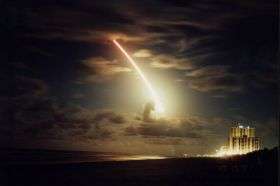
October 12, 2007 Cassini Mission to Saturn Celebrates 10 Years Since Launch

This picture of the Cassini launch was taken by Ken Sturgill of Marion, Virginia

Celebrating the 10th anniversary of its launch from Cape Canaveral, the Cassini-Huygens mission to Saturn is once again at the center of scientific attention. Its latest discoveries about the ringed planet are a leading topic of conversation among the nearly 1,500 scientists gathered this week at a major astronomy conference in Orlando, Fla.

Cassini rode into space Oct. 15, 1997, atop a U.S. Air Force Titan IVB. Its mission: to orbit and study the Saturnian system for four years and to put the European Space Agency's Huygens Probe in position to parachute down to the frozen surface of Saturn's Earthlike moon Titan. Since entering orbit around Saturn, Cassini's scientific instruments, powered by radioisotope thermoelectric generators, have returned immense amounts of new information via NASA's global Deep Space Network to the international team of scientists working on the mission.

Scientists aren't the only ones to benefit from Cassini's voyage of discovery. Since arriving at Saturn three-and-a-half years ago, Cassini's revelations have captured the public imagination. Its spectacular views of Saturn and its realm have graced the covers of magazines around the world.

"With Cassini, amazing discoveries have almost become routine," says Cassini project scientist Dennis Matson of NASA's Jet Propulsion Laboratory, Pasadena, Calif., where the international mission is managed.

"Orbiting Saturn, Cassini is in the middle of the greatest natural laboratory accessible to us in space," says Matson. "With its rings, dozens of moons and magnetic environment, Saturn is like a mini-solar system, with Saturn as a stand-in for the sun, and the moons and rings like planets in formation. Through Cassini and its instruments, we are making fundamental strides in understanding the physical processes that created and govern this and other solar systems."

Some of the discoveries include ice geysers shooting from Saturn's moon Enceladus and the finding that one of Saturn's rings is created from these ice particles. Recently, scientists found that material from Enceladus is also affecting the rotation of Saturn's magnetic field. And an onboard radar instrument, which sees through clouds, has been unveiling the fascinating world of Titan, the large moon with complex chemistry and lakes of hydrocarbons.

More information about the Cassini mission is available at http://www.nasa.gov/cassini and http://saturn.jpl.nasa.gov .

Source: NASA


print this article email this article download pdf blog this article bookmark this article     Stumble it Digg this share on Facebook retweet share on Reddit add to delicious
Rate this story - 4.7 /5 (3 votes)


October 12, 2007 all stories

Comments: 0

4.7 /5 (3 votes)
  • Stumble this up

  • Digg this

  • share this

  • hide
  • Related Stories

  • Fantastic Voyage
    created Nov 02, 2009 | popularity not rated yet | comments 0
  • A long night falls over Saturn's rings
    created Oct 24, 2009 | popularity not rated yet | comments 0
  • Scientists Explore Galactic Frontier, Release First-Ever All-Sky Map (w/ Video)
    created Oct 15, 2009 | popularity not rated yet | comments 0
  • A Hazy View of Early Earth
    created Oct 12, 2009 | popularity not rated yet | comments 0
  • Hot Debate over Icy Moon
    created Oct 08, 2009 | popularity not rated yet | comments 0


  • hide
  • Relevant PhysicsForums posts

  • The shape of our solar system's orbits.
    created Nov 07, 2009
  • Above or Below the Line of Nodes
    created Nov 07, 2009
  • Supernova vs. Nova?
    created Nov 07, 2009
  • Supernova's Gamma Rays and Comets
    created Nov 06, 2009
  • More from Physics Forums - General Astronomy

Other News

NASA satellites make a movie and get rainfall, wind info on Ida

NASA satellites make a movie and get rainfall, wind info on Ida (w/ Video)

Space & Earth / Earth Sciences

created 19 minutes ago | popularity not rated yet | comments 0

NASA satellites are amazing examples of technology. The TRMM satellite peers into tropical cyclones and can tell how much rain is falling per hour and where. QuikScat uses microwave technology to measure Ida's ...


L-R: Chiwetel Ejiofor, Amanda Peet and John Cusack at the premiere of "2012"

NASA on crusade to debunk 2012 apocalypse myths

Space & Earth / Space Exploration

created 8 minutes ago | popularity not rated yet | comments 0

The world is not coming to an end on December 21, 2012, the US space agency insisted Monday in a rare campaign to dispel widespread rumors fueled by the Internet and a new Hollywood movie.


NASA's TRMM Satellite sees most of Ida's heaviest rain stayed off coasts

NASA's TRMM Satellite sees most of Ida's heaviest rain stayed off coasts

Space & Earth / Earth Sciences

created 1hour ago | popularity not rated yet | comments 0

NASA and the Japanese Space Agency's Tropical Rainfall Measuring Mission (TRMM) satellite flew over Ida and captured her rainfall when she passed by Nicaragua, Honduras and Belize this weekend. TRMM data revealed ...


The GOES-12 satellite sees Large Hurricane Ida nearing landfall

The GOES-12 satellite sees Large Hurricane Ida nearing landfall

Space & Earth / Earth Sciences

created 1hour ago | popularity not rated yet | comments 0

Residents of the U.S. Gulf coast thought they were getting a break this hurricane season until Ida showed up. Today, November 9, Ida is a hurricane and is headed for a landfall in the western Florida Panhandle ...


Antarctica glacier retreat creates new carbon dioxide store

Antarctica glacier retreat creates new carbon dioxide store

Space & Earth / Earth Sciences

created 4 hours ago | popularity 5 / 5 (1) | comments 1

Large blooms of tiny marine plants called phytoplankton are flourishing in areas of open water left exposed by the recent and rapid melting of ice shelves and glaciers around the Antarctic Peninsula. This ...