Physicists Predict Stock Market Crashes
February 24, 2006
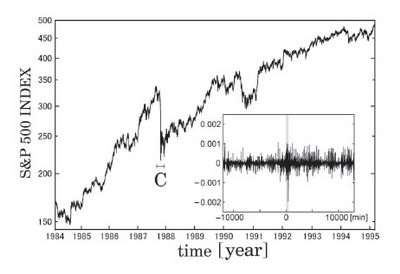
This graph shows the behavior of log returns in the S&P 500 index during 1984-1995. The inset shows the log returns on a 10-minute scale in region C (black Monday). The probability of large fluctuations at this time accompanies the onset of the crash. Source: Kiyono et al.
On Monday, October 19, 1987 – infamously known as “black Monday” – the Dow fell 508 points, or 22.9%, marking the largest crash in history. Using an analytical approach similar to the one applied to explore heart rate, physicists have discovered some unusual events preceding the crash. These findings may help economists in risk analysis and in predicting inevitable future crashes.
Although stock prices fluctuate, the variations across the overall market are relatively small, as well as similarly random (or “Gaussian”) on a large time scale. Nobody knows what causes the giant drops that result in market crashes, except that crashes involve a variety of factors.
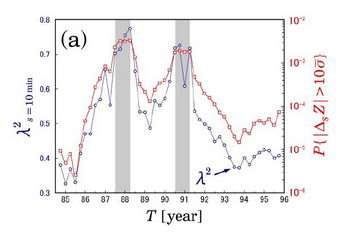
This graph shows the probability of 10-minute price variations during 1984-1995. The significant increase in 1987 resulted in black Monday, and the increase in 1990 did not result in a crash, likely because of the influence of the Iraq-Kuwait and Gulf wars causing sluggish stock activity. Source: Kiyono et al.
While analyzing stock-price fluctuations based on critical dynamics and phase transitions, physicists from the University of Tokyo (Kiyono et al.) have observed some surprising behavior preceding market crashes. During the year before black Monday, the team found that the probability of large price fluctuations increased unexpectedly (“non-Gaussian” behavior), as if approaching a critical point signifying a major change. At the critical point – or day of the crash – an abrupt phase transition did indeed occur as the probability model changed from being scale dependent to scale invariant. Scale invariance, which in this case meant that the prices no longer depended on the time scale, is characteristic behavior observed at a critical point.“Because the probability of the occurrence of extremely large fluctuations shows a sharp increase before black Monday…our observations suggest that, through the internal dynamics, the system gradually approaches a critical point where inherent, multi-scale fluctuations are likely to result in a crash,” said the scientists in a study published in a recent Physical Review Letters.
This “critical” model builds on the idea that the volatility, or variation, of price changes can quantitatively measure how much the market may fluctuate. In fact, volatility – not actual price – is the key input in Black and Scholes’ “option pricing” model on price variation over time, developed in 1973 and highly influential in financial markets.
However, volatility alone could not explain the occurrence of large price fluctuations found by Kiyono et al. The team also studied price changes on a short (10-minute) time scale, and discovered a probability of large fluctuations on this scale, as well. This similarity of fluctuations on different time scales resembles the behavior of earthquakes and heartbeats, which are also scale invariant. The physicists think that the small-scale stock price fluctuations may have caused highly clustered behavior of individual traders, which then grew rapidly through internal interactions in the stock market.
“If the same characteristics can be observed in other stock indices, our approach may be applicable to quantitative risk evaluation,” the scientists reported.
Does an increasing probability of price fluctuations necessarily mean a crash will occur? Not at all, since even the most statistically promising analysis cannot account for external factors. For example, the team observed extreme price fluctuations in log returns before 1990. However, because the Iraqi attack on Kuwait in August 1990 and the Gulf War in 1991 led to declining stock prices and action, the internal dynamics of the market underwent a radical change and a phase transition and critical point did not occur.
Citation: Kiyono, Ken, Struzik, Zbigniew R., and Yamamoto, Yoshiharu. Criticality and Phase Transition in Stock-Price Fluctuations. Physical Review Letters. 96, 068701 (2006)
By Lisa Zyga, Copyright 2006 PhysOrg.com
-
What investors have learned from the major earthquake
Sep 21, 2011 |
not rated yet |
1
-
Blueprint of a trend: How does a financial bubble burst?
May 02, 2011 |
not rated yet |
3
-
Measuring the distant universe in 3-D: BOSS proves it can do the job with quasars
May 01, 2011 |
5 / 5 (8) |
7
-
MIT class studies Kenyan slum's clinic quandary
Apr 27, 2011 |
5 / 5 (1) |
0
-
Biofuels without competing claims in Mozambique
Apr 26, 2011 |
not rated yet |
0
-
Engineers build first sub-10-nm carbon nanotube transistor
Feb 01, 2012 |
4.9 / 5 (30) |
30
-
Something old, something new: Evolution and the structural divergence of duplicate genes
Jan 31, 2012 |
4.6 / 5 (7) |
1
-
The hidden nanoworld of ice crystals: Revealing the dynamic behavior of quasi-liquid layers
Jan 30, 2012 |
5 / 5 (3) |
1
-
Stock market network reveals investor clustering
Jan 27, 2012 |
3.9 / 5 (23) |
8
-
Of microchemistry and molecules: Electronic microfluidic device synthesizes biocompatible probes
Jan 26, 2012 |
5 / 5 (1) |
0
More news stories
Explained: Sigma
It's a question that arises with virtually every major new finding in science or medicine: What makes a result reliable enough to be taken seriously? The answer has to do with statistical significance -- but ...
20 hours ago |
5 / 5 (12) |
30
Borexino Collaboration succeeds in spotting pep neutrinos emitted from the sun
(PhysOrg.com) -- To learn more about how the sun works, scientists study particles that are emitted from it into space due to thermonuclear reactions that occur inside; by applying known physics principles, ...
Physics research suggests new pathways for cancer progression
Observing that certain cancer cells may exhibit greater flexibility than normal cells, some scientists believe that this capability promotes rapid tumor growth. Now computer simulations developed by Boston University Biomedical ...
18 hours ago |
5 / 5 (1) |
0
Quantum physicist explains $100K offer for proof scaled-up quantum computing is impossible
(PhysOrg.com) -- MIT researcher Scott Aaronson has certainly riled the physics community with his offer this past Friday, of $100,000 to anyone who can prove that scaled-up quantum computing is impossible. ...
Physicists 'record' magnetic breakthrough
An international team of scientists has demonstrated a revolutionary new way of magnetic recording which will allow information to be processed hundreds of times faster than by current hard drive technology.
Feb 07, 2012 |
4.5 / 5 (39) |
14
|
'Dark plasmons' transmit energy
Microscopic channels of gold nanoparticles have the ability to transmit electromagnetic energy that starts as light and propagates via "dark plasmons," according to researchers at Rice University.
FDA-approved drug rapidly clears amyloid from the brain, reverses Alzheimer's symptoms in mice
Neuroscientists at Case Western Reserve University School of Medicine have made a dramatic breakthrough in their efforts to find a cure for Alzheimer's disease. The researchers' findings, published in the journal Science, show t ...
Hydrogen from acidic water: Researchers develop potential low cost alternative to platinum for splitting water
A technique for creating a new molecule that structurally and chemically replicates the active part of the widely used industrial catalyst molybdenite has been developed by researchers with the Lawrence Berkeley ...
Ultraviolet protection molecule in plants yields its secrets
Lying around in the sun all day is hazardous not just for humans but also for plants, which have no means of escape. Ultraviolet (UV) radiation from the sun can damage proteins and DNA inside cells, leading ...
Soraa LED light may dim 50-watt halogen rivals
(PhysOrg.com) -- Soraa, a Fremont, California company founded in 2008, this week launched its first product, a light that uses LEDS (light emitting diodes). The "Soraa LED MR16 lamp" is the "perfect" replacement ...
Anyone can learn to be more inventive, cognitive researcher says
There will always be a wild and unpredictable quality to creativity and invention, says Anthony McCaffrey, a cognitive psychology researcher at the University of Massachusetts Amherst, because an "Aha moment" is rare and ...