Testosterone turns male juncos into blustery hunks -- and bad dads
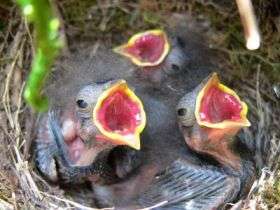
The ability to ramp up testosterone production appears to drive male dark-eyed juncos to find and win mates, but it comes with an evolutionary cost. Big fluctuations in testosterone may also cause males to lose interest in parenting their own young, scientists have learned.
In the December issue of The American Naturalist, Indiana University Bloomington, University of Virginia and University of Southern Mississippi researchers report the results of the first study to examine, in the wild, the way in which natural changes in testosterone levels determine how a male spends his time.
It's a new take on the subject. IUB biologist Ellen Ketterson and other researchers had thought it might be the total amount of testosterone in a male bird that determines his tendency toward aggression and monogamy. The latest findings suggest it's a bit more complicated. It's how much and how quickly his testosterone levels can rise and fall that determines whether he's the kind to stick around and feed his young. Males whose testosterone levels were more stable were more likely to invest more time and energy in parenting.
"This study is one of the first to show for a songbird living in the field under natural conditions that individual variation in the hormone testosterone maps onto variation in aggression and parental behavior," said Ketterson, senior author of the study. "Our data also suggest that there is more than one way to be successful at reproduction. Some males may seek mates at the expense of parental behavior, but other males are doing the opposite. They are being more parental at the expense of aggression. And apparently both ways of being in the world work."
Ketterson, lead author Joel McGlothlin (University of Virginia) and Jodie Jawor (University of Southern Mississippi) see the male Junco's plight as a classic trade-off in evolutionary biology: males have a certain amount of energy and time they can invest in attracting mates and sticking around to parent offspring. Under certain circumstances it may be beneficial for male birds to love 'em and leave 'em, maximizing the number of female partners during a mating season. Under other circumstances, it may be in the male junco's best interests to mate with only one female and stick around until the chick is old enough to fend for itself.
"The results are exciting because they show us how animals that make different choices might differ from each other on a physiological level. On an evolutionary level, they suggest that there may often be more than one right choice, depending on the circumstances," Virginia's McGlothlin said.
Is testosterone calling all the shots? "It is surely more complicated than that," Ketterson said. "The link between testosterone and aggressive and sexual behavior is probably more direct than the link between testosterone and parental behavior. The latter needs much more study."
Diversity in the behavior of male dark-eyed junco is more of a continuum than a dichotomy of Don Juans and Mr. Moms.
"One of the interesting things is that all males stick around and help," Ketterson said. "If they have higher testosterone they help less. If they have lower testosterone they help more."
The situation presents an interesting evolutionary question. Why wouldn't one of the behaviors win out over the other"
"Variation in behavior may persist because the environment varies," Ketterson said. "In cold, wet years, or years when lots of predators are attacking young in the nest, good fathers may be more successful at leaving offspring. When food is plentiful and predators are few, males that focus on mating may be more successful. The balance between the two is probably dynamic."
Another possibility, McGlothlin explained, is that male "quality" is why males divide up their time differently.
"There are only so many eggs out there to fertilize, so every male can't be successful getting extra-pair fertilizations," McGlothlin said. "High-quality males -- those who have more energy to invest -- ought to spend more of it on trying to attract mates. These males may be less likely to survive, but they are more likely to be successful at getting extra-pair fertilizations. The low-quality males don't have as much energy to invest, so they play it safe."
Ketterson, McGlothlin and Jawor studied a natural population of Carolina dark-eyed juncos (Junco hyemalis carolinensis). The birds' behavior is well known -- thanks to the work of IU Bloomington biologist (emeritus) Val Nolan, who is married to Ketterson. Male birds were observed extensively in and around nests, and were at times captured and catalogued. During the male birds' brief captivity, the scientists measured circulating testosterone levels, then injected the birds with gonadotropin-releasing hormone (GnRH) to determine the degree to which each male could produce testosterone in response.
Males that were capable of producing more testosterone in response to the injections not only demonstrated more aggressive behavior, but were also observed to spend less time parenting.
"The next essential step is to relate variation in testosterone to actual measures of fitness, namely lifespan and offspring actually produced," Ketterson said. "Is it true that individuals who resolve the trade-off in different ways have equal fitness? Can a good parent be just as successful in an evolutionary sense as a good mater?"
Source: Indiana University


